


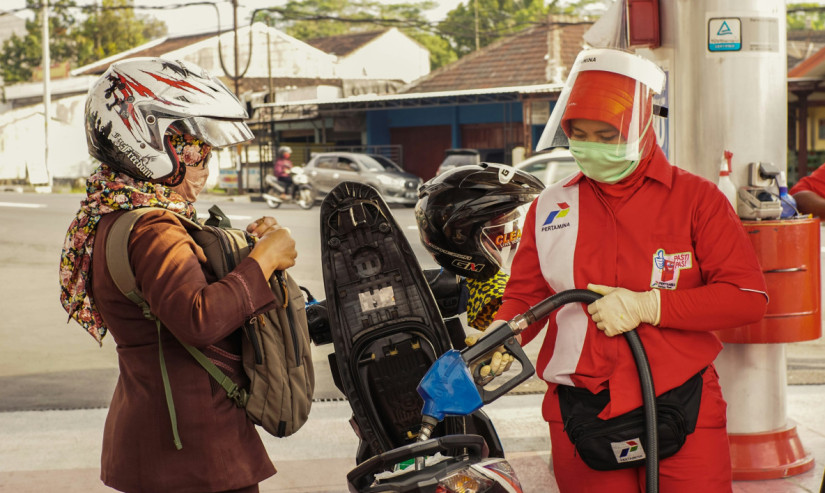
The policy on whether to raise fuel prices has drawn public attention, amid concerns about the war’s impact in Iran. To address this, President Prabowo Subianto decided not to raise fuel prices, taking into account calculations within the State Budget (APBN).
A lecturer at the Department of Politics and Government, Faculty of Social and Political Sciences (Fisipol) UGM, Dr. Mada Sukmajati, observed that current national leadership faces recurring challenges in managing both local and global dynamics, particularly in responding to rising global oil prices.
“The leadership patterns of Presidents Megawati, SBY, and Jokowi can serve as lessons for President Prabowo, which may eventually shape his own leadership model,” he said on Thursday (April 9).
According to Dr. Sukmajati, the issue of global oil prices presents a critical moment for the president in managing international dynamics that also affect domestic conditions.
Sensitivity to timing is crucial, particularly when deciding whether to raise or maintain fuel prices. Based on past presidential terms, policies to increase subsidized fuel prices have consistently triggered public unrest.
The courage to decide against raising fuel prices, while many countries have opted to increase them, must be grounded in accurate calculations and accompanied by the government’s ability to build public trust through tangible policies rather than mere rhetoric, Dr. Sukmajati said.
The real impact is evident in the stability of people’s daily needs, particularly in the economic sector.
“Purchasing power should not weaken further, prices should not continue to rise sharply, job opportunities should not become more limited, and so on,” he explained.
He warned that poor policy management could lead to unfavorable decisions for both the government and the public. Therefore, coordination and orchestration among ministries are key to addressing today’s complex economic dynamics.
According to him, each ministry should introduce similar breakthroughs to demonstrate its capacity to support the president. He emphasized that the public now places greater trust in concrete actions rather than rhetoric alone.
“No matter how small the innovation, as long as it is proven effective and efficient, it is highly valuable in the current context, where pressures are significant both internationally and economically,” he added.
He highlighted several key points, noting that this is a moment when President Prabowo’s leadership is being tested, particularly amid persistent public doubt under intense pressure. He stressed that the government must respond swiftly to feedback and criticism.
Dr. Sukmajati also suggested revising policies incrementally, including the Free Nutritious Meals (MBG) program and the Merah Putih Village Cooperatives, both of which require evaluation.
He expressed hope that the government would not adopt a repressive stance toward criticism or demonstrations, but instead would provide space for public expression. He noted that formal political institutions such as political parties and the House of Representatives (DPR) should remain open to criticism.
“Criticism must not be obstructed, as it is an inherent part of human rights. It will inevitably be expressed, especially when it concerns people’s existence or livelihoods,” he said.
In response to the plan to implement work-from-home (WFH) for civil servants to support fuel-efficiency policies, Dr. Sukmajati viewed this as a concrete step the government could take. However, he emphasized that evaluation and monitoring of its implementation are essential.
Dr. Sukmajati also underscored the need to evaluate the overall performance of ministries, noting that not all parties are considered optimal in supporting government policies comprehensively. In this context, he suggested that a cabinet reshuffle could be considered if necessary.
“With the current large number of ministries, this may serve as a note for the president. If the situation requires it, he should respond promptly and review the situation more effectively,” he concluded.
Author: Hanifah
Editor: Gusti Grehenson
Post-editor: Jasmine Ferdian
Photo: Unsplash