


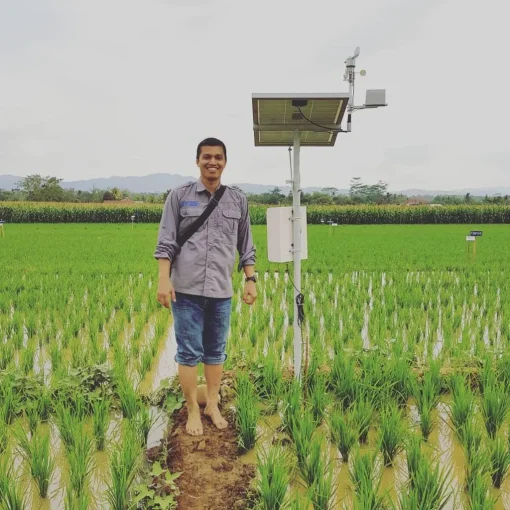
The El Niño phenomenon has once again drawn global attention as rising sea surface temperatures in the Pacific Ocean affect weather patterns across many regions of the world.
Recently, the term “Godzilla El Niño” has been increasingly used to describe an exceptionally strong El Niño event. This condition is expected to have significant impacts on tropical countries, including Indonesia, which heavily depends on seasonal stability. The agricultural sector is among the most vulnerable due to its reliance on water availability. Prolonged drought can reduce productivity and disrupt national food security.
Responding to this phenomenon, Professor Bayu Dwi Apri Nugroho, a Professor of Agroclimatology at Universitas Gadjah Mada, explained that El Niño is part of a long-standing climate cycle. However, global climate change has made its patterns increasingly dynamic and difficult to predict. He noted that the term “Godzilla El Niño” refers to an intensity far stronger than usual. This condition brings serious consequences for the agricultural sector, which is highly dependent on water.
“El Niño is actually a natural cycle that has occurred for a long time. But now the pattern feels faster due to global warming. When the intensity becomes very strong, the impact is certainly felt in agriculture, especially in terms of production,” Professor Bayu said on Thursday (Apr. 2).
According to Professor Bayu, the impact is most evident in staple food commodities that require large amounts of water. Crops such as rice and corn become highly vulnerable because their growth phases depend on an adequate water supply. When water availability declines, crops cannot develop optimally. In extreme conditions, crops may even suffer permanent damage.
“Rice and corn are the most affected because they require a lot of water. If water is insufficient, their growth is disrupted and can even result in crop failure,” he explained.

This vulnerability directly poses short-term risks to farmers in the field. Reduced water availability lowers harvest yields and affects production quality. Professor Bayu noted that this situation affects farmers’ incomes, which depend heavily on harvest outcomes. At the same time, production costs already incurred may not be recovered.
“If drought occurs after planting, farmers may face crop failure. This means that the costs already spent will not return and will become losses,” he said.
In the face of these conditions, Professor Bayu emphasized that mitigation measures at the farmer level are increasingly important for minimizing potential losses. One effective effort is strengthening communication between farmers and agricultural extension workers. Access to information on weather conditions and crop variety options becomes a determining factor in cultivation strategies. Intensive assistance helps farmers adjust their practices in the field.
“The key lies in communication between farmers and extension workers. With clear information, farmers can make more appropriate decisions in the field,” he explained.
According to Professor Bayu, these adaptation efforts are actually supported by Indonesia’s experience in dealing with previous El Niño events. Various programs have been implemented to anticipate drought impacts, including strengthening agricultural infrastructure and technology. Innovations such as water-saving irrigation and the development of drought-resistant varieties continue to be advanced. In addition, weather information is now more accessible in real time.
“We already had experience in 2024, for example, through water pumping and drip irrigation innovations. Drought-resistant varieties have also been developed and just need to be utilized properly,” he elaborated.
Nevertheless, the effectiveness of these efforts depends on farmers’ adaptive capacity in the field. He stressed that the role of extension workers is crucial in bridging innovation with daily agricultural practices. Continuous assistance helps farmers understand and apply technology appropriately. With this support, farmers can be better prepared to face extreme climate conditions.
“The role of extension workers is very important, especially when farmers face prolonged drought like today,” he emphasized.
In the policy context, strategic steps must be taken in an integrated manner involving the government, universities, and related institutions. Providing accurate information down to the village level is crucial in responding to extreme weather conditions.
On the other hand, agricultural technology innovations need to continue to be developed to strengthen the resilience of the food sector. Professor Bayu emphasized that cross-sector collaboration is key to maintaining production stability.
“The government, through the Meteorology, Climatology, and Geophysics Agency, needs to provide accurate early warnings down to the village level, while universities must continue to be encouraged to produce innovations in drought-resistant varieties so the impact of El Niño can be minimized,” he concluded.
Author: Triya Andriyani
Post-editor: Rajendra Arya
Photo: Personal Documentation