


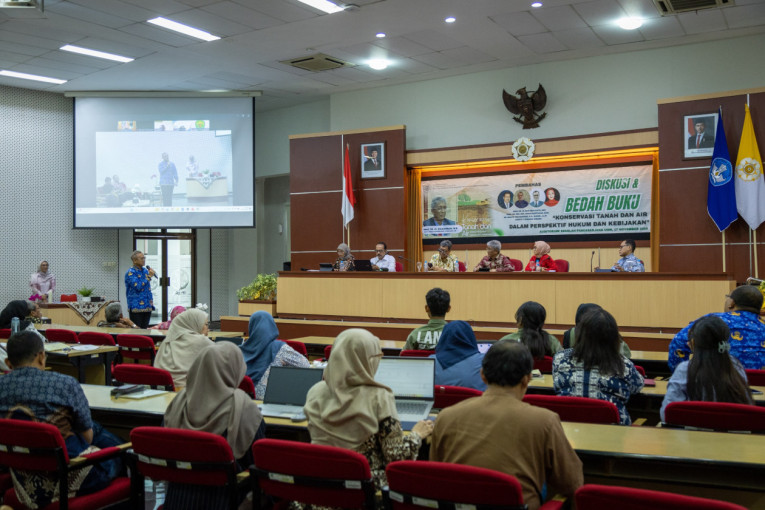
The Environmental Science Master’s Program at Universitas Gadjah Mada (UGM) held a book review for ‘Konservasi Tanah dan Air dalam Perspektif Hukum dan Kebijakan’ (Soil and Water Conservation in Legal and Policy Perspectives) on Monday (Nov. 17) at the UGM Graduate School (SPs UGM) Auditorium. The forum brought together the book’s author, Professor Zulkarnain, and experts from various disciplines to discuss the challenges and relevance of soil and water conservation in development.
The event was attended by academics, students, and practitioners concerned with environmental issues. Through this discussion, UGM aims to strengthen public understanding of the importance of sustainable natural resource governance.
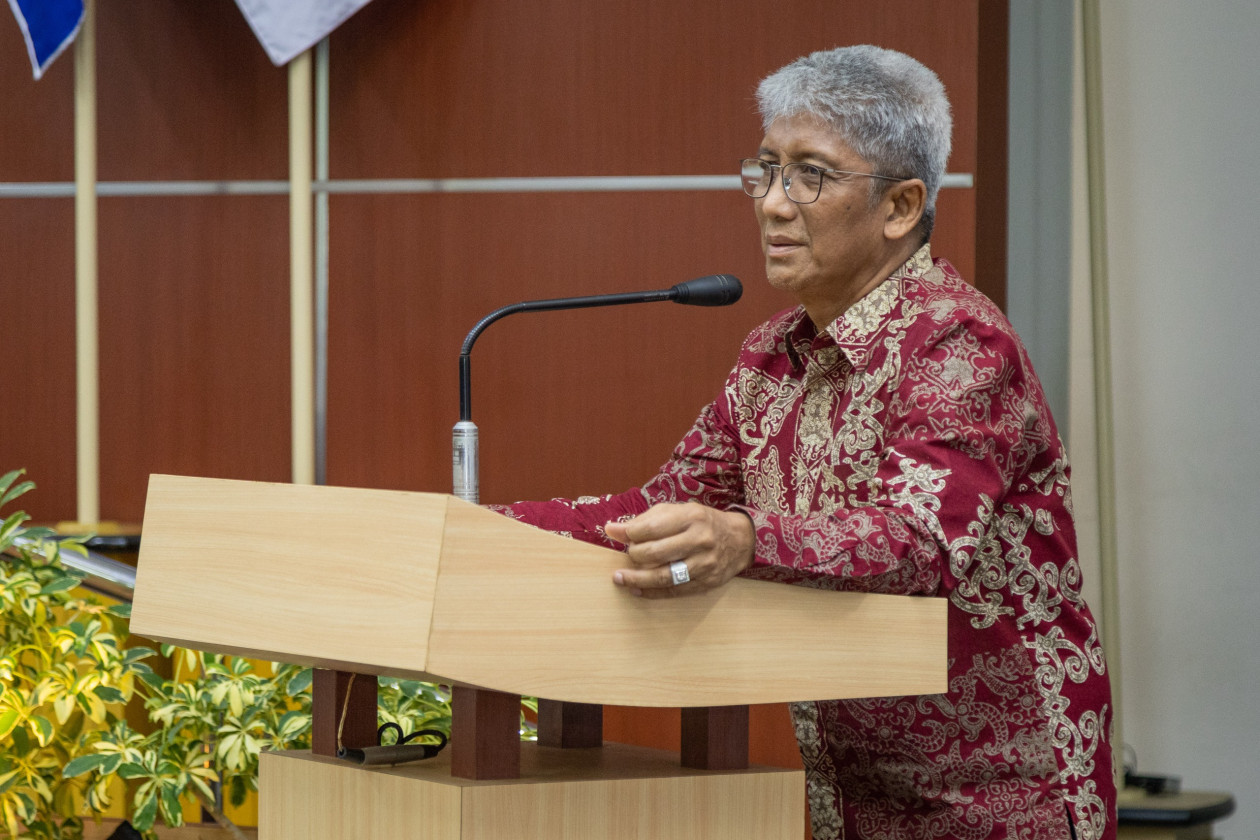
Professor Zulkarnain opened the session by explaining the ongoing issues of soil and water degradation driven by development pressures and weak regulatory implementation.
He emphasized that conservation must be understood as the foundation of sustainability, not merely a technical complement to development.
His explanation highlighted the importance of balancing economic needs with ecosystem stability.
“Legal instruments have been designed to ensure soil and water remain sustainable, but policy loopholes still often lead to environmental damage,” he said.
The first reviewer, Professor Budi Mulyanto, underlined how soil science provides the scientific basis for determining appropriate spatial utilization.
He explained that soil characteristics should be a primary consideration to ensure conservation policies remain well-directed.
This perspective underscores the need for an integrated scientific approach in formulating public policies.
“This book provides a comprehensive understanding of the link between natural resources and human life, which should become the paradigm of resource management,” said the Professor of Soil Science at IPB University.
Next, Dr. Wahyu Yun Santoso examined conservation issues through the lens of environmental law and ecological justice.
He explained that environmental protection is directly related to the community’s right to a healthy environment.
Consistent law enforcement, he stressed, is crucial to ensuring successful conservation on the ground.
“The environment is a prerequisite for the fulfillment of human rights and must be guaranteed through a strong legal framework,” he asserted.
Environmental activist Rosita Y. Suwardi Wibawa from the Kinarya Anak Bangsa shared community-based conservation practices through the Nandur Tuk Banyu program in Gunungkidul.
She described how rainwater-harvesting systems and the planting of productive trees help strengthen water reserves and support local economic resilience.
The approach demonstrates that conservation involves not only ecological dimensions but also social aspects.
“Successful conservation requires a balance between ecological knowledge and social institutional strength,” she said.
The final reviewer, Professor Junun Sartohadi from the Department of Soil Science, UGM Faculty of Agriculture (Agriculture UGM), emphasized the importance of understanding regional and spatial characteristics through a geospatial approach.
He explained that development activities must align with the space’s natural characteristics to minimize the risk of soil and water degradation.
Spatial-based monitoring also allows for easier identification of impacts and planning of mitigation measures.
“Clear spatial delineation guides environmental governance and strengthens legal implementation down to the local scale,” he stated.
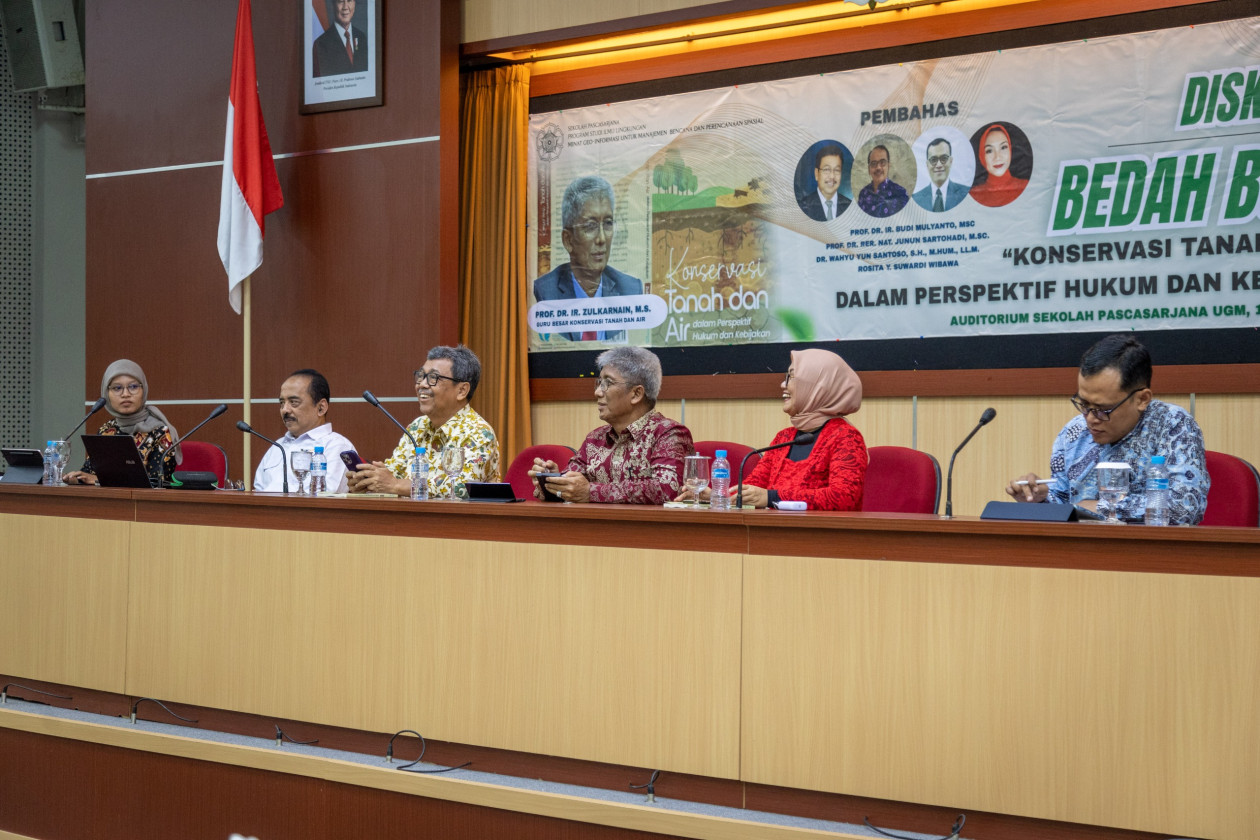
The discussion then moved toward examining the gaps between theory, law, and conservation policy in Indonesia.
Speakers noted that sectoral regulations and weak inter-agency coordination remain challenges to maintaining environmental quality.
Participants observed that scientific understanding needs to be further integrated into development policies.
The forum highlighted the need for cross-sectoral harmonization to strengthen the effectiveness of soil and water conservation efforts.
Participants also emphasized the importance of community and local government roles in ensuring the sustainability of conservation policies.
They highlighted the need to build local capacity and provide more accurate environmental data to support decision-making.
Collaboration among academics, government, and communities is considered essential for effective monitoring and management of natural resources.
During the question-and-answer session, participants expressed that the success of conservation is strongly linked to public participation and consistent oversight.
The event concluded by reaffirming the roles of science, law, and society in achieving sustainable soil and water governance.
The forum offered interdisciplinary insights that broadened participants’ perspectives on conservation as a national strategic agenda.
Both speakers and attendees agreed that sustainability must remain the foundation of all development policies.
The discussion strengthened a shared commitment to protect soil and water as vital heritage for future generations.
Author: Triya Andriyani
Post-editor: Lintang Andwyna
Photographer: Donnie Trisfian