


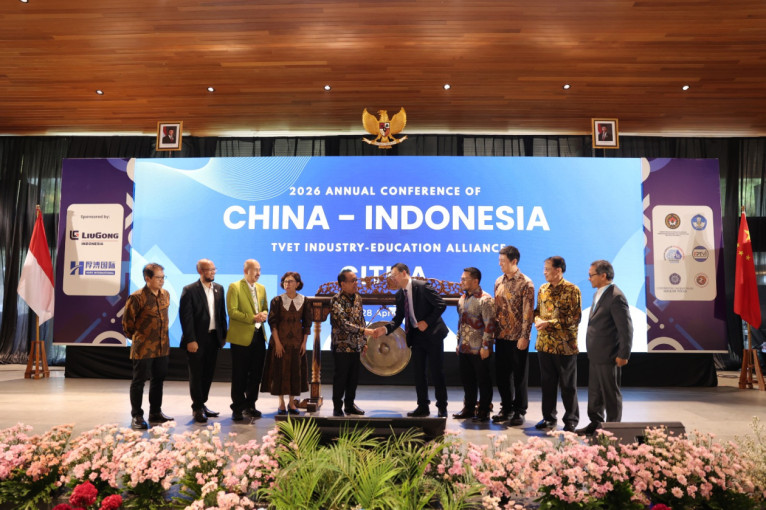
Coordinating Minister for Human Development and Culture, Professor Pratikno, emphasized the importance of integrating education and industry in responding to various global disruptions. Professor Pratikno identified technological developments, climate change, and geopolitical dynamics as challenges that must be addressed adaptively. In this context, collaboration among countries has become increasingly crucial to strengthen competitiveness. He also highlighted that Asia is currently in a phase of global resurgence.
“This is the Asian Century; it is time for Indonesia and China to become the driving forces of Asia’s leadership in the region,” he said while opening the Annual Conference of the China–Indonesia TVET Industry–Education Alliance (CITIEA), held on April 27–28, 2026, at the Gelanggang Inovasi dan Kreativitas (GIK), Universitas Gadjah Mada (UGM).
Professor Pratikno stressed that current disruptions should be viewed as opportunities to make significant leaps forward. According to him, the cooperation established must be oriented toward concrete actions and direct impact on society.
Industry involvement in education also needs to be strengthened to generate solutions to various social issues. Professor Pratikno further underscored the importance of bringing meaningful value into the concept of linking education and industry.
“This collaboration must produce tangible actions by viewing disruption as an opportunity to leap further,” he stated.
In line with this, Rector of Universitas Gadjah Mada, Professor Ova Emilia, noted that international collaboration is key to responding to rapid industrial changes. Professor Ova highlighted the importance of aligning curricula with industry needs and strengthening applied research. Digital transformation and sustainability demands were cited as factors driving these changes. Therefore, universities need to adapt through concrete cross-country partnerships.
“This forum serves as a space to align education with the ever-evolving needs of industry,” she said.
Professor Ova added that this forum carries a strong message about the importance of building an integrated future ecosystem. The interconnection between talent, technology, and industry is a fundamental foundation in facing global competition.
According to her, collaboration is no longer an option but a necessity that must be pursued collectively. From Yogyakarta, UGM seeks to demonstrate its active role in promoting impactful global cooperation.
“We are building a future ecosystem that connects talent, technology, and industry across countries,” she emphasized.
Notably, CITIEA has entered its third year, with Universitas Gadjah Mada serving as the host of this international forum. CITIEA serves as a strategic meeting platform for government, vocational higher education institutions, and industry partners from Indonesia and China. This agenda also strengthens the synergy between vocational education and the evolving needs of global industry.
In addition, the conference serves as both an evaluation and a platform for developing cross-country collaborative programs. Through this forum, Indonesia is encouraged to strengthen its role in the vocational education network within the ASEAN region.
Dean of the UGM Vocational School (SV UGM), Professor Agus Maryono, stated that the conference was attended by more than 300 participants from dozens of vocational institutions in Indonesia and China, as well as various international companies. The involvement of these stakeholders demonstrates a strong commitment to strengthening vocational education through global collaboration.
He noted that the forum provides a space where education, industry, and technological innovation intersect within a single ecosystem. This effort aims to address the increasingly dynamic demands of the global workforce.
“We aim to build connectivity from upstream to downstream, from the learning process to workforce absorption in industry,” he said.
Furthermore, he emphasized that the approach promoted in this forum focuses on comprehensive connectivity between education, training, and the labor market. This scheme is expected to open broader opportunities for vocational students and graduates to access the international job market.
In addition, this collaboration is also directed toward strengthening applied research and joint technology development. In this way, the relationship between educational institutions and industry can become more relevant and adaptive.
“This forum is expected to expand access to internships, global recruitment, and research collaborations that have tangible impacts for both countries,” Professor Agus added.
As a partner organizer and representative of the China–Indonesia TVET Industry–Education Alliance (CITIEA), Professor Qiu Fuming also emphasized the importance of international collaboration in the development of vocational education. He stated that this partnership continues to grow and involves various educational institutions and industries from both countries.
The collaboration aims to enhance the quality of vocational education to ensure it remains relevant to global needs. In addition, the exchange of knowledge and experience is an essential part of this cooperation.
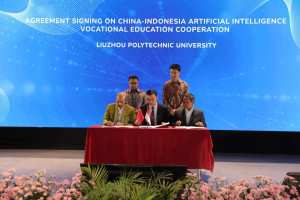
Professor Fuming further emphasized that the development of vocational education requires the support of an interconnected global ecosystem. Through this alliance, various collaborative programs continue to be developed to address future industry challenges. This partnership is considered capable of expanding opportunities for students and workers to adapt to international settings. With the support of both countries, this collaboration is expected to continue growing sustainably.
“We will continue to promote this partnership to provide broader benefits for both countries,” he explained.
Special Advisor to the Minister of Higher Education, Science, and Technology, Oki Earlivan Sampurno, also highlighted the importance of global access for Indonesian vocational graduates. He revealed that there is still a gap between the number of graduates and industry demands.
This condition indicates the need to strengthen a more adaptive vocational education system. The government, he said, plays a role as a bridge between the education sector and industry.
He added that improving workforce competitiveness must be supported by professional certification and international collaboration. Both aspects are important factors in facing global competition.
In addition, the synergy between higher education institutions and industry needs to be strengthened to make graduates more job-ready. This effort is also expected to drive industry-based national economic growth.
“Global collaboration and certification are key to ensuring our graduates can compete in the international job market,” Oki added.
Author: Triya Andriyani
Post-editor: Zahra
Photo: Firsto