


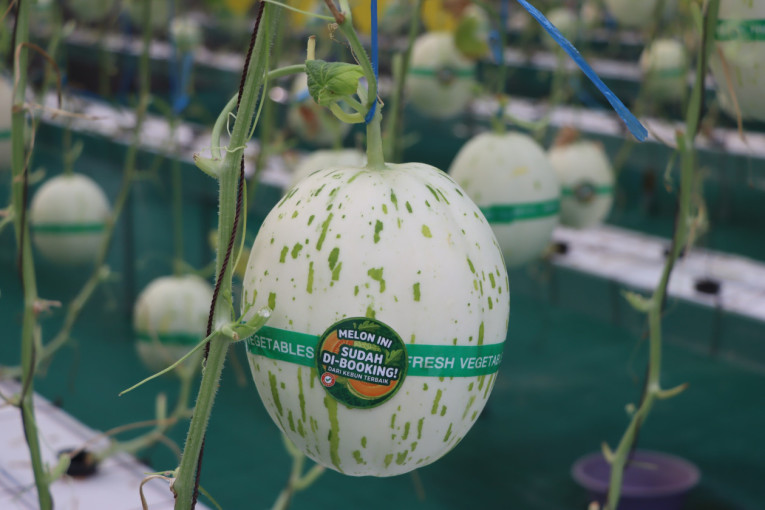
That morning, the sunlight had not yet fully touched the ground, yet a horticulture expert and academic from the Faculty of Agriculture at Universitas Gadjah Mada (Agriculture UGM) was already greeting the melon vines inside the greenhouse of Madania Modern Islamic Boarding School for Orphans and Underprivileged Students. Since 2022, Dr. Agus Budi Setiawan has collaborated with the boarding school management and students to activate a grant-funded facility located in front of a former community health center building in Banguntapan, Bantul, Special Region of Yogyakarta. By 2026, the Islamic boarding school had successfully achieved financial independence through the sale of melons harvested every two and a half months.
In 2021, Madania Islamic Boarding School received a grant for a greenhouse unit measuring 20 by 25 meters, located approximately 1 kilometer north of the boarding school complex. Welcoming the opportunity, the management utilized the facility to cultivate vegetables and melons, recognizing the commodity’s promising market potential.
However, enthusiasm for farming alone was insufficient to achieve the expected results. Limited knowledge of modern agricultural systems and greenhouse management led to less-than-optimal harvests and recurring deficits, which increased operational costs.
“At that time, our vegetable and melon harvests only reached around 30 to 50 percent. But after receiving assistance from Mr. Agus, nearly all of our melon harvests consistently reached 90 percent or even higher,” said Wildan, a member of the Madania Greenhouse Operational Team, on Friday (May 22).
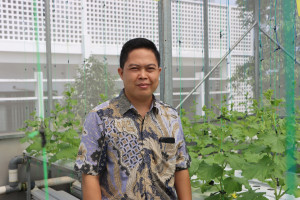
Through a former colleague from their student years in the Agronomy Study Program at Agriculture UGM, Dr. Setiawan became connected with the boarding school management. Since then, he has initiated collaboration to optimize the greenhouse’s potential. The process has been extensive, ranging from knowledge transfer and fertilizer formulation to greenhouse cultivation operations, pollination, and the production of the desired varieties. Today, Madania Greenhouse has achieved seed self-sufficiency and successfully reduced production costs by millions of rupiah previously spent on purchasing external seeds.
As a plant breeding expert, Dr. Setiawan views Madania Greenhouse not merely as a laboratory but also as an asset for commodity development. He described it as a canvas that can help communities achieve empowerment independently. The melon commodity research itself has been developed over several years.
“We see the greenhouse not merely as a physical structure, but as a valuable asset in plant breeding processes. Crops that previously could only be harvested twice a year can now be harvested up to four times,” he explained.
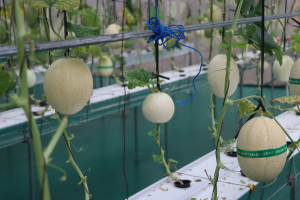
It is known that around 1,300 melons produced in each harvest have almost entirely been claimed and purchased by consumers. Continuous assistance provided since 2022 has enabled the students to independently manage greenhouse operations.
Dr. Setiawan noted that his routine of “greeting the melons” every morning before heading to campus has gradually diminished as the students’ adaptive abilities and knowledge regeneration have continued to grow. Whenever consultations or new cases arise, coordination can now be done remotely through digital communication. This remote monitoring reflects the success of the mentoring process that has been consistently carried out over the past five years.
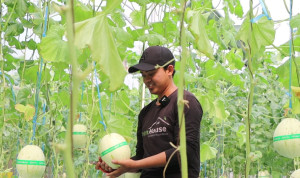
Suyanta, the boarding school manager, stated that the greenhouse’s success has also significantly benefited the institution. The most noticeable improvement has been in economic efficiency. The boarding school no longer depends entirely on donors and social institutions for survival.
Furthermore, Suyanta explained that the operational team has now mastered various technical agricultural skills, including fertilizer formulation, seed breeding for independent seed production, and greenhouse operational management.
Madania Greenhouse stands as tangible proof that community service and research outcomes, when consistently nurtured and implemented, can effectively address society’s needs and challenges.
Author: Ika Agustine
Editor: Gusti Grehenson
Post-Editor: Zabrina Kumara
Photo: Jesi