


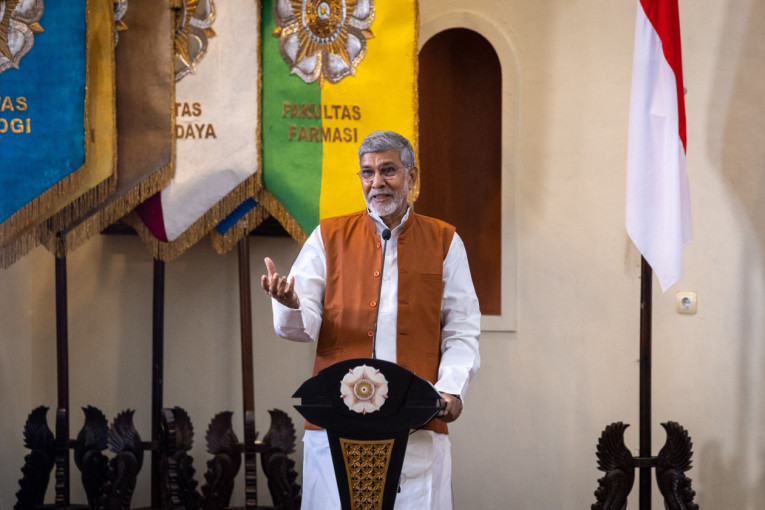
2014 Nobel Peace Laureate Kailash Satyarthi said the world today has abundant knowledge, data, laws, declarations, international institutions, and discussions on global issues. Yet despite this wealth of knowledge and resources, the world still faces challenges such as division, insecurity, and difficulty living together. Knowledge alone cannot resolve these challenges.
According to Satyarthi, when the world is in darkness, even the smallest light can change how people see a situation and make solutions possible.
“In situations of darkness, every act of kindness, everything that we have done for improvement and to bring the light of hope and certainty, makes us understand that a resurgence is possible,” he said during the UGM Annual Lecture Nobel Laureate Series, themed “Global Leadership for Humanity: Advancing Impactful Community Engagement.” The event, attended by the 2014 Nobel Peace Laureate, was held on Friday (August 21) at the UGM Senate Hall.
In particular, he cited the Kuliah Kerja Nyata (KKN) program undertaken by students as one form of “light” amid global challenges. He said he was impressed by seeing communities refer to students not as people who came to help, but as partners.
According to Satyarthi, students do not come to lecture communities; they come to learn together and work as partners. He emphasized that partnership is key to implementing community engagement programs. Students should not come as academics or learners who assume they know more than the community.
“Instead, students also need to learn from communities, including from people who may have never attended school or received only limited education,” he said.
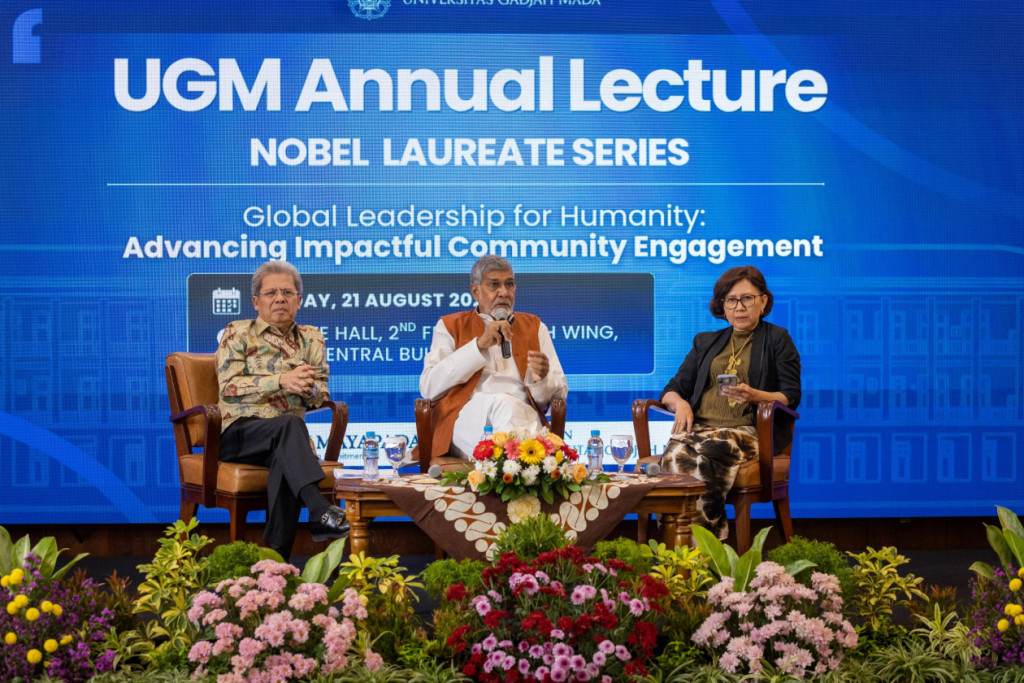
Satyarthi then highlighted three principles that he considers important for creating change, which he described as the 3Ds: dream, discover, and do. He said everyone should have the courage to dream, discover their own strengths and potential while understanding the challenges around them, and then take action.
However, he emphasized that people should not dream only for themselves. Dreams, he said, should also benefit families, universities, nations, and the global community.
Satyarthi then recounted a childhood experience in which he saw a child from a low-income family who could not attend school. The experience made him realize that education should be accessible to every child. He also recalled seeing several children drop out of school because their parents could not afford books and school fees. Together with his friends, he collected books from the community and distributed them to children in need, turning the initiative into a book bank.
“From there emerged the global movement against child labor and the global education movement, the Global March Against Child Labor and the Global Campaign for Education. These became the building blocks of movements for education and children,” he concluded.
Drawing on these experiences, Satyarthi encouraged UGM to transform its KKN experiences into learning and share them globally. He said students and communities should build on their experiences, developing them beyond community engagement activities into knowledge that others can learn from and apply elsewhere.
He added that success should not be measured only by how many people benefit, but also by how many new leaders emerge in communities and how many young people find innovative solutions for their communities.
Furthermore, Satyarthi emphasized the importance of compassion in community engagement. He said empathy alone is not enough to address systemic issues such as gender discrimination, poverty, geopolitical inequality, and economic injustice.
He explained that compassion is not merely about feeling another person’s suffering, but a force that encourages people to take conscious action to address problems.
“Compassion is a force that can drive sustainable change. It is not change that happens only once, but change that continues to grow because everyone feels that they are part of both the problem and its solution,” he said.

UGM Rector Professor Ova Emilia said the Kuliah Kerja Nyata-Pembelajaran Pemberdayaan Masyarakat (KKN-PPM) program actively engages students and expands community engagement across Indonesia.
“KKN-PPM is a mechanism that directly places students in addressing various real-world issues, including access to education, public health, local economic development, infrastructure, and environmental management,” she said.
She also explained that three principles form the foundation of humanity-centered community engagement through KKN-PPM. The first is presence, which means sending resources to places that genuinely need them. The second is responsiveness, referring to the university’s ability to deploy students, lecturers, and available resources quickly. The third is sustainability, meaning remaining involved long enough to contribute to the community’s recovery process.
In addition, Emilia highlighted KKN programs that directly respond to communities facing difficult conditions, including KKN Peduli Bencana. Such efforts have been carried out in response to events ranging from the Yogyakarta earthquake and Mount Semeru eruption to flash floods and landslides in Aceh Province.
“The presence of students is not only focused on helping communities recover from the immediate impacts of disasters, but also on supporting the restoration of their lives. These efforts include constructing temporary housing and strengthening local economies through MSME training,” she said.
In line with the vision and mission of KKN-PPM, Deputy Foreign Minister of the Republic of Indonesia Arif Havas Oegroseno, S.H., LL.M., shared his experience as a student participating in a KKN program in remarks delivered through a video recording. He recalled being assigned to a remote village in Central Java, where the community faced challenges related to clean water and flooding.
“As students at the time, we were asked to be creative and try to find solutions to the village’s problems,” he said.
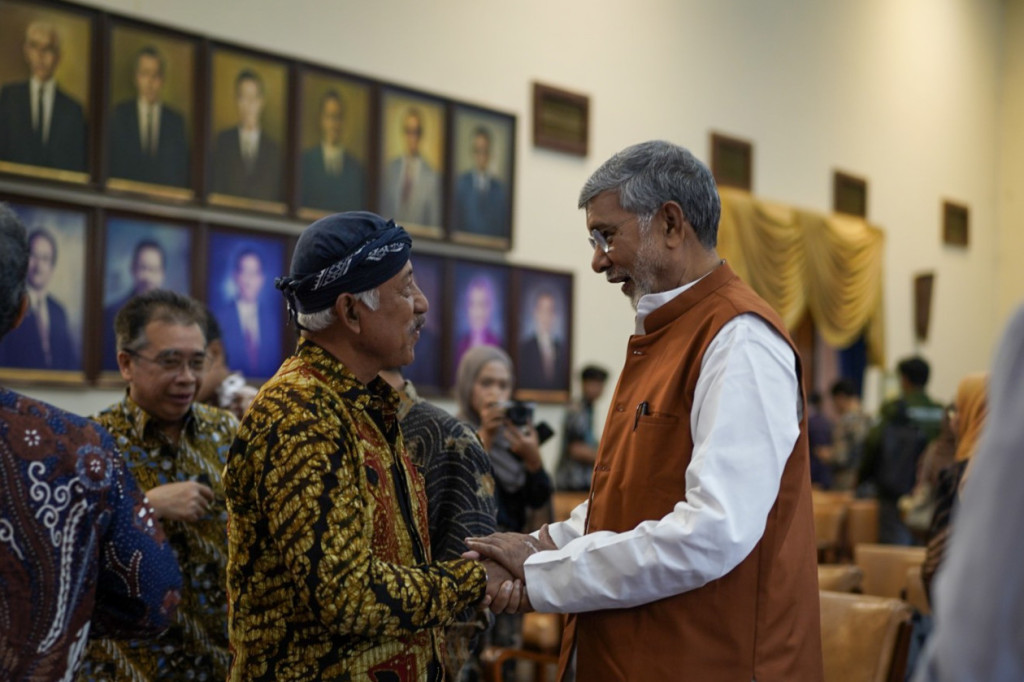
Arif praised UGM for having organized community engagement programs for more than seven decades. He said KKN gives students space to learn to listen before speaking, understand problems before offering solutions, and work with communities.
He emphasized that students cannot fully gain such lessons in a classroom.
“There is no classroom that can teach, in one month or three months, what a village can teach about humility,” he said.
In line with this, Professor Dr. Todung Mulya Lubis, S.H., LL.M., Indonesian Ambassador to Norway, said the KKN program plays an important role in connecting higher education institutions with communities. This is achieved, particularly, through students’ involvement in listening to community needs and jointly developing programs to improve conditions.
“KKN should not be viewed merely as part of fulfilling academic requirements, but also as a form of social responsibility for students and universities to protect the Earth and humanity,” he said.

From an economic perspective, Dato’ Sri Professor Dr. Tahir, founder of Mayapada, said we should consider economic growth not only in terms of GDP growth percentages, but also its impact on society.
He said universities play an important role in improving workforce quality. According to him, education is one of the keys to achieving social justice because it enables people to attain better lives, higher incomes, and improved social status.
“When people can enjoy a better life, better education, and better social status, then we can begin to talk about social justice,” he said.
Emilia said Satyarthi’s presence was not merely an opportunity to welcome a Nobel laureate, but also to bring together two experiences and approaches to advancing humanity.
“The presence at this event provides an opportunity to reflect on how education and community engagement can become forces for creating meaningful and sustainable change,” she concluded.
Author: Hanifah
Editor: Gusti Grehenson
Post-Editor: Zabrina Kumara
Photo: Donnie, Jesi