


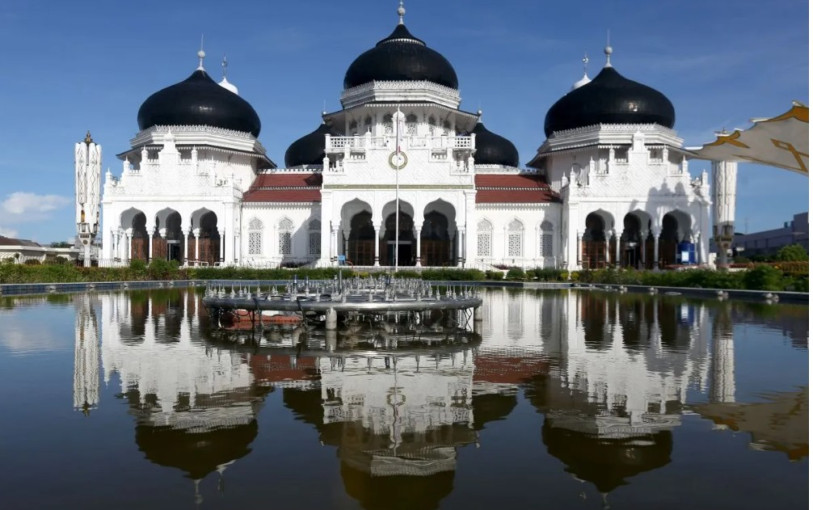
Indonesia is known as the country with the largest Muslim population in the world. It is also recognized as the country with the highest number of mosques globally. According to 2026 data from the Ministry of Religious Affairs, there are at least 706,788 combined units of mosques and mushola (prayer rooms). This abundant number should serve a strategic role as a foundation for building social cohesion and not merely as places of worship.
Chair of the Mosque Management of Masjid Kampus UGM (Maskam UGM), Dr. Mohamad Yusuf, M.A., stated that society often views mosques solely as venues for primary
acts of worship, such as prayer and supplication, while other functions remain underutilized. “The mosque is not an isolated ivory tower, but a medium for uniting humanity as the heart of development and civilization,” Dr. Yusuf said while opening the Ramadan Public Lecture at Maskam UGM last week.
According to Dr. Yusuf, the presence of mosques can generate socio-spiritual impacts. One of these is that the spiritual energy derived from daily acts of worship performed by Muslims can strengthen social capacity and foster peace within society.
Reflecting on history, Dr. Yusuf noted that during the time of the Prophet Muhammad PBUH, the first institution established for civilization-building was the mosque, not a government center or an economic hub such as a marketplace. At that time, he explained, the mosque functioned as the center of activities for strengthening brotherhood, making declarations, and even serving as a seat of governance and deliberation.
“In the context of modern democracy, we recognize it as a parliamentary space where strategic policies are formulated to advance public welfare. At that time, the mosque also functioned as an educational center and even as an emergency hospital,” he added.
In support of this view, Dr. Yusuf emphasized that mosques have several primary functions. First, they serve as neutral zones capable of harmonizing political and jurisprudential differences within society. In addition, mosques can function as centers for community economic empowerment, for example through the establishment of baitul mal facilities, shared ATMs, and accommodations for travelers.
“For instance, during campus assignments that required us to travel to certain regions, we often found mosques locked. While the reason may be security, for travelers this can feel unwelcoming,” he remarked.
For Dr. Yusuf, mosques should continuously strive to accommodate the needs of their congregations. At Maskam UGM, for example, facilities such as the Rumah ZIS (Zakat, Infaq, and Sadaqah House) are provided to support economically vulnerable groups. During Ramadan in particular, Maskam UGM is vibrant with discussions through its study sessions.
“Civilization is built, among other ways, through discussion. Dialogue provides space to question national issues and formulate ideas that become the foundation for development and policymaking,” he concluded.
Writer: Hanifah
Editor: Gusti Grehenson
Post-editor: Zabrina Kumara
Photo: Antara