


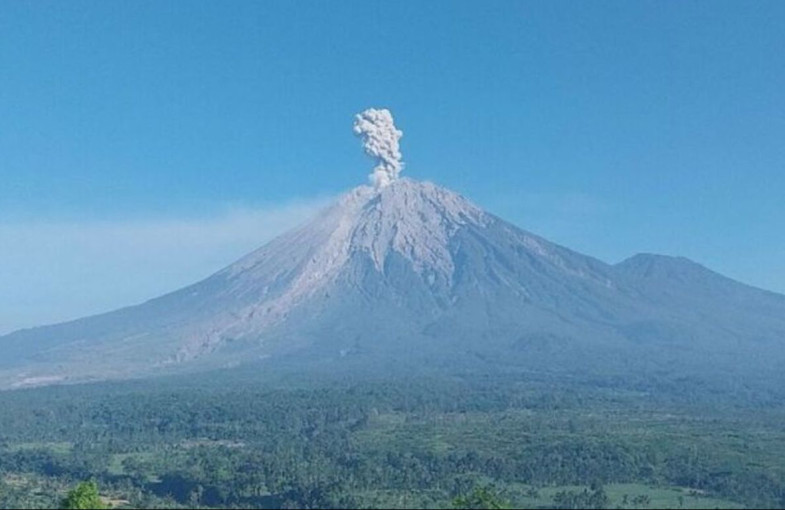
Volcanic activity at Mount Semeru has intensified again following a series of consecutive eruptions that began on June 20. The situation is reinforced by the status issued by Indonesia’s Center for Volcanology and Geological Hazard Mitigation (PVMBG), which has raised the status of the highest mountain on Java Island to Level III (Alert). Despite the growing threat, sand mining along lahar flow paths reportedly continues.
Dr. Indranova Suhendro, also known as Nova, from the Faculty of Geography, Universitas Gadjah Mada (UGM), warned that the hazards posed by Mount Semeru extend beyond volcanic eruptions. He said lahar floods represent one of the most significant threats due to the large volume of loose volcanic material deposited on the mountain’s slopes.
“Volcanic materials produced by daily eruptions, including sand, gravel, and rocks, can easily be carried by rainwater into river channels,” he said on Monday (Jun. 29).
Nova explained that lahars generated by volcanic eruptions are particularly dangerous because they can occur without warning. Heavy rainfall at the summit may trigger lahars that flow downstream through rivers originating on Mount Semeru.
“It may not be raining downstream, but heavy rainfall at the summit can suddenly send lahars rushing down. What makes them especially dangerous is that they carry massive boulders and other large debris,” he said.
He emphasized that the Besuk Semut River watershed is the primary area of concern because it serves as the main pathway for both pyroclastic flows and lahars. For this reason, PVMBG has consistently urged the public to avoid activities within designated exclusion zones and along the river channel.
In response to the ongoing sand mining around Mount Semeru, Nova acknowledged that the issue is highly complex. While mining provides a source of livelihood for local communities, it also poses serious safety risks.
“From both scientific and safety perspectives, these activities should not take place at all. However, they also provide people with a livelihood. This makes the issue extremely difficult, and any policy addressing it is very challenging,” he said.
He added that imposing a complete ban on mining activities would not be easy. Therefore, he believes the most realistic approach is to strengthen occupational safety standards while ensuring that companies employing miners are fully responsible for protecting their workers.
Furthermore, Nova noted that humans have always lived alongside volcanoes, which have existed long before human civilization. As a result, communities must understand volcanic characteristics and comply with official safety advisories.
“If people choose to live alongside volcanoes, they must understand and be prepared for the consequences. When volcanic activity increases, follow the guidance issued by authorities and experts to stay safe,” he advised.
Nova further explained that every volcano has unique characteristics, meaning each presents different hazards. He compared volcanoes to people, each with its own distinct personality.
Research conducted by Nova and his team found that the magma beneath Mount Semeru contains approximately 50 percent crystal fragments. This means the magma is highly viscous because it consists of nearly equal proportions of molten material and solid crystals.
“Under these conditions, the magma is extruded as a lava dome that resembles a boil,” he explained.
Combined with ongoing magma extrusion and the volcano’s extremely steep slopes, these conditions make the lava dome at the summit highly susceptible to collapse, which can trigger pyroclastic flows locally known as wedhus gembel.
“As magma from below continues to push against the unstable lava dome at the summit, the dome can collapse, generating pyroclastic density currents,” he said.
According to Nova, one of the largest pyroclastic flow events occurred on Dec. 4, 2021, when pyroclastic flows traveled approximately 15–16 kilometers from the summit. In addition to magma activity, he noted that rainfall also increases the likelihood of lava dome collapse. Rain can make materials surrounding the crater more slippery, raising the risk of dome failure.
He added that, in addition to generating collapse-induced pyroclastic flows, Mount Semeru is also known for frequent Vulcanian eruptions. These eruptions occur when gas becomes trapped beneath the lava dome, then explodes, ejecting volcanic material into the atmosphere.
“Vulcanian eruptions occur very frequently at Mount Semeru, with intervals ranging from several hours to just a few minutes. However, their impacts are generally localized and confined to areas around the crater,” he explained.
Author: Hanifah
Editor: Gusti Grehenson
Post-editor: Jasmine Ferdian
Photo: Antara/HO-PVMBG