


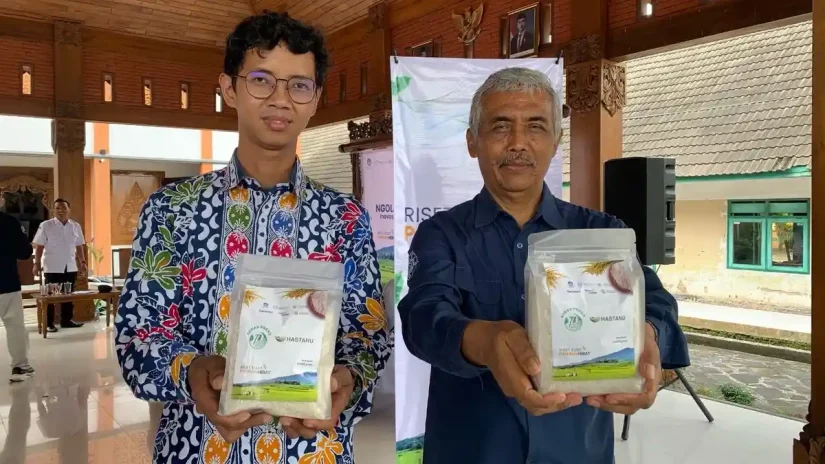
Amid the growing public demand for high-quality food, Universitas Gadjah Mada (UGM) has introduced Presokazi Rice as an innovative product offering premium quality. The product is the result of an extensive research process aimed at producing rice that is soft, clean, and stable when cooked. Presokazi undergoes carefully controlled post-harvest processing to maintain its grain integrity and ensure a pleasant eating experience.
Dr. Andrianto Ansari, a lecturer at the Faculty of Agriculture (Agriculture UGM) and one of the researchers, explained that Presokazi was born out of a desire to provide rice that is enjoyable to serve and offers better nutritional benefits for Indonesian families.
The research team, consisting of Professor Taryono, Ir. Supriyanta, Dr. Ansari, and several other researchers, strives to ensure that the iron (Fe) and zinc (Zn) content receives primary attention because these two elements are needed by many vulnerable groups.
Every stage of the research was carried out to produce rice that supports daily nutritional needs without requiring changes to people’s eating habits.
“We developed Presokazi so families can strengthen their nutrition through a food that is already familiar at the dining table,” he said on Wednesday (Nov. 19).
In the laboratory, various tests were conducted to ensure that Presokazi’s nutrient content remained stable from harvest to consumption. Dr. Ansari shared that each grain was tested for quality to ensure it did not lose its characteristics or flavor during storage and milling.
This approach was adopted to ensure that Presokazi truly meets the standards of premium rice with consistent quality.
“We safeguard the entire process to ensure Presokazi’s nutritional content remains well-preserved,” he noted.
Beyond the laboratory, Presokazi’s development continued on farmers’ fields, which play an important role in maintaining production quality. Dr. Ansari explained that farmers received guidance to ensure cultivation and post-harvest techniques were carried out according to established standards.
Through this collaborative effort, Presokazi has grown as a product shaped by both research and field experience.
“Presokazi’s success is inseparable from the commitment of farmers who support its development,” he said.

From a consumer perspective, many families find Presokazi to have a pleasant taste and a soft texture that remains consistent even when cooked in large quantities. The grains’ cleanliness and color further enhance their appeal, making them highly sought after. Many consumers have shared that Presokazi provides a light yet satisfying rice-eating experience.
“We are grateful for the enthusiasm from households who enjoy Presokazi in their daily meals,” Dr. Ansari said.
As public awareness of nutritional needs continues to grow, Presokazi emerges as a rice option that helps meet those needs without increasing the burden on consumers. Its higher iron and zinc content offer benefits for child development and immune system support.
In many cases, improving food quality is one of the simplest initial steps toward strengthening family nutrition.
“We hope Presokazi becomes a gateway to healthier eating habits,” he explained.
To ensure Presokazi continues to advance, several measures are being undertaken, ranging from increasing production capacity to strengthening distribution channels.
Collaboration with partners and community groups plays a vital role in this process, so the product can reach more regions. These efforts are expected to sustain the innovation that has been developed.
“We want Presokazi to reach communities across many areas,” he said.
Ultimately, Presokazi stands as an example of how well-nurtured research can bring tangible benefits to daily life. This rice is a testament to the belief that knowledge must return to society and deliver a broad impact.
With continued commitment, Presokazi is expected to grow into a food choice that can improve the quality of consumption for Indonesian families.
“We hope Presokazi becomes part of our collective effort to enhance the nation’s food quality,” Dr. Ansari concluded.
Author: Triya Andriyani
Post-editor: Rajendra Arya
Photographer: Firsto Adi