


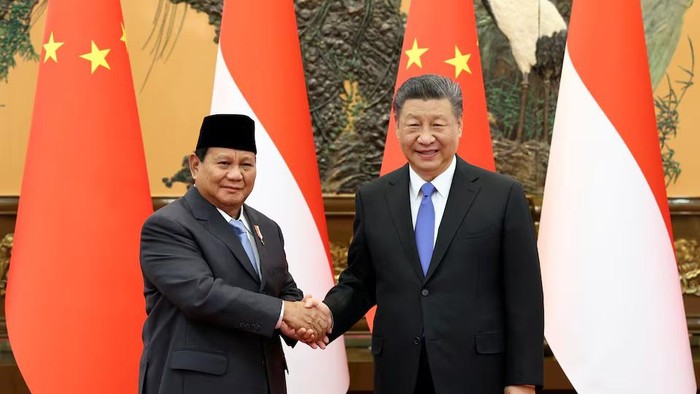
China has become an increasingly significant trading partner for Indonesia. As one of Indonesia’s largest trading partners and foreign investors, China has made substantial contributions to strategic industrial sectors, particularly the digital economy, infrastructure, and nickel. For instance, this includes the nickel industry, mining activities such as mineral downstreaming projects, and the transportation sector, including the Jakarta-Bandung Whoosh high-speed railway.
Diplomatic relations between Indonesia and China have spanned 76 years, beginning on April 13, 1950. Although the relationship was disrupted in 1965, it was later restored and has continued to develop to this day. However, under the current administration of President Prabowo, Indonesia appears to be placing greater emphasis on strengthening its relations with Western countries.
This statement was delivered by Professor Dafri Agussalim, Professor of the Department of International Relations at Universitas Gadjah Mada. He explained that Indonesia’s current foreign policy orientation leans toward Western countries. Indonesia’s participation in the Board of Peace (BoP) and the Agreement on Reciprocal Trade (ART), he noted, indicates a tendency to align more closely with the West.
“After Indonesia joined the BoP, it became a kind of trap for us. There is a perception that our foreign policy orientation is leaning toward the West, while at the same time reflecting Indonesia’s attempt to distance itself from the East, including China,” Professor Agussalim stated on Monday (April 13).
According to Professor Agussalim, maintaining strong relations between Indonesia and China can be achieved through a balancing or hedging diplomacy strategy. This approach allows Indonesia to avoid appearing aligned with any particular side, instead balancing its interests between Western and Eastern countries.
“Ideally, in my view, our foreign policy, especially under President Prabowo’s leadership, should be thoroughly reviewed through in-depth studies, with a clear orientation toward national interests,” he stated.
Professor Agussalim further expressed hope that, by taking into account current geopolitical and geostrategic dynamics, Indonesia’s foreign policy can be reassessed over the long term to avoid strategic missteps. In fact, Indonesia has sufficient capital to strengthen its position, particularly by leveraging its role within ASEAN and the global arena to build trust in international relations.
“The hope is that we can maintain good relations with both China and Western countries in order to serve Indonesia’s interests in economic, political, and security sectors,” he concluded.
Author: Jesi
Editor: Gusti Grehenson
Post-editor: Zabrina Kumara
Photo: China Daily via Reuters