


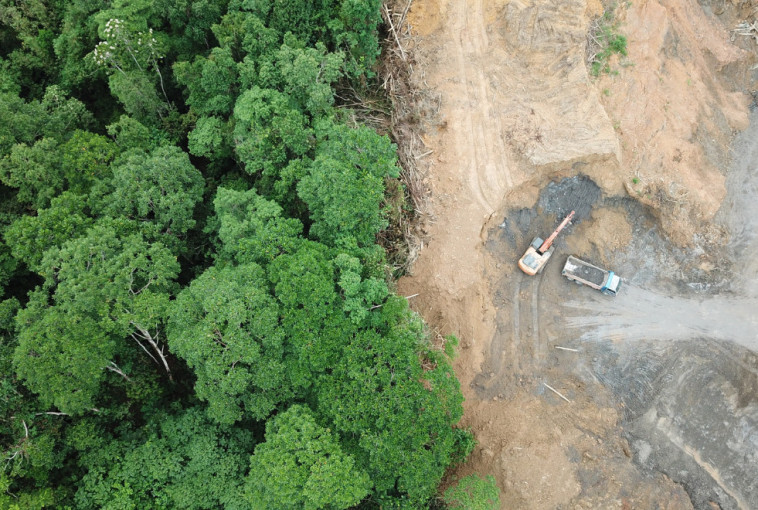
Data from Indonesia’s Ministry of Forestry show that the country’s net deforestation in 2024 reached 175.4 thousand hectares. Meanwhile, reforestation efforts through the Forest and Land Rehabilitation (RHL) program covered 217.9 thousand hectares. Although the rehabilitation figure appears higher, the gap between deforestation rates and the recovery of forest functions remains a serious challenge, particularly amid the growing number of hydrometeorological disasters across Indonesia.
An academic from the Faculty of Forestry, Universitas Gadjah Mada, Dr. Hatma Suryatmojo, said that deforestation is a structural problem that occurs almost every year and involves many actors.
According to him, the rate of deforestation consistently exceeds the pace of rehabilitation. One reason is that the government largely oversees rehabilitation efforts, while deforestation can be carried out by virtually anyone.
“The rate of deforestation is always higher,” said Dr. Suryatmojo, who is often called Mayong, when met at UGM on Tuesday (Dec. 30).
Dr. Mayong explained that forest resources are among the most easily accessible natural resources. Without advanced technology or special expertise, forest encroachment can unfortunately be carried out by individuals or groups.
He added that Indonesia’s vast forest area, currently estimated at around 120 million hectares, poses a major challenge for monitoring. The limited number of forest rangers means that many regions are not optimally supervised.
“Compared to conservation forests, protected forests tend to be monitored less strictly,” he noted.
Nevertheless, Dr. Mayong believes that optimizing the role of Forest Management Units (Kesatuan Pengelolaan Hutan/KPH) could be a realistic and swift solution to oversee and address threats of deforestation and illegal logging.
“The KPH structure is already in place, with infrastructure, offices, and staff. What remains is optimizing the system and its role to monitor and protect forest areas,” he added.
Emphasizing that forest recovery cannot be achieved instantly or simplistically, Dr. Mayong stressed that restoration should not be measured merely by tree growth.
More importantly, it is the recovery of forest ecological functions that matters. He estimated that restoring the functions of protected forests could take up to two decades or even longer.
“Reforestation does not necessarily mean recovery. Deforestation can be considered reversed only when forest functions return, such as the ability to protect downstream areas from floods and landslides,” Dr. Mayong explained.
Amid the increasing frequency of hydrometeorological disasters, Dr. Mayong hopes this situation can serve as a momentum to halt deforestation and accelerate reforestation.
“This undesirable momentum should become a turning point to mobilize all stakeholders, including government, the private sector, communities, and individuals, to jointly reduce deforestation and increase reforestation,” he said.
He also underscored the importance of community involvement in forest restoration efforts.
According to him, communities are in fact capable of creating forests. For instance, if someone owns land and plants it until it becomes an ecosystem, it can already be considered a forest.
“The principle is not about controlling land, but about nurturing ecosystems,” he remarked.
In closing, Dr. Mayong warned that failing to seize this momentum would only lead Indonesia to repeat the same mistakes.
“If this momentum is missed, we will simply repeat past errors. Now is the right time to slow down deforestation and step on the gas for reforestation,” Dr. Mayong concluded.
Author: Hanifah
Editor: Gusti Grehenson
Post-editor: Rajendra Arya
Photograph: Forestdigest.com