


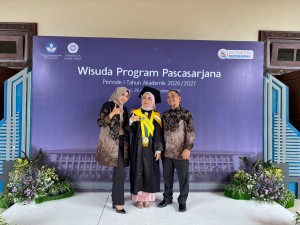
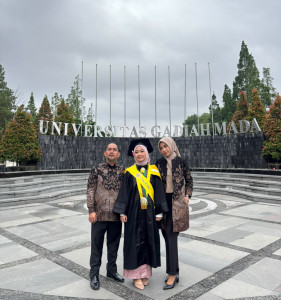
At just 22 years, one month, and 20 days old, Safiera Anindya Syaafiyana completed her Master’s degree in Forestry at the Faculty of Forestry, Universitas Gadjah Mada (Forestry UGM). During the Period I Postgraduate Graduation Ceremony for the 2026/2027 Academic Year, held on October 28–29, she was recognized as UGM’s youngest master’s graduate through the fast-track program, which began her master’s studies in her seventh semester as an undergraduate. By comparison, the average age of the 2,145 master’s graduates in this period was 29 years, six months, and 15 days.
Safiera’s ambition to become an academic and researcher was one of the main reasons to join the fast-track program. She viewed postgraduate studies as a step toward developing her academic interests when Forestry UGM recently introduced the fast-track program for its students.
“I believe that pursuing a higher degree beyond a bachelor’s degree is one of the ways to prepare myself for that aspiration. So, when the opportunity to join the fast-track program came along, I felt that it aligned with my goals,” Safiera said on Thursday (Nov. 5).
Although the program allowed her to complete her education sooner, Safiera admitted that the fast-track journey did not always go smoothly. As part of the first cohort to join the program at Forestry UGM, she faced several academic and administrative challenges because the systems for the undergraduate and graduate programs were not yet fully integrated, and overlapping class schedules between the two degrees became an issue.
“Since we were the very first cohort, there were many things that had not been anticipated but ended up happening. One of them was a scheduling conflict between my undergraduate and master’s courses,” she recalled.
While managing the demands of pursuing two degrees simultaneously, Safiera also sought to fulfill her ambition of participating in a student exchange program. During her seventh semester as an undergraduate, while simultaneously beginning her master’s coursework, she participated in a one-semester student exchange program in Singapore at the National University of Singapore (NUS). In addition, entering her third semester of the master’s program, she undertook an internship at a rubber plantation company.
“Honestly, I really enjoy learning. I believe opportunities like these are something I can only experience while I am a student. That is why I wanted to make the most of my time at university,” she explained.
Despite her demanding schedule, Safiera chose not to let the workload overwhelm her. Instead, she managed her commitments by organizing her time and setting priorities to work more efficiently. From the beginning of her master’s studies, she developed the habit of preparing weekly activity lists and allocating time to complete coursework and work on her thesis.
“I usually make a weekly to-do list. From there, I plan what needs to be done each day and decide when to focus on my thesis, classes, or other assignments. This helps me keep everything better organized,” she said.
Behind her time management, Safiera also acknowledged the support from those around her. She was grateful that her parents trusted her decision to take the opportunity to join the fast-track program, although they initially had concerns about whether she could manage two degree programs simultaneously. She also received support from her academic supervisor, Professor Ronggo Sadono, who guided her throughout the process, from preparing her undergraduate thesis to completing her master’s thesis.
Safiera explained that Professor Sadono’s support helped her overcome the challenges she encountered during her studies. She particularly appreciated the flexibility he provided throughout the supervision process, including when she had to participate in the student exchange program in Singapore and undertake her internship.
“Even when I had activities outside campus, he continued to support me so that I could keep my studies on track and make progress on my final projects,” she said.
After completing her master’s studies with a thesis entitled “Pengembangan Kriteria dan Indikator Keberlanjutan Pengelolaan Hutan Adat: Studi Kasus Orang Rimba Jambi” (“Development of Sustainability Criteria and Indicators for Customary Forest Management: A Case Study of the Orang Rimba in Jambi”), Safiera is now working at Royal Lestari Utama, a company engaged in the rubber plantation industry.
Concluding her story, Safiera encouraged students still pursuing their studies not to waste the opportunities available during their university years. In her view, student life is a valuable time to explore different interests, develop oneself, and gain broader experiences. She also reminded them not to become overly concerned with other people’s opinions, which may discourage them from trying new things.
“I believe students should make the most of every opportunity while they are still at university. Time like this will never come again. Do not focus too much on voices that make you doubt yourself. Instead, remain open to learning and trying new things,” she concluded.
Author: Agito Sitepu
Editor: Gusti Grehenson
Post-editor: Jasmine Ferdian
Photographs: Safiera’s personal documentation