



Excessive and uncontrolled forest exploitation over recent decades has damaged forest resources, affecting the survival of humans and other living organisms. Current El Niño conditions, prolonged dry weather, excessive logging, land clearing for agriculture and plantations, and the use of fire to clear land have contributed to forest and land fires now occurring in parts of Sumatra and Kalimantan. This reduces forest cover but can also affect forests’ ecological functions, including biodiversity, carbon storage, and water provision.
Professor Suryo Hardiwinoto, a retired professor of Silviculture at the Faculty of Forestry, UGM (Forestry UGM), said recent damage to forest resources is linked to forest-use patterns focused on short-term needs without considering future generations. Restoring damaged forests requires support from science and technology.
“Improving degraded forests requires science and technology to rebuild forests, which is one of the key factors for the successful sustainable management of forest resources in Indonesia,” said Professor Suryo, who delivered the keynote address at the national seminar titled “Peran Silvikultur dalam Rehabilitasi dan Peningkatan Produktivitas Hutan” (The Role of Silviculture in Forest Rehabilitation and Productivity Enhancement) at the Forestry UGM Auditorium on Friday (Oct. 2).

According to Professor Suryo, silviculture is an important and relevant field for regenerating forest resources while increasing forest productivity. Silviculture is not limited to tree planting. It combines science, art, and technology to develop forest resources so they provide balanced economic, social, and ecological benefits.
“Silviculture serves to establish and maintain forest stands so that their composition, structure, and growth are consistent with established management objectives,” he explained.
Considering the potential of forest resources, Professor Hardiwinoto said that forests produce not only timber but also a variety of non-timber products and services, such as food, renewable energy, carbon sequestration, water regulation, and other ecosystem services. Therefore, forest management must consider the various benefits forests can provide long term.
“Silviculture needs to continue to be developed both nationally and globally so that it can address the increasingly complex needs of forest management,” he said.
In practice, silviculture involves a series of forest stand management activities, including planting, maintenance, harvesting, and replanting. Professor Hardiwinoto said this sequence is an important principle of silviculture to ensure the sustainability of forest stands after forest products have been harvested.
Silviculture does not end with the harvesting of forest products. After trees are harvested, forest stands must be reestablished through planting to maintain forest functions and productivity.
“Planting, maintaining, harvesting, and replanting are interconnected activities in forest management,” he said.
Professor Suryo further discussed silviculture to improve forest productivity through the management of teak and pine plantations in Java. Plantations of these two species have been developed since the Dutch colonial period through plantation systems that regulate species composition, planting spacing, stand density, and the use of improved seedlings.
“Research and development in pine and teak silviculture continue, particularly in relation to manipulating growing conditions and implementing integrated pest and disease management,” he said.

Looking ahead, Professor Hardiwinoto said silviculture plays an important role in creating productive and sustainable forest stands while balancing economic, social, and environmental considerations. Forest management should not focus solely on producing timber and non-timber products, but also on food, feed, medicines, renewable energy, carbon sequestration, biodiversity conservation, and ecosystem services such as water regulation and ecotourism.
“From this perspective, the forestry sector has an important role in improving community welfare, achieving economic self-reliance, and strengthening the nation’s competitiveness at the international level,” he concluded.
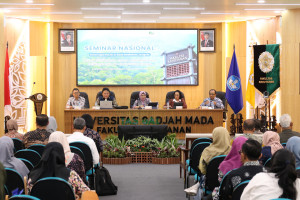
During the seminar’s plenary session, four speakers with different perspectives and experiences presented practical strategies for implementing silviculture in the field. Sri Handayaningsih, Director of Technical Soil Conservation and Forest Rehabilitation at the Directorate General of Watershed Management and Forest Rehabilitation, Ministry of Forestry of the Republic of Indonesia, highlighted the importance of landscape silviculture in watershed management to control erosion and support the Food-Energy-Water Nexus.
Meanwhile, Dr. Digna Jatiningsih, representing PT Kaltim Methanol Industri, shared her experience restoring degraded land in Bontang by planting pioneer vegetation, followed by enriching local Kalimantan species.
The session continued with a presentation by Perum Perhutani Operations Director Wawan Triwibowo on optimizing thinning of Jati Plus Perhutani (JPP) and developing Pinus Bocor Getah (PBG) in response to changing KHDPK dynamics in Java.
Iwan Setiawan, Chair of the Indonesian Forestry Entrepreneurs Association (APHI) Regional Committee for South Sumatra and Lampung, emphasized using modern tree breeding, Nursery Quality Control (NQC) machines, and LiDAR technology to improve the efficiency of large-scale production forest management. Silvicultural science can serve as a foundation for managing forests with different area functions.
Author: Agito Sitepu
Editor: Gusti Grehenson
Post-editor: Jasmine Ferdian
Photographs: Magnific and Seminar Committee Documentation