


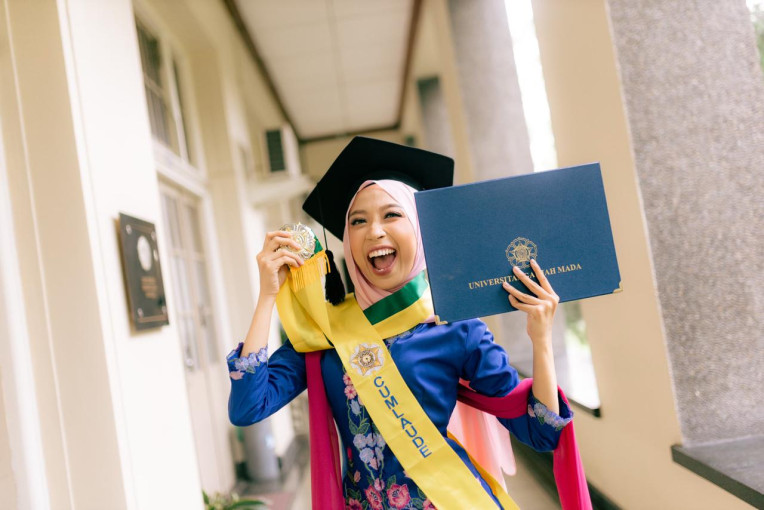
Three graduates from the Medical Study Program at the Faculty of Medicine, Public Health, and Nursing, Universitas Gadjah Mada (FK-KMK UGM), achieved an outstanding accomplishment by earning a perfect Grade Point Average (GPA) of 4.00 at the Undergraduate and Applied Bachelor Graduation Ceremony for Period III of the 2025/2026 Academic Year, held on May 21 at Grha Sabha Pramana UGM. The average GPA for undergraduate graduates in this period was 3.60. The three graduates are Tegar Rinang Pratama, Kharisa Rasikhatul Hikmah, and Ashifa Jasmine.
For Tegar, achieving a perfect GPA was never his primary goal from the outset. He said that he had always approached each stage of his education without setting specific performance targets. However, whenever he attained excellent results, he was determined to maintain them through to the end.
“I usually just let things flow and see where they lead. Since I earned top grades early on, I adopted a principle of always moving forward. Once you’re already wet, there’s no point stepping back. If you’ve come this far, you keep going,” he said in an interview on Friday (Jun. 5).
The Yogyakarta native admitted that he follows a highly disciplined and structured study routine. Unlike in high school, when he often relied on last-minute studying, entering university prompted him to change his learning habits. He began reviewing materials a week before examinations, used breaks between classes to study in the library, and created daily study maps outlining the topics he needed to master.
“By the day before an exam, I no longer allow myself to study new material because my principle is that I should already have mastered everything by then,” he explained.

Although he did not participate extensively in campus organizations, he remained active in self-development through volunteer work and event committees during semester breaks. According to Tegar, these activities allowed him to broaden his experience while developing teamwork and organizational skills without compromising his academic focus.
“During semester breaks, I could join two or three committees, such as the Yogyakarta Gamelan Festival and Jogja Fashion Week, serve as a field assistant for Bulog, and work as a liaison officer during cultural parade events,” he said.
Now that he has entered the clinical clerkship phase, Tegar has witnessed firsthand the realities of the healthcare system. The experience has made him aware of the limitations in access to healthcare services for communities located far from healthcare facilities. Looking ahead, he hopes to become a physician who not only treats illnesses but also provides empathy and emotional support to patients.
“I hope to become a doctor who leaves a lasting impression on patients. I want people to seek me out not only because their illnesses improve under my care, but also because they know me as someone who genuinely empathizes with them,” Tegar concluded.
A different story comes from Kharisa, who is the first doctor in her family. As a result, she pursued medical education without a clear understanding of the field from the outset. She admitted that she never aimed for a perfect GPA when she first entered university. For her, the primary purpose of studying medicine was to gain knowledge that would one day be used to treat patients and safeguard lives.
“The most important thing is that I learn as much as possible because ultimately I will enter a profession that concerns the lives of many people,” she said.

Kharisa’s strategy throughout her studies was to understand her own abilities and establish clear priorities. She realized that she was not the type of student who could manage numerous activities simultaneously. Therefore, she chose to focus on academics and participate only in organizational activities that matched her capacity.
“I know that I’m not someone who can multitask and do many things at once. That’s why I have to understand my limits,” she explained.
During her clinical clerkship, Kharisa also gained valuable lessons through direct interactions with patients. According to her, healthcare does not always unfold as textbook theory would. Every patient has unique characteristics and conditions, requiring doctors to adapt to provide the best possible care.
“I learned that every patient has their own characteristics. Not everything matches what we read in textbooks. We have to adjust to the patient’s condition and the realities in the field,” she said.
These experiences shaped her perspective on the medical profession, reinforcing the importance of understanding patients’ needs holistically. After completing her clinical clerkship and internship program, she plans to work as a general practitioner for a year or two before pursuing specialist training in her field of interest.
“My plan is probably to work as a general practitioner for one or two years before continuing to specialist education,” Kharisa said.
Meanwhile, Ashifa said that her decision to study medicine stemmed from childhood experiences involving frequent hospital visits due to a chronic illness she had suffered from. These repeated encounters with healthcare services introduced her to the medical field from an early age and inspired her desire to help others facing similar circumstances.
“I remember how much doctors and healthcare workers helped me when I was ill. That inspired me to make the same impact on others through healthcare,” she said.
The Lombok native explained that her academic journey was not always smooth. During her studies, she faced financial difficulties and became increasingly aware of the sacrifices her parents made to support her education. She applied for several scholarships, although none of the applications were successful. The situation led her to question herself at times and wonder whether she belonged in such a competitive academic environment. Nevertheless, she chose to focus on what she could control.
“The only thing I can control is my own effort. So I focused on studying and doing the best I could,” she said.
Throughout her medical education, her mother remained a constant source of support. Ashifa said that her mother always encouraged her to keep trying and never be afraid of failure. Those values gave her the courage to pursue opportunities despite experiencing rejection and setbacks.
“My mother always encouraged me to take opportunities whenever they came. She taught me not to be afraid of trying, losing, or failing because those are all part of life,” she said.
Ashifa added that her experiences during clinical clerkship inspired her to serve in Indonesia’s disadvantaged, frontier, and outermost regions (3T) after completing her medical education. She believes these areas continue to face shortages of healthcare professionals and adequate medical services. She hopes to apply her knowledge in 3T regions and make a meaningful contribution to the communities there.
“I want to do my internship or practice in a 3T area because those are the places where doctors and healthcare workers are truly needed,” Ashifa concluded.
Author: Cynthia Noviana
Editor: Gusti Grehenson
Post-editor: Rajendra Arya
Photo: Courtesy of Tegar, Kharisa, and Ashifa