


Amid rapid digital technology, artificial intelligence (AI), and the needs of higher education, libraries are increasingly expected to do more than provide information resources. They are also expected to support learning, advance research, and ensure equitable access to knowledge.
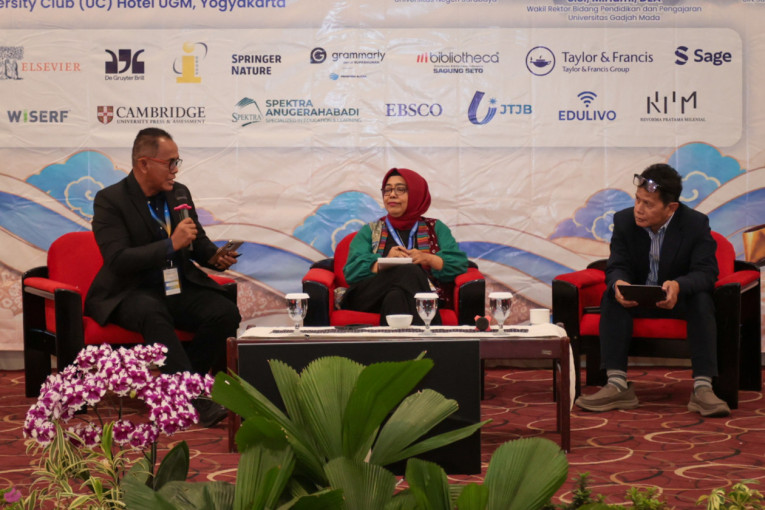
This was highlighted at the 11th National Conference (Munas XI) and National Seminar of the Forum for Cooperation of State University Libraries (FKP2TN) 2026, held October 28 to 30, 2026. The seminar, themed “Reimagining Academic Libraries: Advancing Learning, Research, and Inclusive Services,” was held at the University Club (UC) Hotel, Universitas Gadjah Mada (UGM), Yogyakarta. Brought together university leaders, librarians, academics, and library administrators from public universities across Indonesia.
UGM Vice Rector for Education and Teaching, Professor Wening Udasmoro, highlighted a paradigm shift in academic library management. The abundance of information in the digital environment presents users with new challenges, particularly selecting, evaluating, understanding, and critically using information.
“Today’s challenge is not simply finding information, but also selecting, evaluating, understanding, and using it,” she said.

AI developments have also transformed how members of the academic community access information and engage in learning activities. Although the technology makes finding answers easier, critical thinking skills and academic integrity remain essential. In this regard, libraries play a strategic role as university partners in strengthening knowledge quality and fostering an academic culture.
Wening linked library transformation to higher education institutions’ responsibility in national development. Universities are expected not only to produce graduates and generate knowledge but also to encourage innovation that addresses societal challenges. Libraries, therefore, need to be part of the knowledge infrastructure supporting the Golden Indonesia 2045 Vision.
“Golden Indonesia 2045 Vision requires not only people who are lifelong learners but also people who generate knowledge and innovation. Libraries must serve as a key pillar of the national knowledge infrastructure,” she explained.
To advance learning, Wening emphasized that libraries must actively develop AI literacy. Students must understand how to use AI, when to use it, and for what purposes. Libraries are also expected to support lifelong learning by providing access to information that encourages independence and critical thinking.
At UGM, several initiatives are strengthening the knowledge ecosystem, including UGM Online, UGM Search, and the development of disability services. Wening noted that UGM’s Disability Services Unit is also being prepared to serve as a reference center for 26 state universities with legal entity status (PTN-BH) across Indonesia.
Developing inclusive services is another important aspect of library transformation. Professor Udasmoro shared that undergoing knee surgery had made her more aware of campus facilities that still needed improvement to accommodate people with disabilities.
“I became aware of which areas at UGM are not yet disability-friendly. For example, some counters are too high, and certain facilities are still unavailable,” she said.
UGM currently has 104 registered students with disabilities. Although this represents a relatively small proportion of the university’s overall student population, higher education institutions still have a responsibility to provide inclusive services.
Library accessibility involves more than physical facilities; it also encompasses digital and information access, assistive technologies, and service designs that accommodate users with diverse needs.
“Knowledge for all. Libraries must be spaces that ensure no one is left behind in the knowledge ecosystem,” she emphasized.
In line with these efforts, Dr. Beny Bandanadjaja, Director General of Higher Education at the Ministry of Higher Education, Science, and Technology, who joined the event online, outlined government policies to support learning ecosystems, impactful research, and inclusive services at universities. He explained three aspects of the transformation of higher education quality assurance: adaptive learning, expanded inclusive access, and strengthened student services.
According to Beny, higher education transformation should focus on using digital technology and providing more flexible learning environments. At the same time, universities must ensure that students with disabilities receive reasonable accommodations throughout their education.
These efforts should be integrated into teaching and learning activities rather than limited to providing facilities or establishing disability service units.
Beny also highlighted the opportunities and risks of using generative AI in academic activities. For lecturers, the technology can assist with curriculum design and teaching. For students, AI can help them understand concepts, find information, and engage in discussions.
However, its use must also account for the risks of information bias, unequal access to technology, and plagiarism.
“AI can become a thinking partner and discussion partner for students. However, we need to be aware of data bias. Not every answer generated by AI is correct,” he explained.
Using AI in higher education must be matched with stronger competencies and ethical awareness. Lecturers and students must consider transparency in technology use, proper source attribution, information verification, and data protection. Human intelligence must remain the primary guiding force in technology use.
For inclusive education, universities should establish Disability Services Units (ULDs) as centers for support and reasonable accommodations. Universities also need to adapt teaching methods, learning materials, and assessment formats to students’ individual needs.
This would enable students with disabilities to participate in educational activities without facing barriers that institutions should be able to address.
Furthermore, the potential of libraries can broaden access to knowledge through AI literacy programs, the provision of scholarly references, and open-access infrastructure. Facilities such as accessibility corners and assistive technologies can also be developed to make library services more accessible to users with diverse needs.

Besides the national seminar, the Munas XI FKP2TN 2026 program featured sharing sessions that showcased best practices in library management from Khairun University, Udayana University, Borneo Tarakan University, and Andalas University. The forum gave library administrators an opportunity to exchange experiences and introduce service innovations implemented at their institutions.
On the same occasion, the forum presented the FKP2TN Award in recognition of state university libraries’ innovations, service quality, and achievements.
Participants also took part in cultural visits to the Yogyakarta Presidential Palace, the Yogyakarta Palace (Kraton Yogyakarta), and Taman Sari. The visits formed part of the program to introduce Yogyakarta’s rich cultural heritage while strengthening connections among participants from various state universities.
Through the 11th National Conference and National Seminar of FKP2TN 2026, UGM and FKP2TN seek to strengthen collaboration among university library administrators. Library transformation is expected to go beyond developing collections and digital services, expanding its contribution to the quality of learning, research, and knowledge use for the benefit of society.
Author: Zabrina Kumara
Editor: Gusti Grehenson
Post-editor: Jasmine Ferdian
Photo: Donnie