


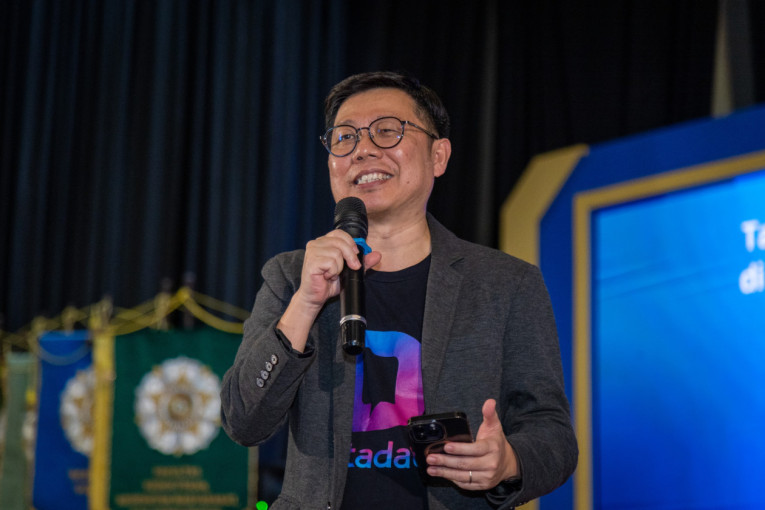
Co-Founder and CEO of Katadata, Metta Dharmasaputra, delivered a briefing on media challenges in the digital era to 1,638 prospective postgraduate graduates of Universitas Gadjah Mada on Tuesday (Apr. 21) at Grha Sabha Pramana. Metta, who is also an alumnus of the Faculty of Economics and Business UGM (FEB UGM), highlighted the acceleration of the digital revolution in reshaping how people access information.
Opening his session, he pointed out that internet penetration and mobile device usage in Indonesia have reached extremely high levels, even exceeding the total population. This indicates that society now operates within a highly intensive digital ecosystem. He added that these changes have shifted the primary sources of public information from conventional media to social media.
“Today, sources of information have largely shifted toward social media,” he said.
According to Metta, this condition requires individuals, especially university graduates, to continuously adapt to the evolving digital communication landscape. Data shows that 90% of information is transmitted to the brain through visuals. Therefore, he emphasized the importance of transforming how information is delivered in the digital era from text-based formats to visual storytelling.
“This condition inevitably demands that individuals no longer rely solely on long-form text. Instead, information needs to be packaged visually to be more effective and easier to understand,” he explained.
He further elaborated that digital transformation has introduced various forms of automation in content production and distribution. Technologies such as speech-to-text, text-to-voice, and text-to-video are rapidly advancing and widely used in the media industry. In addition, content distribution has become increasingly personalized through algorithms, where audiences receive information tailored to their preferences and digital activities.
“This phenomenon enables content that someone has just discussed to quickly appear on their social media timeline. It shows that today’s digital communication ecosystem is not only fast but also highly personalized,” he added.
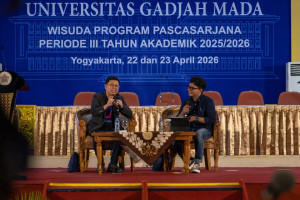
He also noted that the development of artificial intelligence (AI) affects not only the media industry but also economic structures, politics, and global geopolitics. He cited how communication technologies are now part of strategic tools in international conflicts. Nevertheless, he stressed that beyond these challenges, AI also presents significant opportunities to enhance efficiency and innovation across sectors.
Metta emphasized the importance of data in the digital era, where it has become a key asset in decision-making across business, media, and politics. Data is no longer merely complementary but serves as the foundation for generating insights, understanding audience behavior, and shaping policies.
“Indonesia has great potential to become the largest digital economy in Southeast Asia. Therefore, leveraging data is crucial to remain competitive globally,” he stated.
At the end of his presentation, he reiterated that new graduates must equip themselves with “new tools” to face inevitable technological disruption. He argued that complex ideas must be communicated concisely and effectively to ensure quick understanding while remaining relevant to the increasingly dynamic demands of industry. He also emphasized the need for a shift in mindset among younger generations, from being solution-oriented to becoming impact-oriented.
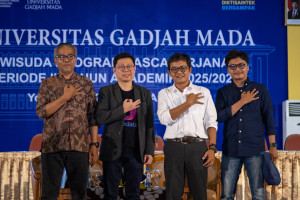
UGM Vice-Rector for Student Affairs, Community Service, and Alumni, Dr. Arie Sujito, extended his congratulations to the postgraduate candidates from various regions across Indonesia. He expressed hope that these future members of the UGM alumni community would play active roles in strategic sectors amid increasingly complex global dynamics. Dr. Sujito also encouraged alumni to maintain strong ties with the university and contribute to the advancement of education, research, and community service.
“Alumni must become strategic actors wherever they work and uphold professionalism as a responsibility for the knowledge they possess. Let us preserve the good name of ourselves, our families, and our alma mater, while continuing to contribute to societal transformation,” he said.
Meanwhile, the Head of the Sports and Recreation Department of the UGM Alumni Association (PP Kagama), Agus Supriyo, introduced Kagama as a large alumni network guided by the principle of guyub rukun migunani (harmonious, united, and beneficial). He explained that these values serve not only as an identity but also as guidance for graduates on how to contribute to society.
“Do not let our knowledge remain confined to academic journals. Let us translate it into policies, applied technologies, or solutions that truly benefit society,” he emphasized.
Author: Cyntia Noviana
Editor: Gusti Grehenson
Post-editor: Jasmine Ferdian
Photo: Donnie