


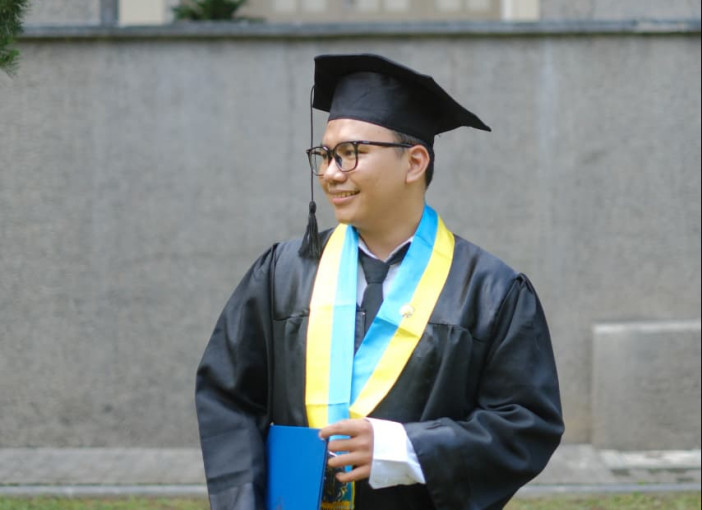
The atmosphere at Grha Sabha Pramana was filled with joyful cheers and waving graduation sashes on Wednesday (May. 21) as Universitas Gadjah Mada (UGM) once again celebrated its outstanding graduates. Among the graduates of the Vocational College (SV UGM) stood Revandra Aryo Dwi Krisnandaru, holding back tears of joy after his name was announced as the best graduate of the Applied Bachelor’s Program for Period III of the 2025/2026 Academic Year.
The Software Engineering Technology student completed his studies with an impressive cumulative grade point average (GPA) of 3.92. The average GPA in this Applied Bachelor’s graduation period was 3.63. The achievement marked a rewarding and unexpected ending for both him and his parents, given that his academic journey was shaped by challenges uncommon among technology students.
Revan admitted that he never expected to be named the graduate with the highest GPA in this period. Busy working as a freelancer during the final stage of his studies, he did not even expect to graduate with cum laude honors because he had to extend his study period.
“I was very surprised. Especially because I was working and had to add another semester,” he said on Wednesday (Jun. 3).
Revan’s concerns during his final years at university stemmed from the significant challenges he had faced since entering college. He explained that his chosen field of study differed greatly from the Petroleum Engineering program he had pursued at SMKN 1 Tuban. Revan acknowledged that the transition required intensive adaptation, leading him to learn independently through online tutorials and free educational websites.
“From the moment I was accepted through the SNMPTN admission pathway until the beginning of my studies, I worked on improving my skills through online courses. At that time, my school counselor also challenged me to create a game, so I casually started developing one using Python,” he explained.
The learning challenges became even greater when Revan began his studies without one of the most essential tools for a technology student: a capable personal laptop. He explained that once in-person classes resumed, he spent much of his time in the department’s computer laboratory to overcome the limitations of his personal equipment.
“During my first semester, I used my parents’ computer. It existed, but it was primarily for their work. Its specifications were not particularly high, so I made the most of the computer laboratory provided by the study program,” he recalled.
Despite limited resources and his freelance work, Revan adopted an efficient learning strategy to maintain strong academic performance amid his busy schedule. He explained that he maximized his focus during every minute of class.
“Technically, I am the type of person who can study efficiently. I learn in class. When I listen to the lecturer, I repeat what is being said and write it down in my notebook,” he explained.
This classroom efficiency also fueled Revan’s productivity outside the classroom. Throughout his studies, he actively participated in research and community service projects alongside faculty members.
“There were around ten projects with lecturers. Some of them even resulted in intellectual property rights registrations,” he said gratefully.
Furthermore, Revan believes that a high GPA essentially reflects a student’s diligence and discipline. He shared that his experience as a teaching assistant also contributed significantly to his academic performance. The position helped him better understand lecturers’ perspectives and expectations regarding assignments.
“Because I served as a teaching assistant for three and a half years, I came to understand how lecturers think. In fact, lecturers place great importance on students’ diligence, whether they submit work on time and complete assignments to the best of their ability rather than doing them carelessly,” he said.
Concluding his story, Revan encouraged fellow students to remain consistent in pursuing their dreams.
“Never feel inferior because of someone else’s progress. Sometimes we only see the results, not the journey behind them. What matters most is not how fast we run, but how long we keep moving forward before we stop,” he concluded.
Author: Aldi Firmansyah
Editor: Gusti Grehenson
Post-editor: Jasmine Ferdian
Photo: Courtesy of Revandra Aryo Dwi Krisnandaru