


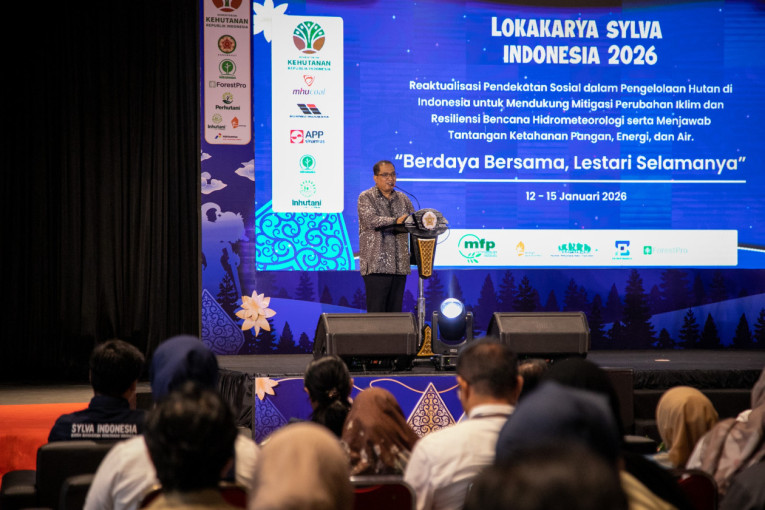
The forestry sector has recently come under intense public scrutiny following flash floods that struck three provinces (Aceh, North Sumatra, and West Sumatra) in late November last year. Issues of poverty, food security, and disaster risk are also closely intertwined with communities living in areas surrounding forests. For this reason, a social approach is increasingly seen as crucial in forest governance. The shift in the government’s role from a sole regulator to a facilitator calls for cross-actor collaboration.
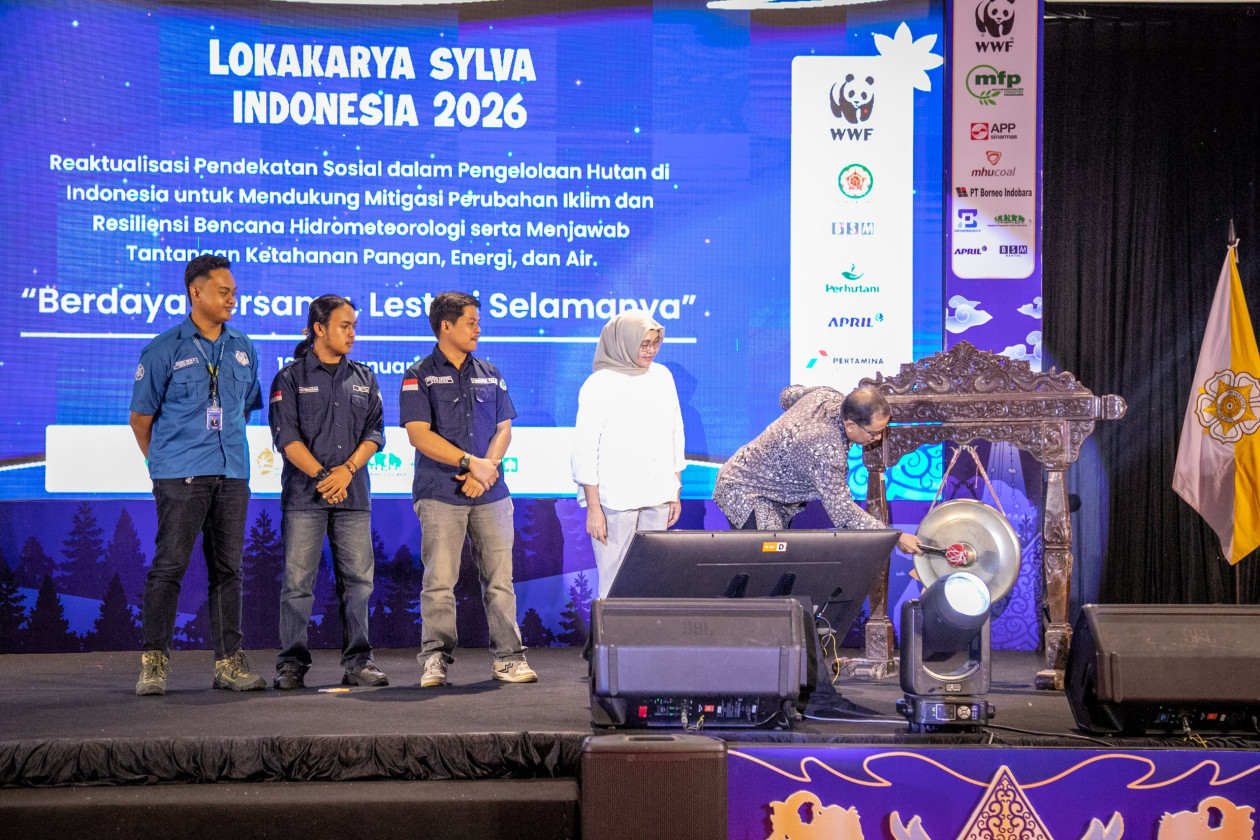
“A social approach is key to ensuring that forest management responds to community needs while safeguarding ecological functions,” said Dr. Sigit Sunarta, Dean of the Faculty of Forestry, Universitas Gadjah Mada (UGM), during the Sylva Indonesia Workshop 2026, titled “Reactualizing Social Approaches in Forest Management in Indonesia to Support Climate Change Mitigation and Hydrometeorological Disaster Resilience while Addressing Food, Energy, and Water Security Challenges,” held at the Joglo of the UGM Innovation and Creativity Hub (GIK UGM) on Jan. 12 (Jan. 12).
He added that forests play a strategic role in climate change mitigation and in providing food, energy, and water security. These fundamental functions can operate optimally only when forest management is carried out in a participatory and sustainable manner.
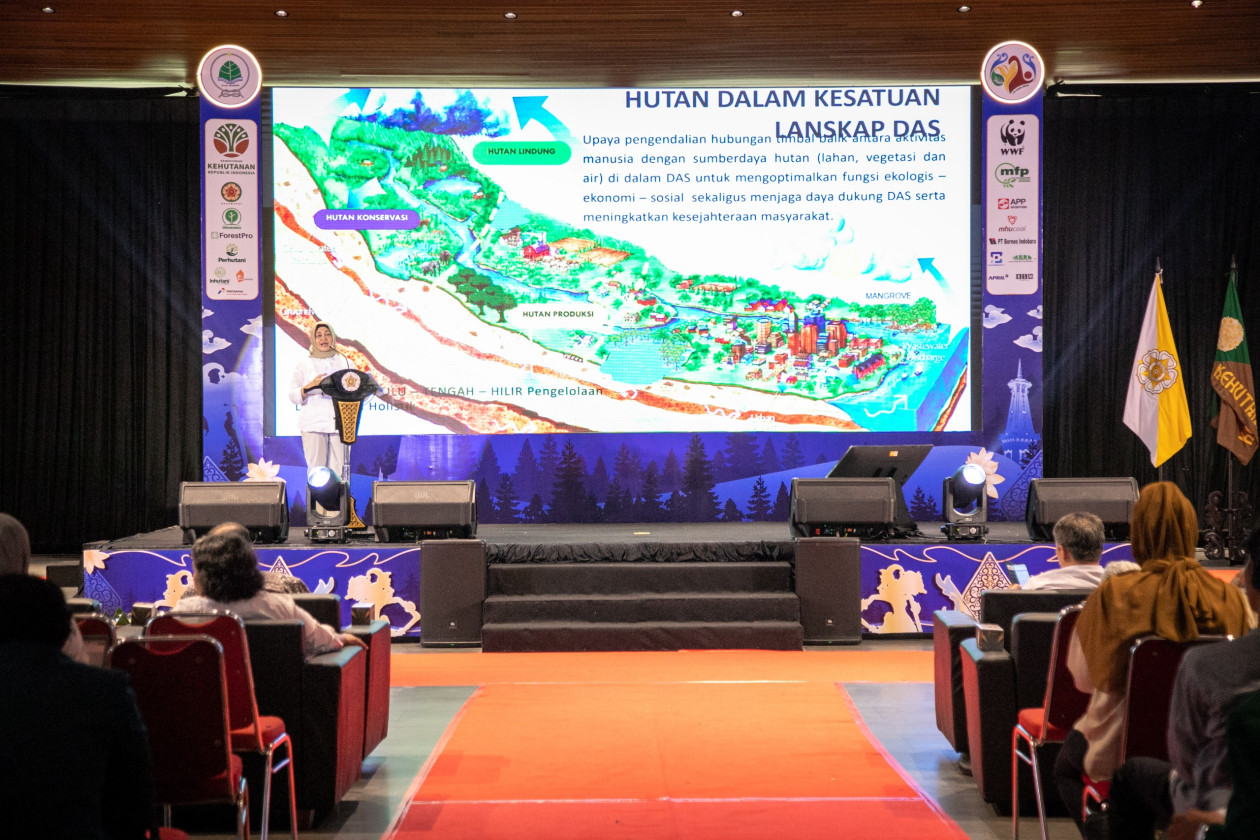
Meanwhile, Dyah Murtiningsih, Director General of Watershed Management and Forest Rehabilitation, explained the importance of integrated watershed management from upstream to downstream.
In upstream areas, efforts are focused on enhancing water infiltration capacity, controlling erosion, and strengthening protection functions. These measures must be accompanied by spatial planning and land-use control. Collective awareness is a prerequisite to ensure that water flows according to its natural functions.
“Watershed management must be understood as a shared responsibility from upstream to downstream,” she stressed.
The director general also outlined that the rehabilitation of degraded land is conducted through a combination of vegetative measures and civil engineering approaches, both within and outside forest areas.
A landscape approach is applied to integrate rehabilitation efforts with local ecosystem conditions, including coastal areas and wetlands.
The government has prepared long-term, data-driven plans to restore degraded land. Support through large-scale nurseries has also been arranged to enable broad community involvement in planting activities.
“Land rehabilitation requires sustainable planning and active community participation,” she explained.
In the context of empowerment, she emphasized the importance of educating communities engaged in activities on sloping land and in upstream areas.
The application of agroforestry principles is considered capable of balancing conservation functions with economic benefits. Timber species with economic value can help stabilize soil and improve water infiltration.
This scheme is expected to foster conservation awareness without neglecting livelihood needs.
“Community economic activities must go hand in hand with conservation principles,” she said.
Furthermore, she emphasized that forest management must be based on three main principles: forest conservation, sustainable development, and community welfare.
The involvement of communities living around forest areas is crucial due to the limited resources of state forest managers. Management access through social forestry schemes opens opportunities for communities to protect forests while gaining economic benefits.
This approach is believed to strengthen a sense of ownership of forest areas.
“When communities feel the benefits, they will become the front line in forest protection,” she noted.
The Sylva Indonesia Workshop 2026 brought together forestry students from various universities.
The forum, held Jan. 12 to 15, 2026, with UGM as the host institution, was designed as a strategic space for discussion, idea exchange, and the formulation of policy recommendations for the forestry sector.
The agenda is expected to make a tangible contribution to strengthening sustainable forest management at the national level.
Chair of the Organizing Committee of the Sylva Indonesia Workshop 2026, Fedora Rifqi Rahmadhan, stated that the forum was designed as a collaborative space for young foresters from across Indonesia.
The workshop encourages synergy, innovation, and youth engagement in forest resource sustainability. Thematic discussions and exchanges of ideas are expected to generate constructive recommendations.
Networking among forestry students is considered an important asset in addressing future challenges in the forestry sector.
“We designed this workshop as a space for ideas and collaboration among young foresters to grow,” he said.
Secretary General of Sylva Indonesia, Wahyu Agung, a student of Universitas Tanjung Pura, concluded the series of remarks by emphasizing the role of forestry students as agents of change.
He reminded participants that forestry challenges are becoming increasingly complex in line with developments in the times and technology.
Therefore, the outcomes of the workshop are expected to go beyond a routine gathering. The recommendations and ideas produced are hoped to have a long-term impact on national forest governance.
“What we formulate today will determine the face of Indonesian forestry in the decades to come,” he concluded.
Author: Triya Andriyani
Post-editor: Rajendra Arya
Photographer: Donnie Trisfian