


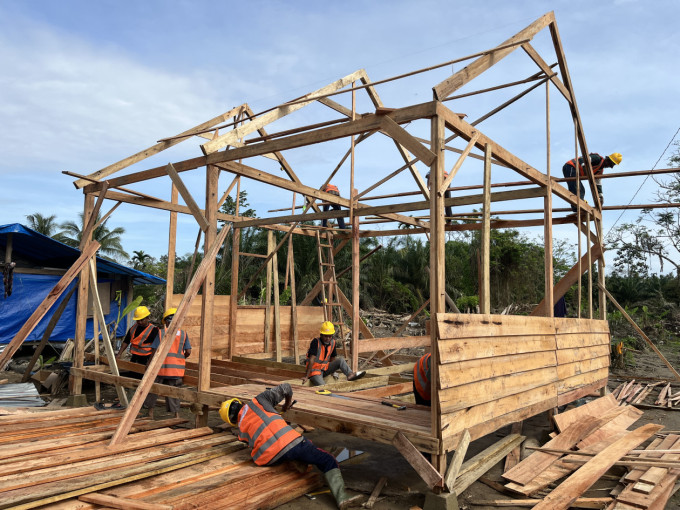
Universitas Gadjah Mada (UGM) continues to strengthen its role in the post-flood recovery phase in Sumatra through the construction of temporary housing for affected residents. One such initiative is the provision of construction skills training for residents as part of the development of 100 temporary shelters (Hunian Sementara/Huntara) in Geudumbak Village, Langkahan District, North Aceh. This program positions the community as the primary driver of recovery, supported by academic expertise and technical assistance from the university.
The construction skills training for residents was conducted on Dec. 31, 2025, involving a team of construction and disaster experts from the Resilient Team (Tim Tangguh) of the Faculty of Engineering (FT UGM).
The team leader, Dr. Ashar Saputra, explained that the activity was designed to equip residents with practical skills in wooden construction aligned with the temporary housing design developed by UGM.
A total of 14 participants from Geudumbak Village and surrounding areas attended the training.
“We departed from Yogyakarta and immediately accompanied the training so that residents would be ready to build these shelters together,” he said on Friday (Jan. 2).
The shelter design uses a simple construction approach to ensure it is easy to understand and replicate.
The UGM team assisted residents in learning the techniques for building a 6 × 6 meter wooden house that can be completed within a relatively short time.
This approach is expected to accelerate the provision of housing for flood survivors.
“We observed that residents quickly grasped the construction technology we introduced,” Dr. Saputra noted.
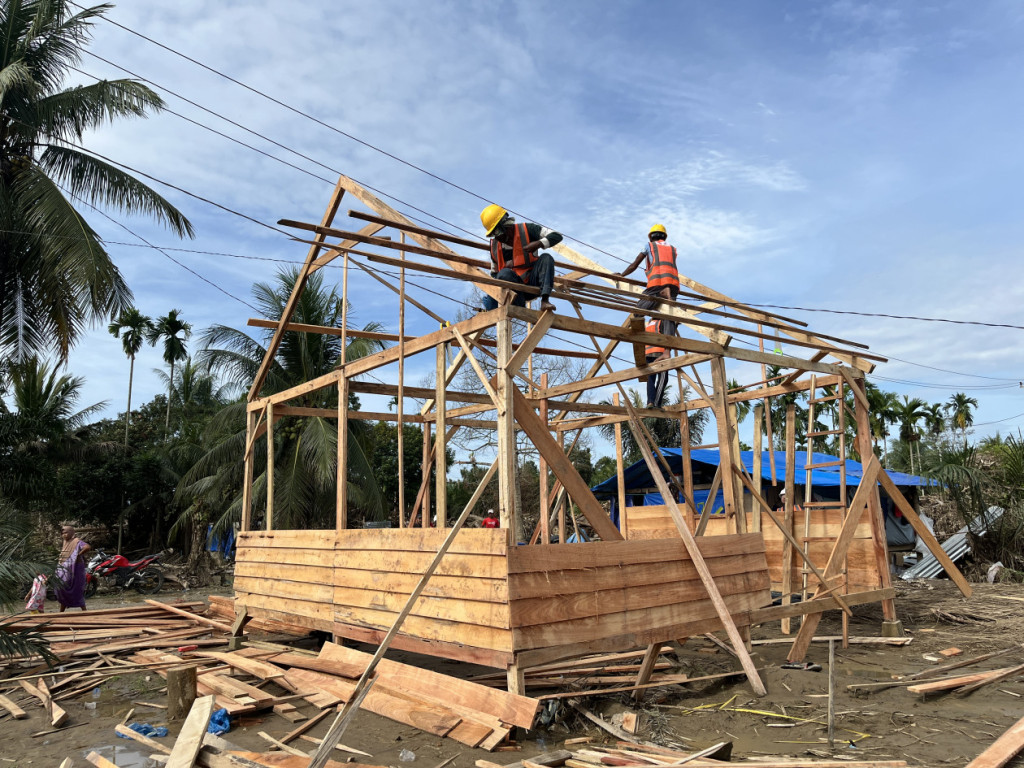
The team leader added that on-site construction faced several non-technical challenges. Limited access to electricity and clean water, as well as muddy road conditions caused by rainfall, required adjustments in the work process; nevertheless, assistance continued by maximizing available resources.
“The main challenges here are electricity, clean water, and access, but these are still manageable when addressed together with the community,” he explained.
The enthusiasm of residents has become a crucial asset in the implementation of the shelter construction.
Their involvement at every stage of the work not only accelerated the process but also fostered a sense of ownership over the houses being built.
Residents did not merely wait for aid; instead, they actively contributed as part of the construction team.
“The residents are very enthusiastic because they can directly participate in building their own homes and see the results firsthand,” Dr. Saputra said.
Collaboration with humanitarian partners has further strengthened the program’s implementation on the ground. In constructing the 100 temporary shelters, UGM partnered with Rumah Zakat, which provided funding and supported basic needs during construction.
A representative of Rumah Zakat, Ar Razi Izzatul Yazid, explained that this synergy enabled UGM’s academic approach to be effectively applied in the affected area.
“We provided generators and worked to set up wells and water tanks so that the shelter construction could proceed smoothly,” he explained.
Beyond providing housing, the collaboration also emphasized community capacity building through construction skills training. The construction methods introduced represent new knowledge that can be used by residents in the long term. This impact was directly felt by those involved in the project.
“For the local community, this has been a new insight, that even with wooden boards, it is possible to build a strong and decent house,” Yazid remarked.
The presence of temporary shelters has a significant impact on flood survivors during the recovery phase. The shelters allow residents to return to safe and comfortable living conditions while maintaining family privacy.
Community involvement has also opened opportunities for local economic recovery.
“Residents are very grateful because they can once again have safe housing and resume their livelihoods after the disaster,” Yazid concluded.
Author: Triya Andriyani
Post-editor: Rajendra Arya
Photographs: Lukmanul Hakim