


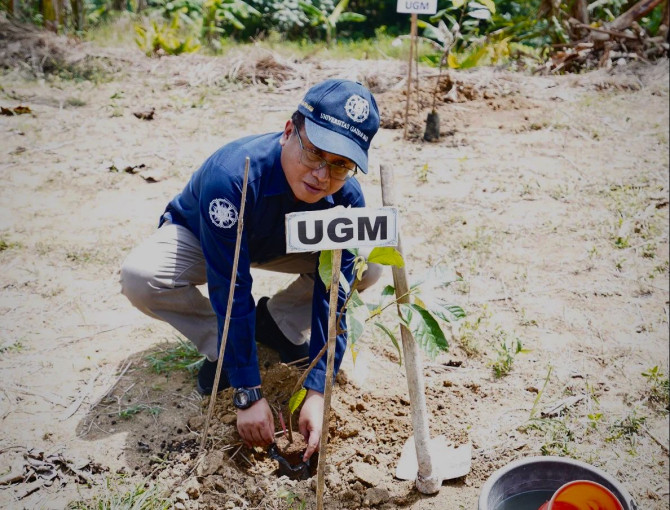
The Faculty of Agriculture at Universitas Gadjah Mada (Agriculture UGM), in collaboration with PT Riset Perkebunan Nusantara (RPN), the Goa Gogor Asri Forest Farmer Group, and Fuji Oil Co., Ltd., carried out the initial planting of high-quality cocoa in Jambusari Village, Jeruklegi District, Cilacap Regency, Central Java, on Thursday (March 26).
The initial phase of cocoa commodity development in Cilacap Regency is being implemented over 44 hectares. The symbolic planting of the cocoa demonstration plot was conducted by the Vice Dean for Research, Community Service, and Cooperation of Agriculture, Professor Subejo, together with the Head of the Plantation Division of the Cilacap Agriculture Office, Handewi, the Fuji Oil representative, Ichiro Nakamura, and the Jambusari Village Head, Sukhat.
Professor Subejo stated that this collaborative cocoa development initiative aims to support sustainable cocoa development in Cilacap Regency, Central Java, by strengthening the cocoa value chain through coordinated, inclusive, and long-term efforts.
“The development of high-quality and sustainable cocoa in Indonesia requires an integrated approach that connects scientific knowledge, industry engagement, farmer participation, and institutional support,” he said.
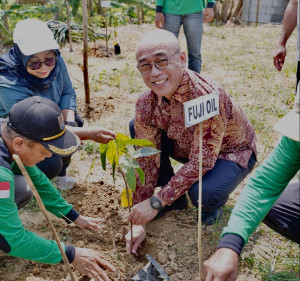
Professor Subejo expressed appreciation for the collaboration in developing high-quality cocoa in Cilacap Regency. Through this collaborative framework, each stakeholder is expected to gain tangible and complementary benefits. For Fuji Oil Co., Ltd., the partnership supports the development of a reliable, sustainably produced supply of high-quality cocoa beans while strengthening long-term supply chain resilience.
“For farmer groups, this initiative provides access to improved planting materials, continuous technical assistance, and stronger market linkages, contributing to increased productivity and more stable livelihoods,” he explained.
He added that this collaboration offers a platform for applied research, student learning, and community engagement, ensuring that scientific innovation directly responds to field realities. The program enables field validation and the scaling up of research-based innovations.
“This collaboration supports regional development goals, rural economic growth, and sustainable land management,” he said.
Furthermore, he explained that cocoa development in Cilacap is expected to improve the quality and sustainability of cocoa beans through responsible input management and strengthened post-harvest handling, including fermentation.
“These efforts aim to produce cocoa beans with consistent quality while maintaining soil health, environmental balance, and long-term agricultural resilience,” he said.
Handewi, Head of the Plantation Division of the Cilacap Agriculture Office, stated that Cilacap Regency has significant potential for cocoa development due to its favorable agroclimatic conditions, the availability of agricultural land, and growing farmer interest. Initial assessments indicate strong prospects for producing aromatic and high-quality cocoa beans, positioning Cilacap as an emerging cocoa-producing region in Central Java.
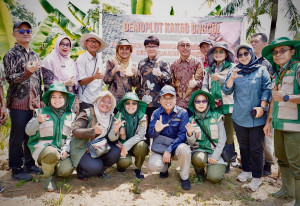
According to Handewi, farmer empowerment and capacity building are key pillars of this collaboration. Farmers are supported through training and continuous mentoring activities covering nursery management, field planting, crop maintenance, and cocoa fermentation. Active farmer participation strengthens technical skills, enhances decision-making capacity, and encourages the long-term adoption of improved practices.
“Not all villages receive this kind of support, so we should be grateful for this opportunity. Once the seedlings are available, we must plant and maintain them properly to improve farmers’ welfare. Ladies and gentlemen, we have received this assistance; now it is up to us to plant and take care of it. Do not plant and neglect it; there will certainly be results, as cocoa is highly demanded across all age groups,” she explained.
Meanwhile, Nakamura added that in the development of the chocolate industry, a key factor determining quality and sustainability lies in raw materials, particularly how cocoa beans are produced. He noted that Indonesia is the largest cocoa producer in Asia and plays an important role in the global chocolate industry. At the same time, many smallholder farmers face challenges in accessing the knowledge, techniques, and inputs required for high-quality cocoa production, including proper cultivation management and fermentation practices.
“Cilacap Regency is endowed with an agricultural climate well-suited for cocoa cultivation, as well as soil conditions capable of producing cocoa beans with distinctive aromatic characteristics. As an emerging cocoa-producing region in Central Java, this area holds great potential through collaboration among industry, academia, government, and the community,” he said.
Author: Agung Nugroho
Post-editor: Zabrina Kumara