


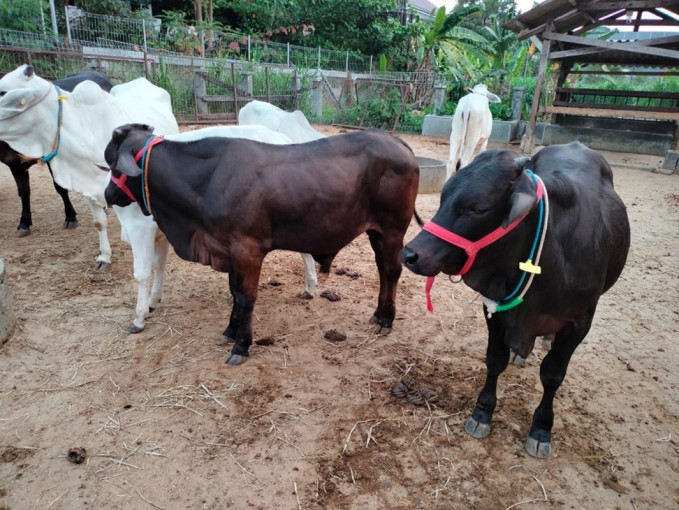
Recognizing the potential of the Belgian Blue breed as a superior beef-producing cattle, a team of researchers at Universitas Gadjah Mada (UGM) began developing a crossbreed between the Belgian Blue and local Indonesian cattle in 2024. The result of this crossbreeding is named GAMA Cattle. This initiative is carried out by the UGM Faculty of Animal Science UGM (Animal Science UGM) in collaboration with PT Widodo Makmur Perkasa and the University of Liège, Belgium.
Tristianto Nugroho, a researcher at Animal Science UGM, explained that Belgian Blue cattle, originating in Belgium, are known for their double-muscle trait, caused by a mutation in the Myostatin (MSTN) gene.
In this crossbreeding project, he emphasized the importance of environmental adaptability.
“Belgian Blue cattle come from cold climates. Coupled with relatively small vital organs, this condition makes them more vulnerable to heat stress in Indonesia’s tropical environment,” he said at Animal Science UGM on Thursday, Jun. 19, 2025.
In his research, he studied the behavioral patterns of the crossbreed between Belgian Blue and Ongole Crossbred cattle.
The research was conducted during the peak of the dry season by placing the cattle in an open, loose-housing system, where the animals were allowed to roam freely without a roof.
“Observations were made continuously for 2×24 hours and repeated across two different weeks to obtain a comprehensive behavioral profile,” he explained.
Nugroho stated that the research has been published in the Journal of Animal Behaviour and Biometeorology, a Q2-ranked international journal with an impact factor of 1.8.
The publication reported that the research team identified 73 distinct behaviors categorized into postural, locomotion, activity, and social behaviors.
It was also found that the cattle spent a relatively balanced amount of time standing and lying down.
“Forty-two percent of the standing time was used for feeding activities. Interestingly, male cattle were observed to eat more frequently but for shorter durations compared to female cattle,” Nugroho noted.
Furthermore, he explained that the cattle’s daily behavioral patterns typically involved standing from 5 a.m. to 5 p.m. and lying down almost the entire night, starting at 10 p.m.
However, around 10–11 a.m., when air temperatures peaked, the cattle were observed changing from lying to standing multiple times.
“After the morning feeding, the cattle usually lie down to ruminate. But due to the heat of the barn floor, they might feel discomfort and stand up again to seek a cooler spot to lie down,” he explained.
Based on these findings, Nugroho expressed hope that the results could serve as a foundation for managing the care of Belgian Blue crossbred cattle, particularly in the design of barns suited to tropical climates.
He also mentioned that the research is ongoing and requires further observation.
“The current research is being extended to conduct a more in-depth analysis of each behavior type, including comparisons with local cattle,” he added.
Professor Panjono, a member of the GAMA Cattle research team, stated that animal behavior is a key indicator of adaptability to environmental conditions.
For him, adaptation is one of the main considerations in developing this breed.
He acknowledged that Belgian Blue cattle from colder climates are highly productive in terms of meat yield. In contrast, local cattle, while less productive, are well-adapted to the Indonesian environment.
The crossbreeding is intended to ensure that the Belgian Blue genetic composition is not fully dominant, aiming instead for complementary effects.
“Through this research, we hope that GAMA Cattle can soon achieve stable performance and become widely accepted and developed within local communities,” he added.
Reporter: Animal Science UGM/Satria
Author: Agung Nugroho
Post-editor: Lintang Andwyna