


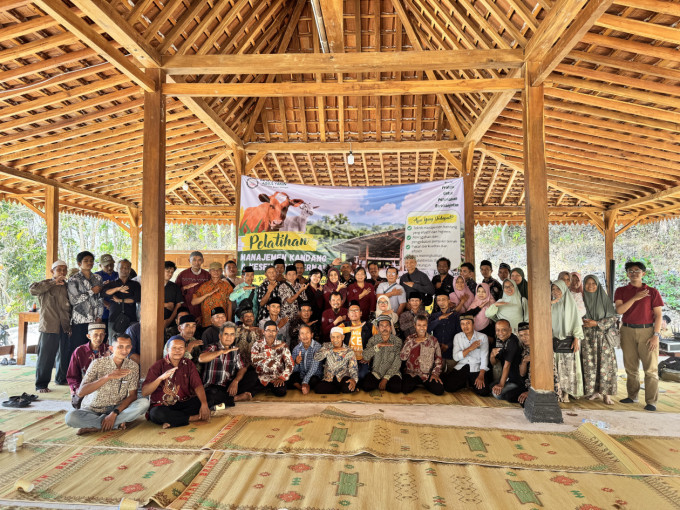
The Department of Physiology at Universitas Gadjah Mada’s Faculty of Veterinary Medicine (FKH UGM) held a training session on livestock housing management and animal health at Griya Peternakan Ainul Yakin in Karangtengah Hamlet, Gunungkidul Regency, Special Region of Yogyakarta, on Saturday (October 10). The community outreach program aimed to improve participants’ knowledge and skills in managing healthy and sustainable livestock farming.
Head of the Department of Physiology at FKH UGM, Professor Sarmin, explained that the development of an integrated livestock farming system at Ainul Yakin holds considerable potential, supported by ample land and cooperation with the surrounding community.
He noted that integrated livestock farming is not solely focused on increasing production but can also serve as a learning platform that provides tangible benefits for students with special needs at the Islamic boarding school.
“Through activities such as feeding animals, cleaning livestock sheds, caring for livestock, and helping manage the land, the students have opportunities to develop a sense of responsibility and teamwork according to their individual abilities,” Sarmin said in a statement sent on Monday (November 2).
For Sarmin, fostering entrepreneurship is an important part of the program. Through productive livestock farming activities, students with special needs are expected to become familiar with business processes, understand how to manage simple economic activities, and develop skills that can help them lead more independent lives.
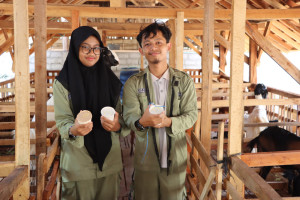
In addition to training on livestock housing management, the FKH UGM team, in collaboration with the Wonosari Animal Health Center (Puskeswan), also conducted an outreach session on preventing foot-and-mouth disease (FMD). Head of the Wonosari Animal Health Center, Wiwit Astuti, emphasized the importance of preventing livestock diseases and maintaining animal health.
She explained that farmers need to understand disease prevention measures, monitor their livestock’s health, and use animal health services as needed.
“Collaboration between universities and animal health service units is expected to broaden public access to information while supporting better livestock farming practices,” Wiwit said.
In addition to serving as a training venue for the community, Griya Peternakan Ainul Yakin is part of an initiative to empower students at Ainul Yakin Islamic Boarding School, an institution specifically established for children with special needs.
Through an integrated livestock farming system, animal husbandry activities serve as a means of learning, social and behavioral therapy, life skills development, and entrepreneurship training for students.
The livestock housing management and animal health training also featured six speakers from the Department of Physiology at FKH UGM, including Professor Pudji Astuti. Other speakers and participants included Claude Mona Airin, Vincentia Trisna Yoelinda, Wiwit Astuti, a veterinarian and head of the Wonosari Animal Health Center; and Professor Ibnu Syamsi of Yogyakarta State University (UNY).
The Department of Physiology at FKH UGM has supported Ainul Yakin since 2020. The program initially focused on developing farming of Jawa Super chicken, goat, and sheep. In 2025, it expanded to include grass cultivation as an animal feed source. In 2026, the assistance program shifted its focus to developing beef cattle farming.
Through this program, the Department of Physiology at FKH UGM and Griya Peternakan Ainul Yakin are committed to continuing to develop an integrated livestock farming system that not only produces healthy, productive livestock but also delivers social and economic benefits to the community while creating opportunities for students with special needs to become more independent.
Author: Agito Sitepu
Editor: Gusti Grehenson
Post-Editor: Priyananda
Photo: Team Documentation