


Successful community empowerment depends not only on community facilitators’ performance but also on their ability to mobilize communities toward self-reliant development. Community Empowerment Facilitators (PSM) play a strategic role in building ecosystems that connect communities, institutions, government, and businesses. Therefore, PSM facilitators need to develop practical, adaptive, and innovative approaches tailored to each region’s characteristics.
“Success in community empowerment is not measured by the success of the PSM facilitators themselves, but by their success in mobilizing their communities,” said Rika Fatimah, a lecturer at the Faculty of Economics and Business, Universitas Gadjah Mada (FEB UGM).
She made the statement during the National Technical Socialization on Competency Testing for Community Self-Help Facilitator Functional Positions and Community Empowerment through Village Entrepreneurship Ecosystems, organized by the Ministry of Villages and Development of Disadvantaged Regions on Monday (Oct 5). The event was held in a hybrid format, with Rika participating as the founder and concept developer of G2R Tetrapreneur and Vice Chair of Technical Committee 03-13 for G2R Tetrapreneur.
Rika also highlighted the lack of coordination among institutions as a persistent challenge in community economic development. Various community organizations, including the Family Welfare Movement (PKK), Tourism Awareness Groups (Pokdarwis), and Karang Taruna youth organizations, often run their own programs with limited coordination. Integrating these programs and fostering collaboration among institutions are essential to better using local resources and potential.
“It is not about profit or sales, but about the ecosystem,” Rika emphasized.
She explained that entrepreneurship development should begin by building an ecosystem that connects various resources and stakeholders, rather than focusing solely on increasing sales or profits.
In this context, the government plays an important role in establishing policies and supporting the implementation of programs that address the needs of communities in each region.
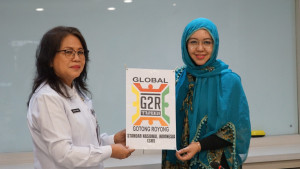
To put this approach into practice, Rika encouraged PSM facilitators to participate in the G2R Tetrapreneur ecosystem in the areas they support. This involvement could take the form of establishing G2R Tetrapreneur units integrated with legally established institutions or organizations, such as Village-Owned Enterprises (BUMDes), cooperatives, and Tourism Awareness Groups.
According to Rika, strengthening institutions is essential to prevent community empowerment programs from operating in isolation. Through structured cooperation, community resources and local potential can be connected to support business sustainability and expand economic benefits for rural communities.
Rika explained that implementing Indonesian National Standard (SNI) 9445:2026 for G2R Tetrapreneur is expected to develop rural entrepreneurship ecosystems that go beyond business growth by strengthening collaboration, community self-reliance, and the practice of gotong royong, or mutual cooperation, in local potential-based economic development.
She further explained that SNI 9445:2026 for G2R Tetrapreneur serves as a quality guideline for entrepreneurship ecosystems, integrating the values of gotong royong and Pancasila Economics into business processes. This approach seeks to connect the social values embedded in communities with the development of structured economic activities.
“Many people say that Pancasila Economics is more of a movement or a philosophy. That is true. However, we have long applied capitalist calculations, and things have remained much the same. Therefore, there is nothing wrong with having a mechanism that supports the nonfinancial aspect, namely the spirit of our national identity, incorporated into business processes through gotong royong,” she explained.
Rika further explained the four main pillars of G2R Tetrapreneur. The first, Chainpreneur, focuses on strengthening the upstream stages of the entrepreneurship chain, including institutional capacity and the development of iconic products. The second, Marketpreneur, aims to expand market access and educate consumers about the village’s flagship products. The third, Qualitypreneur, focuses on improving product quality to help local products compete in national and global markets. The fourth, Brandpreneur, emphasizes the role of government at all levels, from national to village, in strengthening the identity and supporting the development of flagship products.
Through these four pillars, rural entrepreneurship is expected to develop in an integrated manner while taking into account local potential, distinctiveness, and wisdom. Rika emphasized that G2R Tetrapreneur is not intended to standardize characteristics across regions. Instead, it aims to establish a culture of collaboration that can be adapted to local conditions.
“G2R Tetrapreneur does not make every region the same. Rather, it is a culture that must be cultivated, so that the final outcomes will reflect the conditions and specific characteristics of those implementing it,” she concluded.
Author: M. Aidil Syahputra
Editor: Gusti Grehenson
Post-editor: Zabrina Kumara
Photo: Ministry of Transmigration, Rika Fatimah’s Documentation