


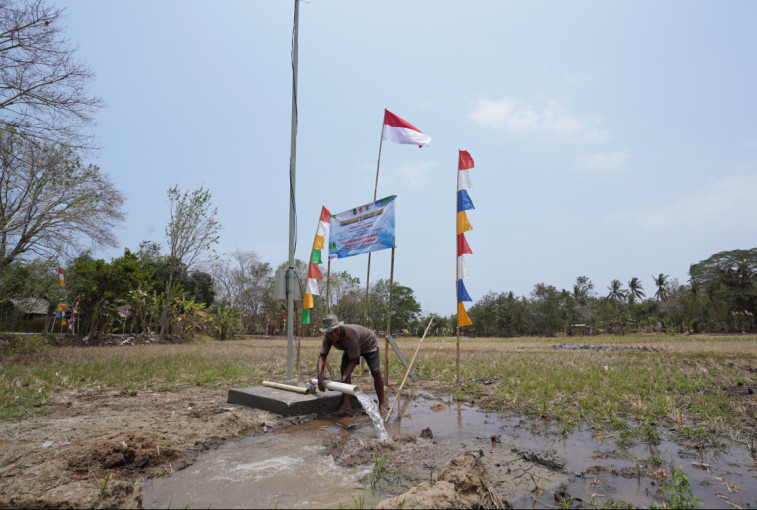
Dry-season water shortages can disrupt agricultural activities, particularly preparation for the third cropping season. To establish a water supply initiative rooted in groundwater potential, Universitas Gadjah Mada, through its Graduate School (SPs UGM), joined forces with Muda Ganesha—the alumni network of SMAN 1 Purworejo. In 2026, the collaboration resulted in the construction of 11 wells in several villages across Purworejo Regency. These wells provide communities with water to meet daily needs and support agricultural activities.
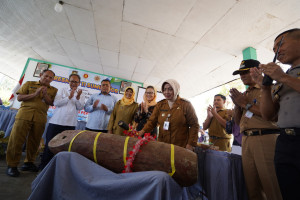
The 11 wells were officially inaugurated in Kertosono Village, Banyuurip District, Purworejo Regency, on Monday (Oct. 12). The event extended the benefits of research and alumni collaboration to locals. Purworejo Regent Yuli Hastuti stated that water availability plays a vital role in meeting basic needs and supporting economic activities, including agriculture.
She hopes that the newly constructed wells will be used effectively and properly maintained to ensure their long-term benefits. Cooperation among various stakeholders was necessary to develop solutions that address local needs.
“The water supplied by these wells is essential for meeting daily needs while also supporting agricultural activities and community livelihoods,” she said.
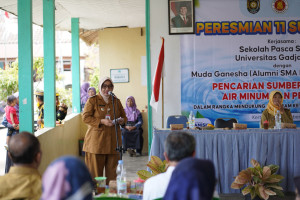
Dean of SPs UGM, Professor Siti Malkhamah, emphasized the need to sustain water supply initiatives through collaboration among various stakeholders. Universities can contribute their expertise and research findings, while village governments and locals help ensure the facilities meet local needs and are properly maintained. The collaboration is expected to develop similar programs in other areas.
“Synergies like this need to be strengthened so that the benefits can reach more communities,” she said.
Head of the UGM Master’s Program in Environmental Science, Dr. Sudaryatno, explained that the program originated from a 2024 study on groundwater potential in the Bogowonto River Basin. The research team assessed several locations to identify potential groundwater sources. One site was in Karangrejo Village, where the team met the village head, who reported that residents struggled to access water.
“At the time, we were conducting research on groundwater potential in the Bogowonto River Basin,” he explained.
Followed by surveys and the construction of wells in several villages. The work began in 2024 through collaboration with various stakeholders and continued in 2025, expanding to several other locations. Another expansion in 2026 resulted in 11 wells that were officially inaugurated. Requests for new water sources continued from several areas across Purworejo Regency. He hoped that future development could proceed gradually, guided by local needs and technical assessments.
Drilling sites must be selected through assessments tailored to local conditions. Groundwater potential surveys help the team identify locations likely to yield water and determine appropriate drilling depths. At one site, a borehole approximately 62 meters deep produced a flow rate of around four liters per second, based on findings presented during the event. This research-based approach is expected to help direct construction efforts toward areas with the highest need for water.
“My hope is that UGM will first establish a technically sound program. We need to conduct studies to identify the necessary locations throughout the regency, after which development can proceed gradually,” he said.
The benefits of improved water access are also evident in agricultural activities in several areas. Farmers who previously struggled to cultivate their land during the third planting season can now plant again, with some locations already reaching harvest time. One borehole reportedly provides irrigation for approximately 2.5 hectares of farmland. This access to water helps farmers sustain cultivation when other water sources are limited.
“But now, thankfully, they can cultivate their land during the third cropping season,” he said.
Looking ahead, Sudaryatno hopes that further borehole development will be supported by a more comprehensive assessment of water needs. Mapping is necessary to identify priority areas, determine the number of wells required, and establish construction phases based on each region’s conditions. He also emphasized cooperation among UGM, local governments, alumni, and communities in ensuring the program’s sustainability.
“Ideally, if possible, this could be expanded nationwide. This month, I am traveling to Belu, East Nusa Tenggara. Together with the Regent of Belu, we are planning surveys in 80 villages to assess the potential for developing wells,” he concluded.
Beyond infrastructure development, the proper use and maintenance of water sources are essential. Locals are encouraged to use water responsibly, based on household and agricultural needs. Through scientifically informed planning and collaboration, the borehole program is expected to expand to help communities cope with water shortages.
Author: Triya Andriyani
Post-editor: Jasmine Ferdian
Photo: Firsto