


The Universitas Gadjah Mada (UGM) Community Service Program (KKN-PPM) team in Banggai Islands held a virtual workshop to kick off their 2025 KKN activities. Conducted via Zoom on Wednesday, Jun. 18, 2025, the event was a collaboration between the KKN Banggai team and Jejakin, an environmental technology startup. Designed to provide students with a foundational understanding before being deployed to their community service sites on Jun. 20, the workshop emphasized awareness of carbon footprints in service-related activities.
With a data-driven, reflective approach, this initiative marked the beginning of a greener transformation of UGM’s community service model.
“This initiative is a tangible expression of UGM’s sustainability spirit, turning community service into a learning space to act ecologically,” said Dr. Hendrie Adji Kusworo, the supervising field lecturer.
The workshop discussion addressed key questions regarding emissions from KKN activities, many of which often go unnoticed.
One such point was raised by Tegar Prakasa, Founder of Vontripo, who highlighted the significant carbon footprint produced from deploying thousands of students across regions.
He underscored that inter-island transportation, the use of packaged logistics, and generator use were major sources of emissions.
His thought-provoking question encouraged students to re-evaluate practices long considered routine.
“When will UGM’s KKN become an emission-free program?” he asked.
In response to this challenge, the KKN Banggai team partnered with Jejakin, which introduced CarbonIq, a carbon emission tracking application.
The app enables students to log their daily activities during KKN and calculate their individual emission contributions.
More than just a tracker, it also provides data-based mitigation recommendations.
The collaboration aims to increase student awareness of the ecological impact of their actions.
“CarbonIq was designed to make emissions tracking simple yet accurate, and it can even convert emissions into the number of trees that need to be planted,” explained Sarah Azzahra, a representative from Jejakin.
The results of the carbon calculation then serve as the basis for real-world action.
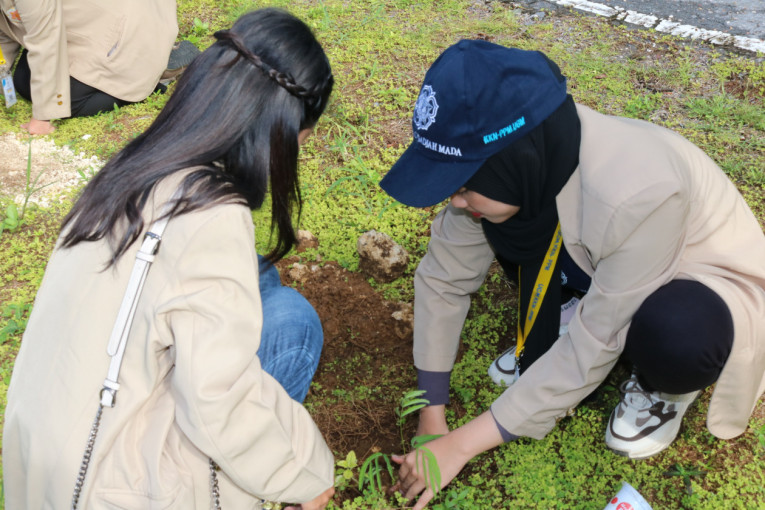
Ashim, a former KKN-PPM Banggai student, shared his experience planting Caliandra trees as a form of carbon compensation.
This tree species was selected for its rapid carbon sequestration and adaptability to a range of soil conditions.
The planting took place around the KKN site, with the number of trees adjusted according to emission calculations.
“After calculating our carbon footprint, we agreed to plant fast-growing trees to offset it,” said Ashim.
Not all locations are suitable for tree planting.
Therefore, the KKN team also employed alternative strategies, such as limiting motorized vehicle use and selecting more eco-friendly logistics.
These approaches require student creativity and adaptability to ensure program implementation without neglecting environmental concerns.
Such methods are seen as more flexible yet impactful in the long term.
The Green Footsteps concept serves as a simple yet meaningful guide for service activities.
Instead of relying on large-scale interventions, students are encouraged to begin with small, consistent, and sustainable actions.
This approach instills the understanding that impactful change doesn’t always have to be dramatic but can start with good habits that are continually upheld.
The Banggai experience proves that sustainability values can be seamlessly integrated into the KKN framework without compromising its community-centered essence.
“The hope is that this approach won’t stop at Banggai Islands but will be adopted by other UGM KKN-PPM units,” said Dr. Kusworo.
For other KKN units interested in following similar steps, the KKN Banggai team is opening space for broader collaboration.
Students and supervisors can initiate early communication to learn about app usage and field-based mitigation practices.
This spirit is part of UGM’s broader efforts to amplify student contributions to sustainability.
Cross-unit collaborations are expected to expand the positive impact already initiated.
“Feel free to reach out if you’d like to discuss further; email is the best way to connect,” said Angga Alfian Parmadi, Student Coordinator of KKN Banggai 2025.
Reportage: KKN Banggai 2025 Team
Author: Triya Andriyani
Post-editor: Lintang Andwyna