


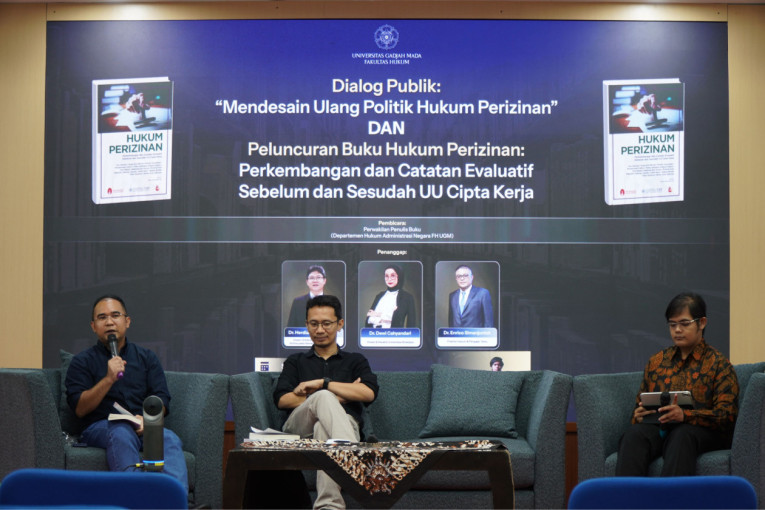
The Department of Administrative Law (HAN), Faculty of Law, Universitas Gadjah Mada (FH UGM), launched a book titled “Hukum Perizinan: Perkembangan dan Catatan Evaluatif Sebelum dan Sesudah UU Cipta Kerja” (Licensing Law: Developments and Evaluative Notes Before and After Indonesia’s Job Creation Law) on Saturday (April 25) at the UGM Faculty of Law.
Published by Setara Press, the book is a collaborative work by faculty members and research assistants of the HAN Department at FH UGM. The work not only captures regulatory changes from a normative perspective but also provides an in-depth analysis of the fundamental concepts of licensing law by examining various Constitutional Court rulings.
In addition to discussing licensing issues in general, the book explores strategic sectors that have drawn public attention, such as oil and gas, mineral and coal mining, and National Strategic Projects. The writing process involved a series of focus group discussions and multiple rounds of review to produce a comprehensive study for both academics and legal practitioners.
The head of the HAN Department and the book’s editor, Dr. Richo Andi Wibowo, stated that the book was prepared in response to criticisms from international scholars. According to Wibowo, legal education in Indonesia is often seen as superficial because it focuses solely on theory and regulation.
“This book seeks to integrate theory, regulation, and problem-based approaches alongside case analysis. It also reminds readers that the essence of licensing law is to prevent undesirable negative impacts,” Wibowo said on Tuesday (April 28).
He noted a growing tendency for regulations to be continuously relaxed in the name of investment, often at the expense of ecological considerations and the rights of affected communities. This situation, he added, is further exacerbated when the judiciary’s role in providing public protection is limited.
As the author of the chapter on licensing in National Strategic Projects, Wibowo also identified the persistence of an outdated “law and development” paradigm, which tends to expand executive discretion and authority in pursuing development agendas. However, this approach diminishes legal protection for individuals, including the judiciary’s role in safeguarding rights.
“As a result, the law is reduced to merely a tool to facilitate or even accelerate development, rather than to achieve justice,” he explained.
Complementing this perspective, FH UGM lecturer Dr. Oce Madril highlighted weaknesses in the Online Single Submission (OSS) system, which is often not supported by coherent data coordination among government institutions. In the book, Madril authored the chapter on risk-based licensing under the OSS framework.
During the discussion session, a lecturer from the Faculty of Law at Universitas Mulawarman, Dr. Herdiansyah Hamzah, addressed legal issues arising from the implementation of the Job Creation Law. He criticized the current licensing scheme for being detached from the principle of the State’s Right to Control (HMN) for public welfare.
“There is a paradox of risk in the latest regulation, as high-risk sectors such as mining are in fact made easier to exploit through guarantees of automatic concession extensions,” he said.
Meanwhile, a lecturer from the Faculty of Law at Universitas Brawijaya, Dr. Dewi Cahyandari, presented findings on the shift of corruption loopholes from regional to central levels resulting from licensing centralization. She also highlighted how licensing can become a tool for rent-seeking rather than a risk-control or gatekeeping mechanism. In addition, she pointed to the ongoing complexity of digital bureaucracy.
“The lack of clear standard operating procedures (SOPs) in permit rejection is one of the challenges in digital bureaucracy,” she noted.
At the same time, Bandung Administrative Court (PTUN) judge Dr. Enrico Simanjuntak examined the complex issue of the loss of authority of Administrative Courts in adjudicating positive fictitious applications. This condition has created a legal vacuum, leaving the public without an executing body to pursue their rights when the government is unresponsive.
He also emphasized inconsistencies in authority mandates when permits are revoked by institutions other than those that issued them.
“This situation complicates legal protection for permit holders in judicial disputes,” he explained.
With the launch of this book, the HAN Department of the UGM Faculty of Law aims to offer recommendations to improve future licensing policy, encouraging the government to return to the principles of prudence and due diligence, while providing greater space for the judiciary to ensure public protection.
Reporters: Muhammad Fadhlan Surya Nugroho and Richo Andi Wibowo / HAN Department, FH UGM
Author: Salwa
Editor: Gusti Grehenson
Post-editor: Zabrina Kumara
Photo: HAN Department, FH UGM