


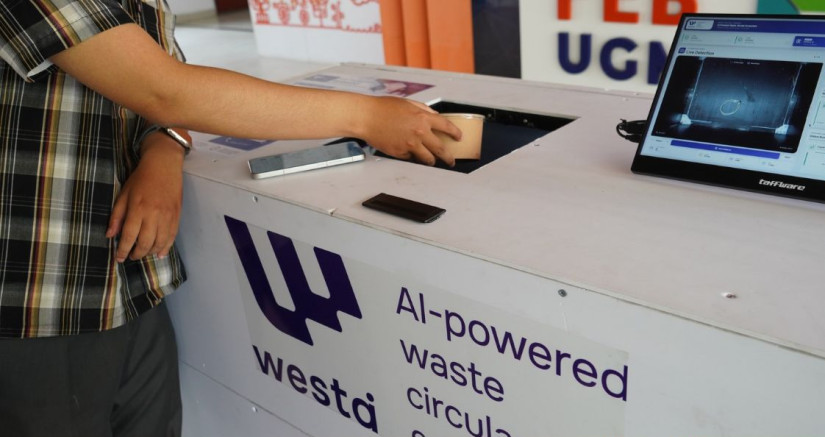
UGM Faculty of Economics and Business (FEB UGM) Department of Management lecturer Luluk Lusiantoro developed Smart Waste Bin, an artificial intelligence (AI)-powered waste sorting device capable of identifying and sorting waste. The device is designed to generate data on waste types and weight, map locations, and calculate carbon emissions.
Luluk explained that Smart Waste Bin is one of the devices in the WESTA (AI-Powered Waste Circular Ecosystem) ecosystem. The device is intended to minimize errors in waste sorting that commonly occur when sorting is done manually.
“We often find that waste is still sorted incorrectly even when separate bins for organic, inorganic, and residual waste are provided. We want to minimize these errors using AI, so users only need to put their waste into the smart bin. The AI will then sort it automatically,” he explained on Monday (October 5).
Smart Waste Bin, developed in collaboration with Qubit Instrument (CV Bumi Lestari), is currently designed to recognize three waste categories: organic, inorganic, and residual waste.
Going forward, the classification will expand so the device can recognize more waste types, including hazardous and toxic materials (B3).
The Smart Waste Bin does not operate independently, but it is also integrated with the WESTA application. This integration displays waste-identification data on the device’s screen and through a mobile application currently under development and being prepared for release on the Google Play Store.
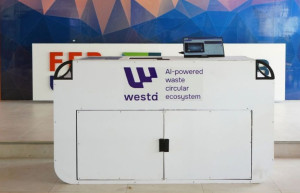
Through the system, users can obtain information about the identified waste type, estimated weight, estimated carbon emissions, location, and even the product brand found in the waste. This information is an important part of WESTA because waste data can identify waste-generation patterns and support data-driven waste management.
“Why is the brand important? Because we can later provide this data to companies whose products generate waste in the community. Hopefully, this can support the principle of Extended Producer Responsibility, in which producers are also responsible for the waste generated by their products,” Luluk said.
The device is not only intended to help communities sort waste more accurately. The data generated can also support a circular-economy ecosystem by linking waste information to the parties that produced the corresponding products.
The Smart Waste Bin connects to the WESTA application through Bluetooth Low Energy (BLE). Users can connect the application to the device, insert waste, and allow the system to scan and send the detection results. The results include the waste category, estimated weight, and carbon footprint reduction in kilograms of CO₂e.
Luluk added that the device is also being developed to support an incentive system, particularly for waste with economic value, such as plastic bottles.
Identified waste that enters the waste management chain can be converted into points, providing users with additional incentives to sort and manage waste.
“The feature for exchanging points for rewards is currently still under development,” he explained.
The development of Smart Waste Bin is part of the 2026 Innovation Development Grant (HPI) program, which aims to scale up WESTA into a system ready for operational testing. The ecosystem integrates the Smart Waste Bin device, the Mobile Waste Scanner mobile application, and an enterprise dashboard for managing and analyzing waste and carbon footprint data.
The development of the Smart Waste Bin device has also entered the integration stage. As of August 2026, the electronic installation had been completed, and by August 18, all device functions were operating in an integrated manner with the application and AI model.
As part of the development process, WESTA is planned to undergo trials within FEB UGM. The next stages of development include optimizing the AI model, integrating four waste classes, including B3, into the hardware, testing accuracy and stability, and conducting usability testing.
By integrating devices, applications, AI, and data analytics, WESTA is being developed to establish a waste management system that goes beyond disposal and sorting by generating data to support decision-making and the development of a circular economy.
Reporter: Kurnia Ekaptiningrum/FEB Public Relations
Editor: Gusti Grehenson
Post-Editor: Priyananda
Photo: FEB Documentation