


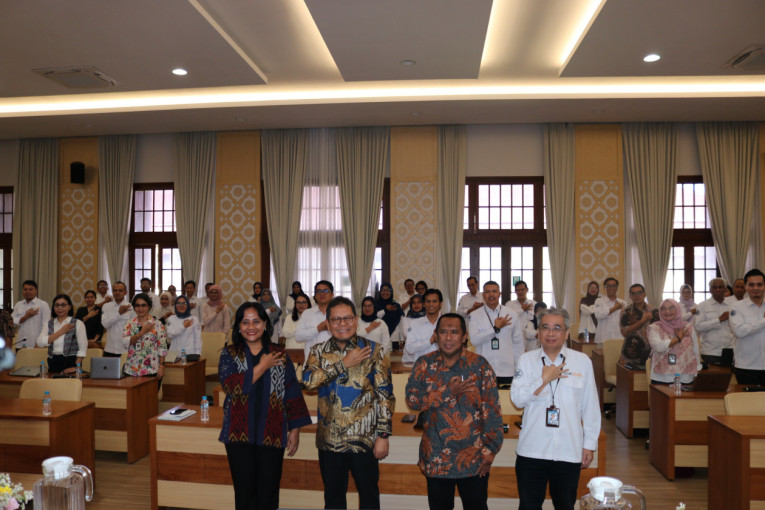
Professor Wening Udasmoro, Vice Rector for Education and Teaching at Universitas Gadjah Mada (UGM), said UGM graduates secure employment on average within 2.9 months after graduation. Graduates from health-related disciplines require even less time, averaging 1.9 months.
“Based on our tracer study, UGM graduates secure employment within an average of 2.9 months after graduation, while graduates from the health sciences find jobs in just 1.9 months on average,” Professor Wening said during the Workshop on the Accreditation Mechanism for Higher Education Institutions and Study Programs Under Ministerial Regulation No. 39 of 2025, organized by the University Quality Assurance and Reputation Unit (SPMRU) on Monday (Jun. 29) at the UGM Central Office Building.
According to Professor Wening, graduates’ job-waiting time reflects the quality of higher education, as demonstrated by their achievements in the workforce. The degree to which graduates’ jobs align with the competencies acquired during their studies is another important indicator. For example, 87.7 percent of graduates from engineering disciplines are employed in positions that match their academic qualifications.
“These figures did not emerge by chance. They reflect the hard work of our faculties, study programs, lecturers, educational staff, and students, who uphold the quality of UGM’s tri-dharma every day,” she said.
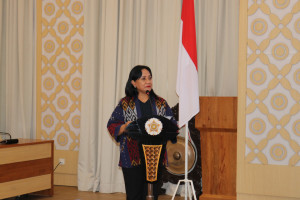
Professor Wening noted that graduates’ reputation in the workplace is an important factor in global university reputation rankings. According to her, UGM’s achievements in various international rankings result from the university community’s collective commitment to continuously fostering a culture of quality.
This year, UGM climbed 18 places in the QS World University Rankings, rising from 224th to 206th. Over the past three years, the university has also improved its position in the Times Higher Education (THE) Impact Rankings, moving from 81st to 41st, reflecting its contributions to sustainable development.
“These achievements are certainly encouraging, but what matters most is the quality behind them. Rankings reflect how consistently we manage education, research, community service, and student support,” Professor Wening said.
To further improve educational quality, Professor Wening said UGM supports the government’s initiative to transform the national accreditation system through the newly issued regulation.
“UGM is encouraging all units to prepare for implementing a quality assurance system that can adapt to the evolving landscape of higher education,” she said.
Professor Indra Wijaya Kusuma, Head of UGM’s University Quality Assurance and Reputation Unit, who moderated the discussion, said the workshop provided an important opportunity for all university units to understand the direction of Indonesia’s new higher-education accreditation system.
He emphasized the need for early preparation, as UGM is scheduled to undergo institutional accreditation in 2027 using the latest accreditation instrument. Currently, approximately 84 percent of UGM’s study programs have achieved the highest national accreditation status, either Unggul (Excellent) or Grade A, and continuous quality improvement remains a priority.
“We want everyone across UGM to have the same understanding. When the new accreditation instrument is implemented, what we prepare should not merely be documentation but a quality assurance system that truly operates in practice,” he said.
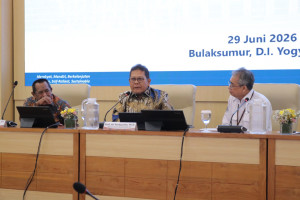
Professor Ari Purbayanto, Executive Director of the National Accreditation Board for Higher Education (BAN-PT), explained that Ministerial Regulation No. 39 of 2025 replaces Ministerial Regulation No. 53 of 2023 on Higher Education Quality Assurance and serves as the legal foundation for improving the national accreditation mechanism.
The regulation introduces the 2025 National Accreditation System (SAN 2025), which streamlines the assessment framework from nine criteria to four core areas: quality culture, relevance, accountability, and mission differentiation. Accreditation status has also been simplified into three categories: Accredited, Excellent Accredited (Terakreditasi Unggul), and Not Accredited, based on compliance with the National Higher Education Standards.
“These changes are intended to ensure that accreditation genuinely measures the quality of higher education delivery rather than merely assessing administrative completeness,” Professor Ari said.
Professor Ari added that the new accreditation system places greater emphasis on the effectiveness of each institution’s Internal Quality Assurance System (SPMI). Assessment will no longer depend on the volume of documents prepared before an evaluation but on the consistent implementation of education, research, and community service, as well as their measurable impact on society and industry. He stressed that every university must also establish a clear development strategy aligned with its distinctive mission and strengths.
“What we assess is whether the quality assurance system is genuinely embedded in the university’s daily operations and whether it produces demonstrable impact,” he said.
He further noted that the regulatory changes serve as a reminder that a university’s reputation must be built upon continuous quality improvement. Higher education institutions must continually adapt to advances in science and technology, as well as the evolving needs of society and industry, to remain competitive. In this context, accreditation functions not only as an evaluation mechanism but also as an instrument for strengthening institutional quality.
“If we believe our current achievements are sufficient and stop improving, both the quality and reputation of our universities may decline,” he warned.
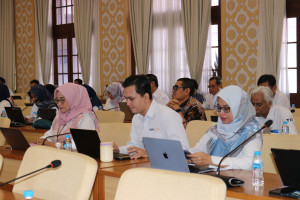
In the following session, Professor Slamet Wahyudi, a member of the BAN-PT Executive Board, presented the implementation of the Higher Education Institution Accreditation Instrument (IAPT) 4.1 and SAPTO 2.0 as operational tools for the new accreditation system. He explained that the assessment indicators are designed to evaluate the relationship between inputs, processes, outputs, outcomes, and the impact of universities’ tri-dharma activities. The system also utilizes integrated higher education databases, making the assessment process more objective and efficient.
Professor Slamet explained that accreditation now centers on four main criteria: quality culture, relevance, accountability, and mission differentiation. Every university is expected to maintain an integrated information system that consistently documents both academic and non-academic data. These data serve as the foundation for evaluating the effectiveness of education, research, and community service while measuring universities’ contributions to society.
“Good data are not data compiled shortly before accreditation but data that are consistently maintained as part of an institution’s quality culture,” Professor Slamet emphasized.
Concluding his presentation, Professor Slamet encouraged universities to view the regulatory changes as an opportunity to strengthen their quality assurance systems. He expressed confidence that a consistently cultivated quality culture would lead to greater public recognition, stronger competitiveness, and an enhanced institutional reputation at both the national and international levels. According to him, successful accreditation is ultimately the result of maintaining quality every day.
“When a culture of quality becomes a habit, accreditation is no longer a burden but a reflection of the university’s true quality,” he concluded.
Author: Triya Andriyani
Post-editor: Priyanandaningrat
Photo: Jessi