


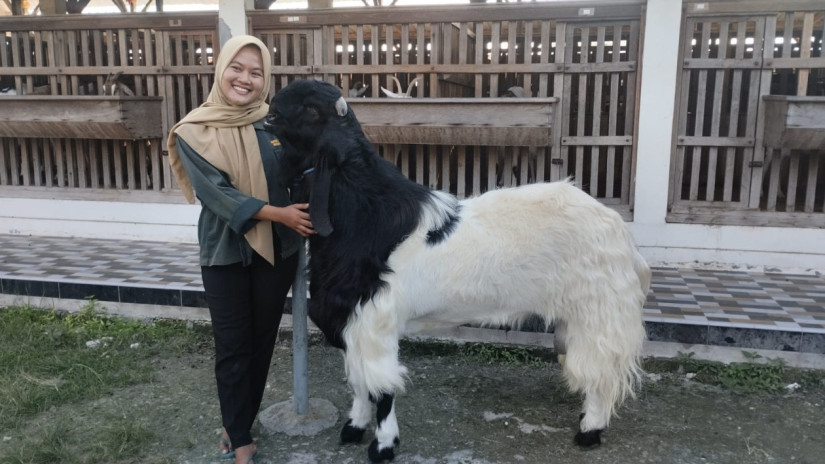
Before turning 28, Mila, a 2021 graduate of the Faculty of Animal Science at Universitas Gadjah Mada (Animal Science UGM), had successfully established a modern livestock enterprise called Kerabat Ternak 1-3, which is now widely recognized across East Java.
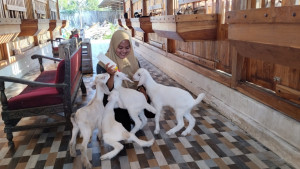
Despite the common perception that livestock farming is a male-dominated profession with limited economic prospects, Mila has proven otherwise. Together with her husband, Sahroni, she has developed a goat and sheep farming business with multiple business lines, including livestock fattening, breeding, dairy production, and the sale of livestock production supplies (sapronak). What began as a modest venture has grown into a business generating hundreds of millions of rupiah in revenue.
Mila’s journey was far from easy. When she decided to enroll at the UGM Faculty of Animal Science, her family initially questioned her choice. However, their doubts became her motivation to prove that livestock farming could be both a rewarding profession and a meaningful way to serve the community.
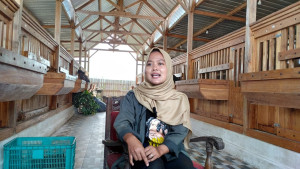
“My family was initially unsure when I chose to study animal science,” Mila recalled during an interview at the Kerabat Ternak farm in Tuban, East Java, on Monday (Jun. 29).
Born on Jan. 1, 1999, into a modest family, with a father working as a timber entrepreneur and a mother who was a homemaker, Mila developed a strong work ethic and independence from an early age. Her interest in livestock farming began during her teenage years. Long before becoming a university student, while still in her second year of senior high school in 2014, she started raising five sheep, laying the foundation for the business that has since grown significantly.
After graduating from Animal Science UGM in 2020, Mila decided to devote herself fully to livestock farming. The knowledge she gained during her studies became a strong foundation for building her business. She said her education emphasized not only theory but also practical training and field experience relevant to the livestock industry.
“At Animal Science UGM, we learned not only theory but also practical skills and field experience. That has been incredibly valuable now that I’m running my own business,” she said.
During her university years, Mila actively expanded her knowledge by learning directly from lecturers, industry practitioners, and experienced livestock farmers across Indonesia. She believes success in livestock farming comes from combining scientific knowledge with hands-on experience.
“Theory is important, but it’s not enough. You have to get into the field directly,” she said.
Her entrepreneurial journey was not without setbacks. Mila experienced financial losses when some of her livestock died. However, she treated every case as an opportunity to learn, carefully investigating the causes to prevent similar incidents in the future. Those experiences deepened her understanding of livestock health management, from pneumonia caused by temperature changes to various infectious diseases that commonly affect goats and sheep.
Today, Kerabat Ternak 1-3 has grown into a modern livestock enterprise that prioritizes not only herd size but also animal quality and welfare. In addition to maintaining clean housing facilities, Mila carefully manages feed, using approximately 1.5 hectares of forage land supplemented with tofu pulp and dried water spinach to meet the animals’ nutritional needs.
Rather than focusing solely on increasing livestock numbers, Mila prioritizes improving animal quality and genetics. This strategy has significantly increased the value of her livestock. Premium-quality goats are sold for between Rp16 million and Rp23 million each, while local breeds are priced between Rp3 million and Rp5 million. In addition to supplying livestock for qurban and aqiqah, Kerabat Ternak also markets livestock production supplies, including milk replacers for young goats, vitamins, and various farming equipment, which are distributed throughout several regions in East Java.
The Eid al-Adha season marks one of the busiest periods for the business. During the two months leading up to the 2024 Qurban season, Kerabat Ternak recorded revenues ranging from Rp500 million to Rp700 million. Outside the festive season, its aqiqah services, livestock breeding, milk sales, and livestock production supplies generate around Rp50 million in monthly revenue, with an additional Rp75 million coming from livestock production equipment sales. Its market continues to expand to Lamongan, Bojonegoro, and other parts of East Java.
Beyond managing her business, Mila has actively shared her knowledge through TikTok since 2023. Her educational content introduces modern livestock farming practices and highlights the importance of applying scientific knowledge and practical skills to manage a successful livestock enterprise.
Kerabat Ternak has also created positive social impacts within the local community. Mila and her husband currently employ two staff members and actively support community livestock groups. One beneficiary is Erma, a member of one of the assisted livestock groups, who said Kerabat Ternak has been especially helpful in marketing goat milk and improving farmers’ knowledge.
“I no longer have to worry about selling my goat milk. I’ve also learned so much through the livestock group and from Kerabat Ternak,” she said.
A similar experience was shared by Agung Setiawan, a vocational student from SMK Negeri 4 Bojonegoro, completing his industrial internship at Kerabat Ternak.
“I’ve gained so much knowledge during my internship here,” he said.
For Mila, business success is measured not only by financial gains but also by the ability to create learning opportunities, empower communities, and provide sustainable livelihoods for local people. What began with five sheep during her high school years has grown into an inspiring example of modern livestock farming driven by scientific knowledge, practical experience, and community empowerment.
Her determination to challenge stereotypes, resilience in overcoming setbacks, and consistency in building her business make Mila an inspiration for young people, especially women. She has demonstrated that the livestock sector offers promising career opportunities and provides a meaningful space for women to thrive. Behind the livestock barns lies a story of courage to dream, resilience in the face of failure, and a belief that livestock farming is not merely a profession but a calling that can improve people’s livelihoods.
Reporter: Satria, Faculty of Animal Science Public Relations
Author: Cyntia Noviana
Editor: Gusti Grehenson
Post-Editor: Priyanandaningrat
Photo: Courtesy of Faculty of Animal Science Public Relations