


Biomaterials are emerging as a promising approach to addressing the limitations of conventional bone grafts in treating bone damage and supporting bone reconstruction. One material with considerable potential for this purpose is hydroxyapatite (HA), a ceramic compound whose composition resembles the primary mineral found in bones and teeth.
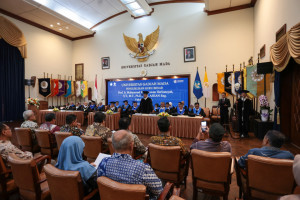
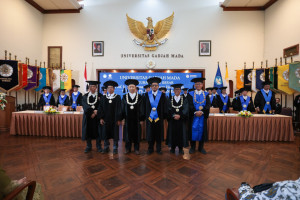
At the UGM Senate Hall, UGM Central Office, on Thursday (Nov. 5), Professor Muhammad Kusumawan Herliansyah explained during his inauguration speech as a professor in Materials Processing Technology entitled “Pengembangan Material Hidroksiapatit untuk Aplikasi Biomaterial” (“Development of Hydroxyapatite Materials for Biomaterial Applications”) that hydroxyapatite has the potential to serve as an alternative material for supporting bone tissue repair and regeneration.
Bone grafts play an important role in promoting fracture healing, bone fusion in joints, and the regeneration of bone lost due to trauma or infection. Based on this research, these materials function by filling defects in damaged bones and providing a scaffold for new bone growth, which can gradually be replaced by natural bone tissue.
The treatment of bone defects has traditionally relied on natural bone grafts, including autografts, allografts, and xenografts. Autografts, which are obtained from a patient’s own body, offer biological advantages because they contain cells and growth factors that support bone formation.
However, their use remains limited because they require an additional surgical procedure, potentially increasing costs and the risk of complications at the donor site.
Meanwhile, allografts, which are obtained from human donors, and xenografts, which come from other species, also have limitations, including the risks of immune rejection and pathogen transmission. These challenges have encouraged the development of synthetic materials as alternatives for bone reconstruction.
“In this regard, hydroxyapatite is the most suitable ceramic material for implants intended to replace hard tissue,” he said.
He explained that hydroxyapatite has good biocompatibility with body tissues and can bond directly with bone. These characteristics make it a promising material for bone repair and augmentation. However, its relatively brittle mechanical properties mean it is not yet ideal for applications that require the ability to withstand heavy loads.
One approach is to fabricate porous materials. An interconnected pore structure is essential for supporting cell penetration, nutrient transport, and the formation of blood vessels and new bone tissue.
“The material should not merely fill the damaged part of the bone but also provide an environment that supports the regeneration process,” he added.
In addition to developing porous structures, developing hydroxyapatite-based composites is another approach to improving material strength and toughness while maintaining control.
Incorporating other materials into a hydroxyapatite matrix can improve its mechanical strength. Nevertheless, composite development must balance strength, biocompatibility, and the material’s ability to undergo biological degradation.
“Reinforcing HA with bioinert materials requires careful consideration of the balance between mechanical properties and bioactivity, as well as the compatibility of the implant’s elastic modulus with that of bone, to avoid increasing the load borne by the implant,” he explained.
Through studies of the structure and properties of natural hard tissues, as well as various fabrication methods for pure and composite hydroxyapatite, the development of hydroxyapatite materials is expected to contribute to bone graft materials for biomedical applications.
“This research is expected to address several gaps in the literature and provide further insights into the development and fabrication of hydroxyapatite bone grafts for biomedical applications,” he concluded.
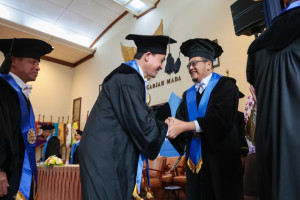
Following his inauguration, Professor Muhammad Kusumawan Herliansyah officially became one of the 546 active professors at Universitas Gadjah Mada. At the UGM Faculty of Engineering (FT UGM), Kusumawan is one of 94 active professors out of the faculty’s 118 professors.
Author: Agito Sitepu
Editor: Gusti Grehenson
Post-editor: Jasmine Ferdian
Photographs: Donnie