


Indonesia faces a paradox: it is an agrarian country endowed with abundant and diverse natural resources. However, it continues to grapple with hidden hunger and malnutrition among certain segments of the population.
According to Statistics Indonesia (BPS) data in 2024, rice, as Indonesia’s primary staple food, is still imported in quantities exceeding 3 million tons per year. A high reliance on food imports can erode people’s purchasing power and threaten national stability.
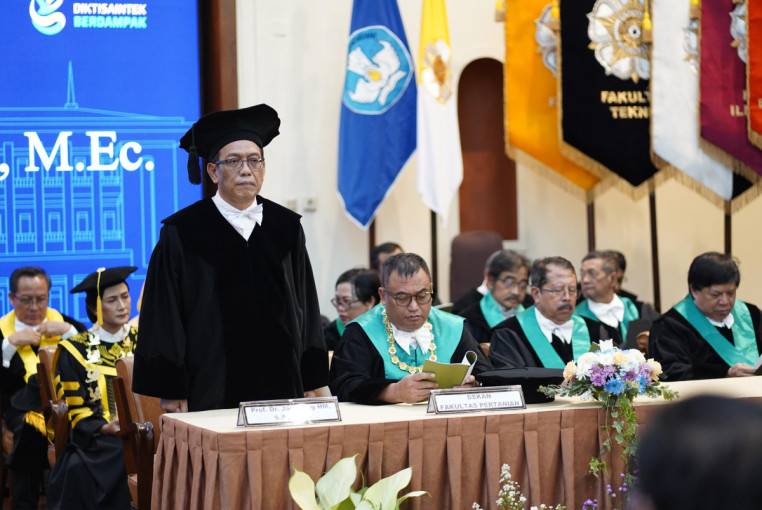
“Global staple food prices show an increasingly volatile trend. A surge in global food prices can quickly translate into domestic inflation,” explained Professor Jangkung Handoyo Mulyo of the Faculty of Agriculture, Universitas Gadjah Mada (Agriculture UGM) during his inauguration speech as a professor on Tuesday (Feb. 11) at the Senate Hall, UGM Central Office.
According to Professor Mulyo, food cannot be understood solely as an agricultural sector issue; it must be viewed as a macroeconomic and national stability issue. Law Number 18 of 2012 on Food clearly positions food security, food self-sufficiency, and food sovereignty as the main pillars within the national development framework.
However, the phenomenon of farm fragmentation indicates that national food production capacity rests on an increasingly weakened land tenure structure.
Meanwhile, the rate of agricultural land conversion, which reaches 120,000 hectares per year, has become a serious issue that must be addressed to achieve national food self-sufficiency. Data show that the rate of agricultural land conversion far exceeds the country’s capacity to develop new rice fields.
“This condition underscores a fundamental contradiction in national food development,” he said.
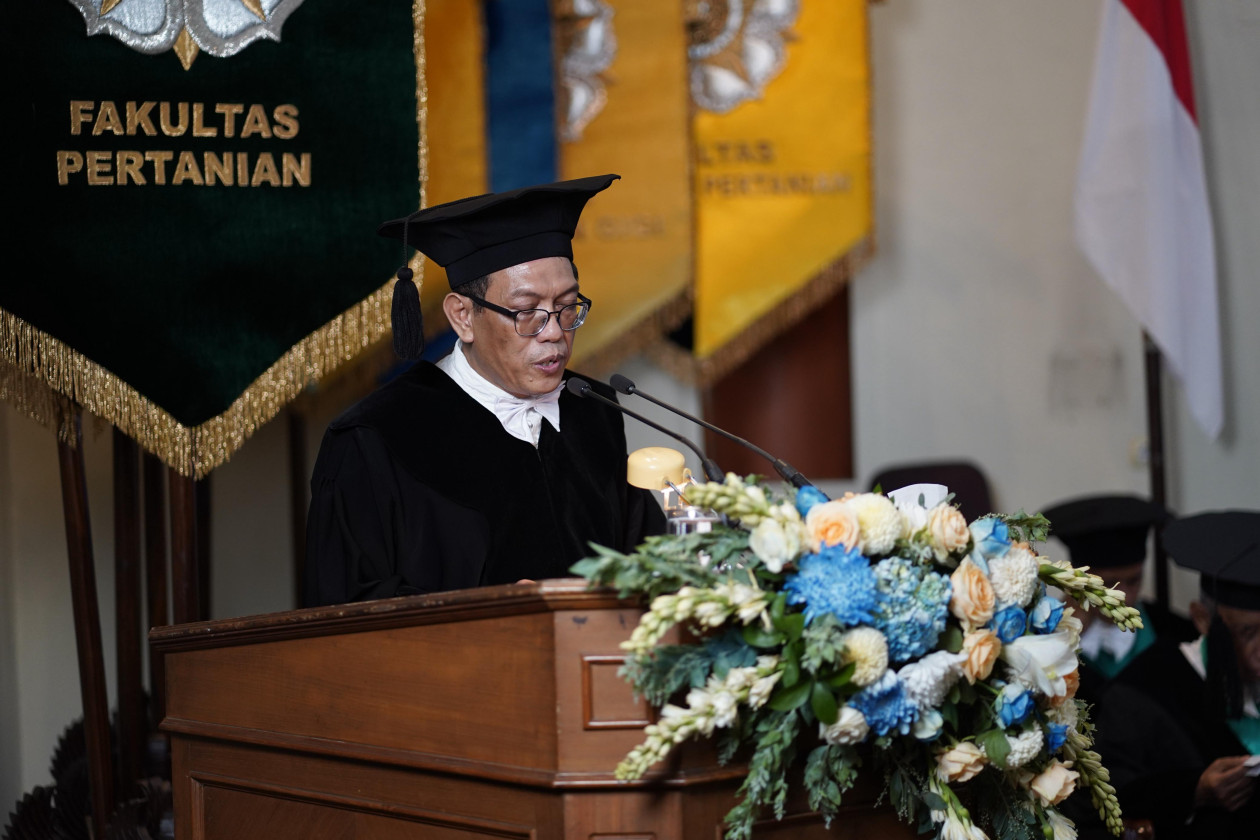
Increasing productivity is a rational choice when land expansion (extensification) faces limitations. However, when productivity is used as the primary indicator of food development success, we face an irony: productivity rises, yet many farmers’ welfare levels remain nearly unchanged.
“Food self-sufficiency without farmers’ self-reliance is merely pseudo self-sufficiency,” he stated.
Professor Mulyo further argued that food self-sufficiency alone is insufficient. A nation cannot be truly independent without food sovereignty. Sovereignty provides the state with policy space to determine the direction of its food system independently, protect farmers, and guarantee citizens’ fundamental right to food without external pressure.
“When import policies are reactive, unmeasured, and not integrated with strengthening domestic production, they risk leading us into a food trap,” he emphasized.
Ultimately, achieving food self-sufficiency must have a tangible impact on improving farmers’ welfare. However, data reveal a troubling paradox. In recent years, the agricultural sector has recorded relatively consistent productivity growth of 1.07% per year. Nevertheless, this increase has not been proportional to improvements in farmers’ welfare.
“We face a bitter reality: food productivity is increasing, but farmers’ welfare remains stagnant,” he said.
Farmers’ welfare is a multidimensional issue. Broader market access and improved distribution chain efficiency offer hope for strengthening farmers’ bargaining positions. However, these opportunities can only be realized if disparities in digital literacy and rural infrastructure are addressed equitably.
He added that all efforts to achieve food self-sufficiency must be carried out without neglecting environmental sustainability.
“Production increases that disregard ecosystem carrying capacity will ultimately weaken long-term welfare, as food production processes inevitably generate negative externalities,” he concluded.
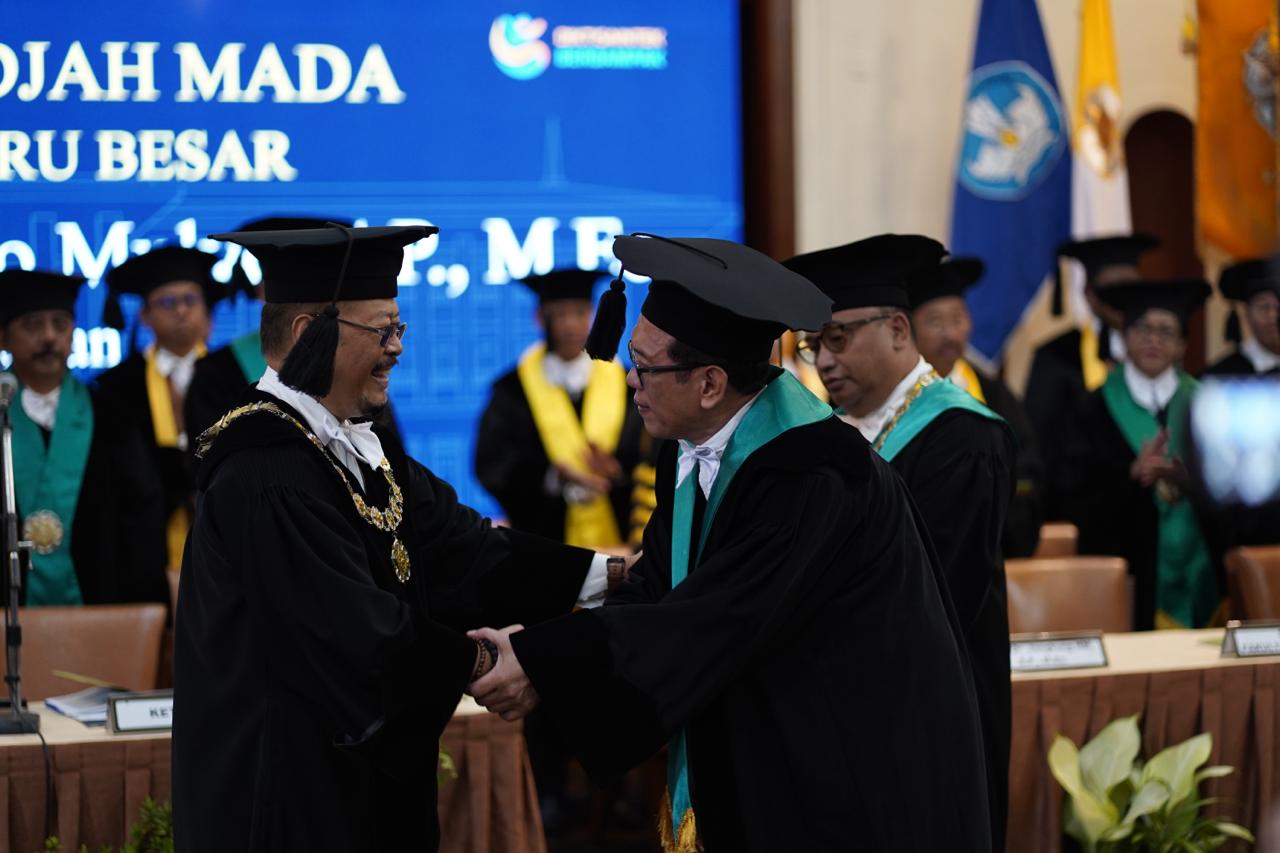
At the end of his speech, Professor Mulyo stated that the Indonesian nation must understand a fundamental principle: food issues are not merely about production and availability, but about how a nation manages the relationship among the state, the market, and its citizens.
“Food self-sufficiency provides the capacity to endure, food sovereignty provides the space to determine direction, and national welfare is the ultimate goal that gives meaning to all these efforts,” he concluded.
Chair of the Board of Professors, Professor Muhammad Baiquni, noted that Professor Mulyo is one of 543 active professors at UGM and one of 31 active professors out of the 65 professors the Agriculture UGM has had.
Author: Jelita Agustine
Editor: Gusti Grehenson
Post-editor: Rajendra Arya
Photographer: Firsto Adi