


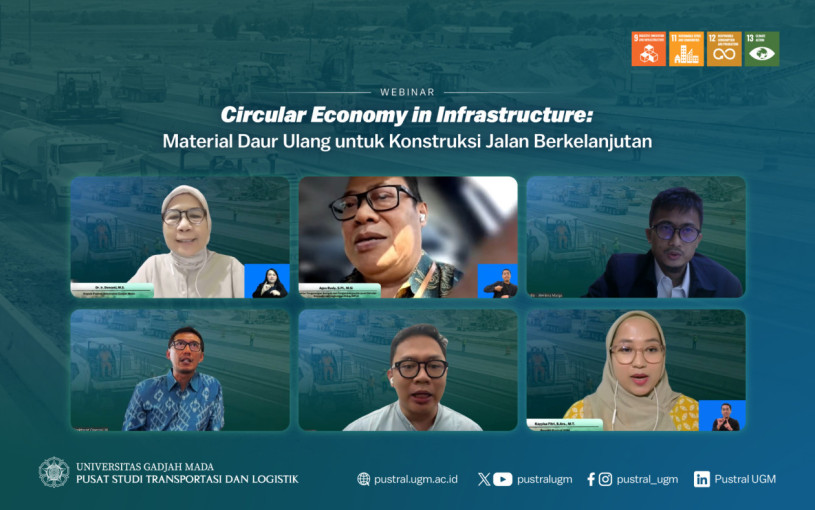
The Center for Transportation and Logistics Studies (Pustral) at Universitas Gadjah Mada (UGM), in collaboration with PT Hutama Karya, is promoting the implementation of a circular economy in toll road development as part of efforts to advance green infrastructure in Indonesia. The initiative was the focus of a national webinar titled Circular Economy in Infrastructure: Recycled Materials for Sustainable Road Construction, held online on Tuesday (Jul. 7). The webinar brought academics, government representatives, and industry stakeholders together to discuss strategies for utilizing recycled materials while addressing the challenges posed by Indonesia’s rapidly expanding infrastructure development. More than 1,700 participants from across the country joined the event via Zoom and YouTube.
The rapid expansion of toll road infrastructure over the past decade has significantly increased the demand for construction materials. At the same time, this intensified the exploitation of natural resources and generated growing volumes of construction waste under a linear economic model. Therefore, the Head of Pustral UGM, Dr. Dewanti, emphasized that the infrastructure sector must transition to a circular economy as part of sustainable development.
“The circular economy challenges us to redesign construction systems by eliminating waste from the planning stage and preserving the value of resources within the economic cycle for as long as possible,” said Dr. Dewanti.
Furthermore, implementing a circular economy in toll road development also requires adequate regulatory support and technical standards. Senior Road and Bridge Management Expert at the Directorate of Toll Roads, Ministry of Public Works, Dr. Alfa Adib Ash Shiddiqi, explained that the government is encouraging the use of environmentally friendly alternative materials in National Strategic Projects, provided they meet quality and safety standards. According to Dr. Alfa, developing technical guidelines and updating specifications are essential to enable broader adoption of these innovations.
“The use of recycled materials must always be supported by precise technical validation without compromising infrastructure quality or safety,” he said.
In addition to improving material efficiency, the circular economy is also viewed as a solution to Indonesia’s waste management challenges. Agus Rusly, Director of Waste Reduction and Circular Economy Development at the Ministry of Environment, stated that low-value plastic waste and used tires have significant potential as road-construction materials. Their utilization can reduce the burden on landfills while increasing the value of waste through infrastructure development.
“The infrastructure sector can become a major off-taker of waste, allowing road construction to contribute to solving Indonesia’s waste management challenges,” said Rusly.
The circular economy concept has been implemented by PT Hutama Karya in the construction of the Trans-Sumatra Toll Road, with 1,145 kilometers of completed sections as of May 2026. Director of Operations III at PT Hutama Karya, Iwan Hermawan, presented the company’s sustainability initiatives, built on four pillars: material innovation, energy efficiency, digital construction, and circular asset management. These innovations include the use of locally produced White-100 Thermoplastic Road Marking, hollow column technology, the conversion of Asphalt Mixing Plants to compressed natural gas (CNG), and the adoption of Building Information Modeling (BIM) 7D and artificial intelligence. These technologies have improved construction efficiency while supporting carbon emission reduction efforts in toll road development.
From the academic perspective, Pustral UGM expert team member and lecturer at the UGM Department of Civil and Environmental Engineering, Taqia Rahman, Ph.D., presented research findings on the performance of recycled materials for road construction. Based on a series of tests, waste-derived materials such as plastic and rubber were found to improve the physical properties of asphalt, making it more resistant to deformation caused by heavy traffic loads and high temperatures. The findings demonstrate that recycled materials can serve as reliable construction alternatives when designed according to their technical characteristics.
“For example, asphalt modified with certain plastic waste mixtures has been shown to have a higher softening point. This means the pavement is more resistant to deformation, or rutting, caused by heavy vehicles and tropical temperatures,” explained Rahman.
The discussion, moderated by Pustral UGM researcher Kayyisa Fitri, featured active participation and valuable input on implementing circular economy principles in the infrastructure sector. The forum produced several strategic recommendations to support the development of Indonesian National Standards (SNI) and more environmentally sustainable road construction policies. Collaboration among universities, government institutions, and industry was identified as the key to accelerating the adoption of recycled materials in national infrastructure projects. Through this synergy, the circular economy is expected to support the realization of more sustainable infrastructure development while contributing to Indonesia Green 2045.
Reporter: Dwi Ardianta Kurniawan (Pustral UGM)
Author: Triya Andriyani
Post-editor: Jasmine Ferdian