


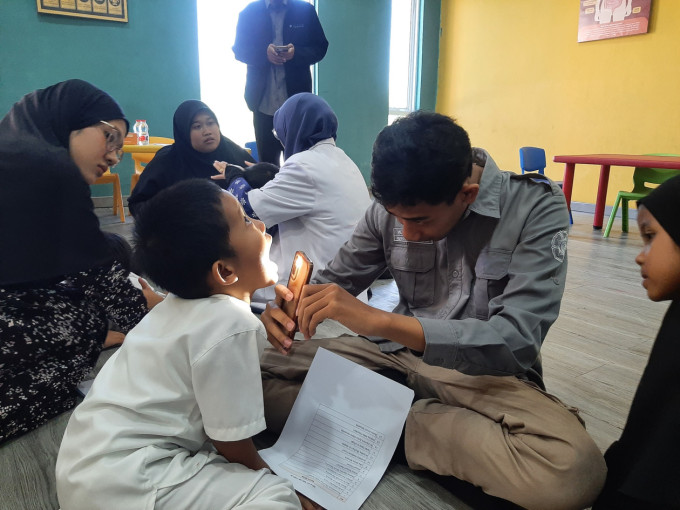
A team of researchers at Universitas Gadjah Mada (UGM) has developed an Artificial Intelligence (AI)-based dental health screening platform. The innovation, named Denteksi, requires only photos taken from multiple angles using a smartphone camera, which are then analyzed to assess a patient’s overall dental health. The platform has achieved an accuracy rate of up to 90 percent for healthy teeth screening, while caries screening accuracy exceeds 80 percent.
Muhammad Fakhurrifqi, a lecturer in the Software Engineering Technology Program at UGM Vocational College (SV UGM), explained that the idea for Denteksi was initiated in 2021 during the COVID-19 pandemic. At the time, large-scale social restrictions posed significant challenges for dental consultations and examinations, limiting direct interaction between dentists and patients.
Rifqi collaborated with two colleagues from Kebayoran Baru Community Health Center in South Jakarta. Together with two dentists, Dewi Arifahni and Dhinintya Hyta Narissi, he initially developed a teledentistry service using a chat-based application that enabled patients to consult with dentists remotely. As user demand increased, the team advanced the system by integrating computer vision technology.
These improvements included reducing the number of required images to three angles, adding standardized photo-taking guidelines, and developing an odontogram feature that provides medical records and treatment recommendations for patients. The latest version, released earlier this year, also incorporates additional algorithms to enhance reporting accuracy.
“Previously, dental check-ups required in-person visits and manual examinations. With Denteksi, users only need to take photos from the front, top, and bottom, and the results are generated instantly. The current version includes algorithms that produce odontograms, identifying tooth positions, conditions, and generating reports with significantly higher accuracy,” he explained on Tuesday (April 28).
Rifqi stated that the platform has achieved an accuracy rate of 90 percent for healthy dental screening, while caries detection accuracy exceeds 80 percent. However, he emphasized that AI systems still operate below professional standards in many fields, making expert validation essential for further treatment decisions.
“Experts have generally welcomed and supported this innovation. However, screening is only intended for early detection. Patients still need to consult a dentist for further treatment. A definitive diagnosis still requires professional expertise,” he said.

Since its official launch in August 2022, Denteksi has received recognition from various innovation competitions and institutions. It won the Healthcare Service Quality category at the Indonesia Health Innovation Award (IHIA) 2022 and secured first place at the 2022 Jakarta Provincial Quality Convention.
In the following year, Denteksi further strengthened its presence by receiving the Jakarta Innovation Awards (JIA) 2023, organized by the Jakarta Provincial Development Planning Agency (Bappeda) in September 2023.
These achievements reflect the platform’s credibility and impact. Denteksi’s intellectual property is managed under PT Senyum Cerdas Indonesia. In practice, the platform can screen approximately 100 children within a three-hour session.
Several organizations have collaborated in implementing screening programs, including the Indonesian Dental Association Flores Branch, Gistrav Islamia School Foundation, and the Kebayoran Baru Community Health Center in South Jakarta. Although institutional partnerships remain limited, the platform is publicly accessible via its official website.
As the initiator, Rifqi stated that the team remains open to collaboration with various stakeholders. Recognition from experts further highlights Denteksi’s potential as a future AI assistant that can support dental professionals and help address the limited number of dentists in Indonesia, ultimately contributing to improved dental health outcomes.
Author/photo: Ika Agustine
Editor: Gusti Grehenson
Post-editor: Zahra