


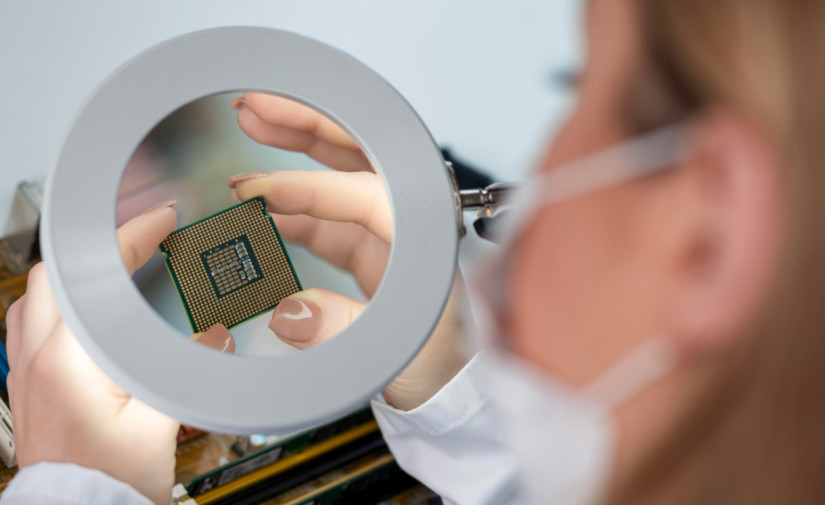
Artificial Intelligence (AI) technology is not merely a trend but a technological revolution shaping human life. Its application has expanded beyond information and communication technology to industry, healthcare, and agriculture. Scholars at Universitas Gadjah Mada (UGM) are intensifying studies on the use of AI in industry and its benefits for everyday life.
UGM scholars have also mapped potential AI research collaborations to be pursued under cooperation schemes with industry partners. Research collaboration on Artificial Intelligence (AI) innovation at UGM is being carried out with strategic industry partners, including NVIDIA, Indosat Ooredoo Hutchison, and Telkom Indonesia.
In the field of agriculture, UGM scholars are developing smart agriculture systems through the application of AI. One of them, Dr. Andri Prima Nugroho, a lecturer in Agricultural Informatics at the UGM’s Faculty of Agricultural Technology (FTP UGM), explained that AI technology can be applied in various agricultural schemes.
These include supporting fertilization models tailored to local wisdom, adjusting crop needs through sensors, and creating fully controlled agricultural environments.
Dr. Nugroho explained that fertilizer dosage requirements are not purely mathematical or uniform across crops but must be adapted to plant characteristics and established local practices.
“Plant needs can be directly detected using sensors and thermal cameras to identify the Crop Water Stress Index (CWSI). This is not intended to eliminate stress, but to maintain it at a measurable level so that crops remain productive and develop optimally,” Dr. Nugroho said in a statement issued on Thursday (Feb. 5) following discussions on mapping AI research potential at UGM.
The use of AI can also be applied to indoor farming by controlling light exposure to mimic natural light rhythms that follow sunrise and sunset patterns.
“This is done so that plants are not ‘shocked,’” he explained.
Meanwhile, Dr. Wiwit Suryanto, a Seismic Exploration Researcher from the UGM’s Faculty of Mathematics and Natural Sciences (FMIPA UGM), explained that the research team is also utilizing AI in fiber-optic cables as sensors for various monitoring and security purposes. According to him, fiber-optic cables can function like “microphones” or vibration sensors along their entire length.
“This technology enables real-time data collection from existing infrastructure without the need to install thousands of new sensors, making it far more efficient,” he said.
In addition, fiber-optic cables can be used for tsunami and earthquake mitigation by detecting vibrations, identifying vessel types and engine vibration characteristics, and preventing damage to undersea cables caused by ship anchors through early warning systems.
“When a vessel approaches or becomes entangled, activities such as illegal fishing or other unlawful actions near borders can be detected,” he added.
According to Dr. Suryanto, one of the system’s advantages is its ability to detect vibrations from large fish or sounds within the earth. Its monitoring range is also extensive, reaching up to 100 meters from the cable. This ongoing research is supported by partners from France and is currently being validated using seismographs.
For him, AI plays a crucial role in processing the massive volume of vibration data to determine whether an earthquake, a vessel, or large marine animals such as whales caused the event.
“We can obtain real-time data from what is happening in Indonesian waters,” he concluded.
Author: Leony
Editor: Gusti Grehenson
Post-editor: Rajendra Arya
Illustration: Freepik