


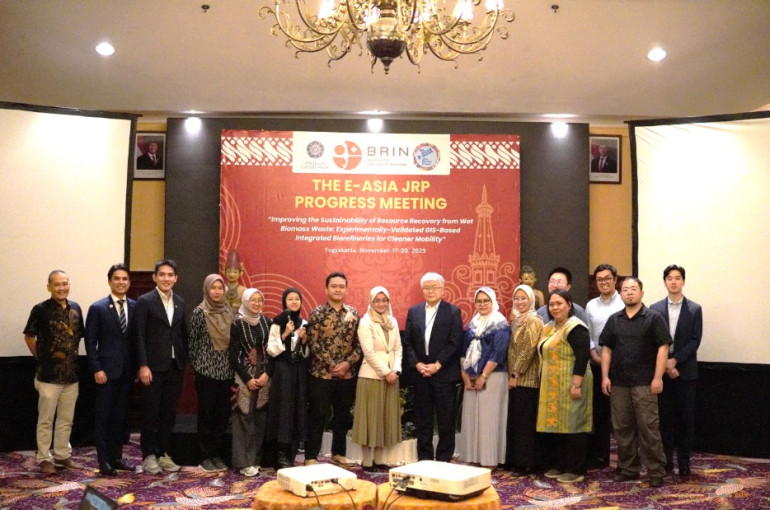
The worsening waste crisis in Yogyakarta has drawn the attention of Universitas Gadjah Mada (UGM), prompting the university to take part in efforts to deliver evidence-based solutions. The temporary closure of the Piyungan Final Disposal Site (TPA) has been identified as one of the factors exacerbating waste management challenges in Yogyakarta City. In response to this situation, researchers from the UGM Faculty of Engineering (FT UGM) continue to strengthen their contribution to developing waste management systems in the Special Region of Yogyakarta (DIY).
The research team, led by Dr. Hanifrahmawan Sudibyo, received funding on 25 April 2025 through the e-ASIA Joint Research Program (e-ASIA JRP) to conduct a three-year multinational research project in collaboration with partners from Japan (Waseda University), Thailand (Chulalongkorn University and ENTEC), and the Philippines (Mindanao State University – Iligan Institute of Technology).
The research, titled Improving the Sustainability of Resource Recovery from Wet Biomass Waste: Experimentally-Validated GIS-Based Integrated Biorefineries for Cleaner Mobility, was officially announced by e-ASIA JRP on 13 December 2024.
The project focuses on the management of wet biomass, including the organic fraction of municipal waste.
Against the backdrop of Yogyakarta’s waste challenges, the study combines geospatial modeling, laboratory experiments, and the design of integrated biorefinery systems to enhance resource recovery from organic waste.
Dr. Sudibyo explained that one of the key focuses of the project is geospatial mapping to determine optimal locations for waste collection depots, transportation routes, and processing units.
The analysis considers waste generation, composition, land availability, energy consumption, emissions, and safe distances from residential areas.
“Initial findings show that Piyungan has been designated as the final waste processing site for DIY, allowing the analysis to focus on optimizing routes and collection points. The research team is also developing a series of interconnected biochemical and thermochemical processes to maximize resource recovery,” he said at UGM on Monday (Nov. 24).
The technologies explored in the study include thermophilic anaerobic digestion, hydrolysate fermentation, catalytic hydrothermal liquefaction, membrane-based nutrient recovery, and wet oxidation.
This integrated system aims to produce methane-rich biogas, bioalcohols, biocrude oil, hydrochar, inorganic liquid fertilizers, and clean water.
As part of the research activities, the e-ASIA JRP team held a progress meeting on 18-19 November 2025 at The Phoenix Hotel Yogyakarta, following the kick-off meeting previously held in Bangkok in April 2025.
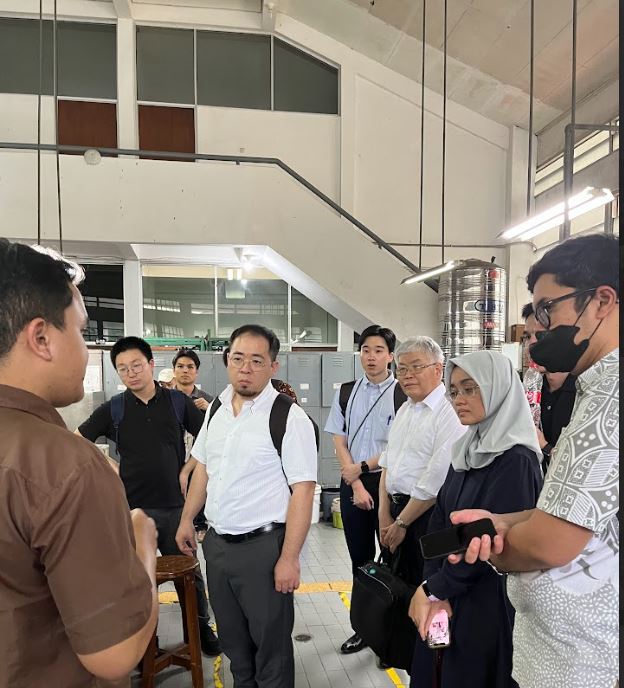
Dr. Sudibyo shared that the first day of the progress meeting included visits to TPS3R Bramamuda and TPST Tamanmartani to observe on-site waste sorting and processing practices.
The team later visited the Yogyakarta City Development Planning Agency (BAPPEDA) and discussed key challenges in urban waste management with its head, Agus Tri Haryono.
“One important finding is the designation of Piyungan as the final waste processing site for DIY. This allows the geospatial analysis to focus on optimizing transportation routes and identifying the most efficient collection depot locations,” Dr. Sudibyo said.
On the second day, representatives from each partner country presented research progress from five work packages (WP).
WP1, led by Professor Kazuaki Iwamura of Waseda University, focuses on Geospatial Modeling & Waste Allocation and presented the integration of satellite imagery and statistical data into the GGOD (Grid of Grids Optimization Designer) platform.
The following steps include constraint analysis to determine optimal routes, depot locations, and biorefinery points.
WP2, also from Waseda University and led by Dr. Liu Jiang, covers the Development of Automated Waste Collection & Sorting Systems.
The team has made progress in designing AI-based prototypes for waste transport and sorting.
However, further technological evaluation is needed, as the current system is only effective for dry plastic waste that has been pre-sorted at the household level.

Meanwhile, WP3, led by UGM Professor Wiratni Budhijanto and Dr. Jirasin Koonthongkaew, presented a study on the kinetics and mechanisms of biogas production from various substrate compositions using simplex centroid design.
The resulting regression model can predict kinetic parameters to determine retention time and digester size for continuous operation.
WP4, focusing on Thermochemical Processes & Membrane Separation, involves Dr. Hanifrahmawan Sudibyo, Dr. Lisendra Marbelia, and Dr. Bhumin Than-Ardna.
Their study examines integrating hydrothermal liquefaction with thermophilic anaerobic digestion to process food waste digestate.
Experiments will be designed using a mixture of organic macromolecules to ensure feedstock consistency.
Aromatic amine-modified membranes are also being developed to separate organic compounds from nutrients, producing liquid organic fertilizers.
Finally, WP5, Socio-Techno-Economic & Life Cycle Assessment, led by Dr. Andante Pandyaswargo, reported that the initial research stage focuses on a social survey involving multiple stakeholder groups as the basis for assessing the impacts of implementing geospatial-based integrated biorefineries.
Dr. Sudibyo added that the research team will reconvene in Tokyo, Japan, in 2026 for a follow-up workshop on GGOD platform operations, as well as demonstrations of automated sorting technologies and waste processing systems already implemented in Japan.
“We hope this collaboration will significantly contribute to improving the effectiveness of waste management in Indonesia and support the realization of cleaner, more sustainable mobility across Asia,” Dr. Sudibyo concluded.
Author: Jelita Agustine
Editor: Agung Nugroho
Post-editor: Lintang Andwyna