


Students from Universitas Gadjah Mada (UGM) who are members of a Student Creativity Program in the Creation and Innovation category (PKM-KC) developed Ostosense, an innovative smart medical belt designed to detect the risk of stoma bag leaks. A stoma is an artificial opening in the abdominal wall that serves as a passage for digestive waste, such as feces. The innovation was developed to help stoma patients address a common problem associated with stoma bags: leakage.
Stoma bag leaks can cause not only physical problems, such as irritation of the skin around the stoma and unpleasant odors, but also interfere with patients’ mobility and daily activities. The condition can even affect patients psychologically, causing anxiety or discomfort when engaging in activities outside the home.
Ostosense was developed by a program team led by Putri Eka Desintha, together with Hamzah Abdul Aziz from the Bachelor’s Program in Electrical Engineering, Markus Adytama Wisnumaya Nugraha Jati from the Applied Bachelor’s Program in Instrumentation and Control Engineering Technology, and Rasyadwa Arsya Irnantyanto and Marcellinus Dinoglide Yoga Prakoso from the Bachelor’s Program in Information Technology. The team developed the innovation under the supervision of faculty advisor Ir. Ridwan Wicaksono, S.T., M.Eng., Ph.D., IPM.
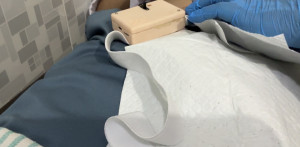
Ostosense Team Leader Putri Eka Desintha from the Bachelor’s Program in Nursing explained that the system is designed with two complementary detection pathways. The first uses a capacitive sensor and artificial intelligence (AI) processed locally on the device through edge AI to identify patterns indicating a risk of leakage before it occurs. The second uses an LIG-based resistive sensor as a fail-safe system that can still detect actual leakage if the AI model encounters problems.
“This innovation combines a predictive system based on capacitive sensors and local AI with a fail-safe system based on LIG resistive sensors. With this approach, the device not only detects leaks that have already occurred, but also identifies risk patterns before leakage occurs, allowing users to take preventive action earlier,” Putri explained on Thursday (October 1).
To ensure the innovation meets users’ needs, the team visited and held discussions with healthcare professionals who treat stoma patients. The team visited Griya Puspa Wound Care in Caturharjo, Sleman, Yogyakarta, and met with Indaryati, a clinical stoma care nurse and founder of Jogja Nursing Center.
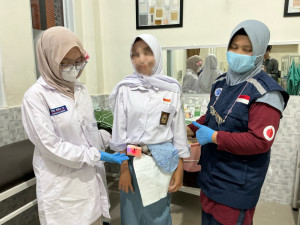
Healthcare professionals’ input became part of the Ostosense development process to ensure the technology could be adapted to patients’ everyday needs. The early detection system is expected to help colostomy patients recognize an increased risk of leakage so they can take preventive action before the leakage becomes more severe and reaches the baseplate.
Going forward, the PKM team hopes to continue developing the innovation into a useful, affordable, and easy-to-use device for patients who require a stoma. Further development is expected to expand Ostosense’s benefits by supporting patient independence and improving comfort during daily activities.
“We hope Ostosense can continue to be developed so that it can eventually become a useful and easy-to-use device while helping patients with digestive system disorders who require a stoma,” Putri concluded.
Author: Adinda Putri Rahma
Editor: Priyananda
Post-Editor: Priyananda
Photo: PKM Team