


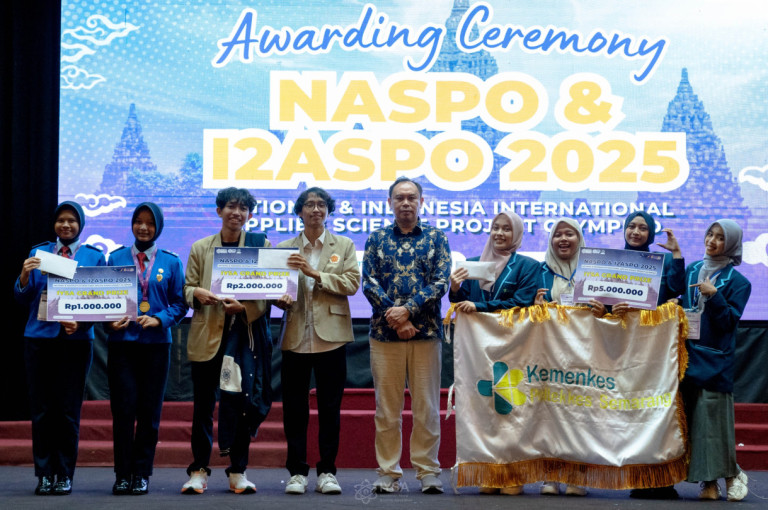
A team of Universitas Gadjah Mada (UGM) students achieved a remarkable accomplishment by winning the Gold Medal at the 6th Indonesia International Applied Science Olympiad (I2ASPO), held on Dec. 18 to 21, 2025, at the UGM Innovation and Creativity Hub (GIK UGM). The UGM team outperformed 629 participants from 13 countries in the prestigious competition.
The team consisted of Pandu Sukma Hastyadi, Samuel Khrisna Wira Waskita, and Aqila Dziki Muhamad Iqbal from the 2022 Chemistry Program, as well as Billy Natanael and Muhammad Radithya Akmal Rasheed from the 2023 Chemical Engineering Program.
Under the supervision of Dr. Fajar Inggit Pambudi, a lecturer from UGM’s Faculty of Mathematics and Natural Sciences (FMIPA UGM), the team successfully integrated computational and experimental approaches in their research.
As team leader, Pandu Sukma Hastyadi explained that the research focused on utilizing polyethylene terephthalate (PET) plastic bottle waste processed into activated carbon to adsorb atmospheric CO₂ gas.
The team introduced an innovation by developing Carbon Capture Technology (CCT) based on PET plastic waste materials.
“This innovation offers a more economical gas capture alternative compared to existing commercial technologies, which are still constrained by high operational costs,” he said when contacted on Monday (Jan. 19).
Hastyadi further emphasized that the development of low-cost adsorbents is crucial for the successful implementation of CCT, as high costs have long been a major barrier to its application.
“We see great potential in PET plastic bottle waste. With its high carbon content, PET waste is an ideal precursor for activated carbon,” he explained.
Team member Samuel Khrisna Wira Waskita noted that the decision to use PET plastic bottle waste was driven by the urgency of Indonesia’s suboptimal waste management issues.
“Around 48 percent of plastic waste is currently managed through incineration, which actually increases CO₂ emissions into the atmosphere,” he explained.
“In addition, the PET recycling rate in Indonesia is still relatively low, at only about 13 percent of its production capacity.”
He added, “For us, transforming this waste into a functional material for emission capture is a strategic step that benefits the environment.”
Billy Natanael explained that numerous studies have explored the use of plastic waste-based adsorbents for CCT applications. However, limited CO₂ adsorption capacity remains a major challenge. The research team found that incorporating zeolite could address this issue.
“Based on the references we reviewed, the formation of activated carbon–zeolite composites is indeed capable of overcoming this limitation,” he said.
The team’s supervising lecturer, Dr. Fajar Inggit Pambudi, emphasized that the research’s uniqueness lies in its strong focus on sustainability. The use of plastic waste as a raw material, combined with porous materials such as zeolite, creates a highly sustainable solution.
“This research addresses two problems at once: plastic waste and CO₂ emissions,” he explained.
Dr. Pambudi further revealed that the product has strong commercial potential, as industries increasingly need efficient technologies to convert exhaust gas emissions into industrial raw materials or energy sources.
Author: Aldi Firmansyah
Editor: Gusti Grehenson
Post-editor: Rajendra Arya
Photograph: UGM Student Team