


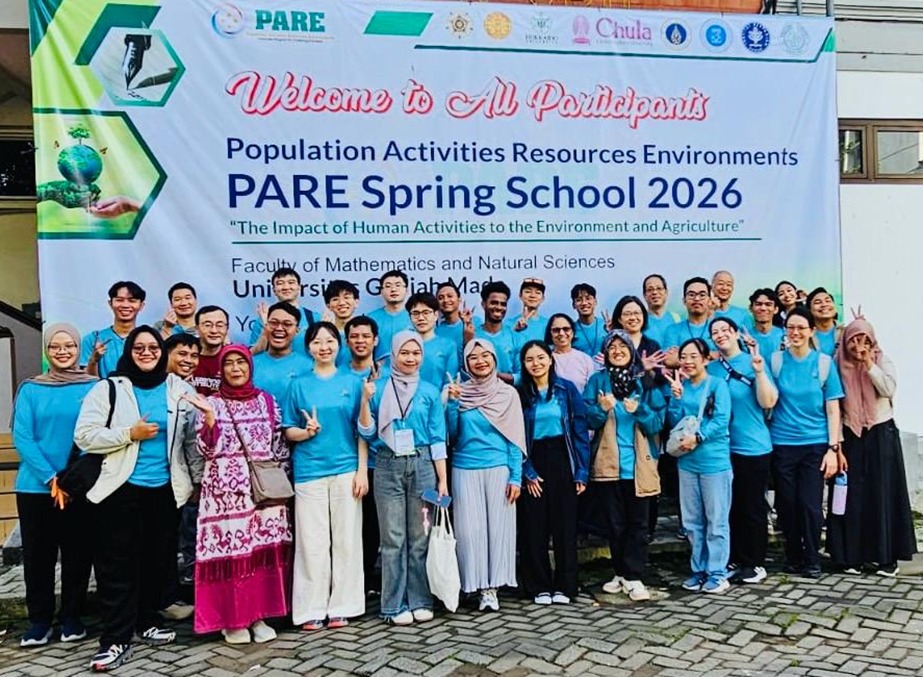
The Department of Chemistry, Faculty of Mathematics and Natural Sciences at Universitas Gadjah Mada (FMIPA UGM), hosted the Populations-Activities-Resources-Environments (PARE) Spring School 2026 from February 6–17. This year’s program addressed the issue of human activities and their impacts on the environment and agriculture. The program was initiated by eight universities from three countries: Japan (Hokkaido University), Thailand (Kasetsart University, Thammasat University, Mahidol University, and Chulalongkorn University), and Indonesia (Universitas Gadjah Mada, Institut Teknologi Bandung, and Institut Pertanian Bogor)
Chair of the PARE Spring School 2026 organizing committee, Professor Suherman, stated that the program was conducted in a hybrid format, with participants attending both online and onsite at the UGM campus.
“With the hybrid concept, the PARE program is expected to expand opportunities for participation from both domestic and international participants, which has been reflected in the total number of participants exceeding 100,” said Professor Suherman on Thursday (Feb. 19).
He noted that 20 participants attended in person, representing UGM, IPB, and ITB, as well as Hokkaido University (Japan), Kasetsart University, and Thammasat University (Thailand). Meanwhile, approximately 110 students joined online, including 40 international students from various countries and 70 Indonesian students from different universities, both in Indonesia and those currently studying abroad.
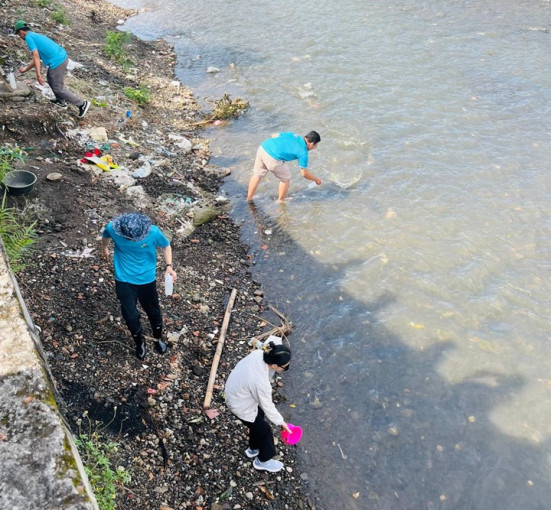
Over the two-week program, participants engaged in 13 lecture sessions delivered by 10 visiting professors from overseas and three Indonesian professors. The program also included field activities, such as water sampling at the Code River and a study visit to the Sewon Wastewater Treatment Plant (IPAL) in Bantul Regency. These activities were guided by expert lecturers and researchers from UGM and partner institutions abroad.
“Through the field visits, we want participants to understand and develop concern for current environmental challenges occurring in many countries, including Indonesia,” he explained.
Meanwhile, Professor Roto, representing the FMIPA Dean’s Office, expressed his hope that the two-week PARE Spring School would serve not only as an academic forum but also as a platform for communication and cultural exchange among participants from diverse international backgrounds.
“We want our students to broaden their perspectives while expanding their international networks,” he said.
Author: Jelita Agustine
Editor: Gusti Grehenson
Post-editor: Zabrina Kumara
Photo: FMIPA Public Relations