


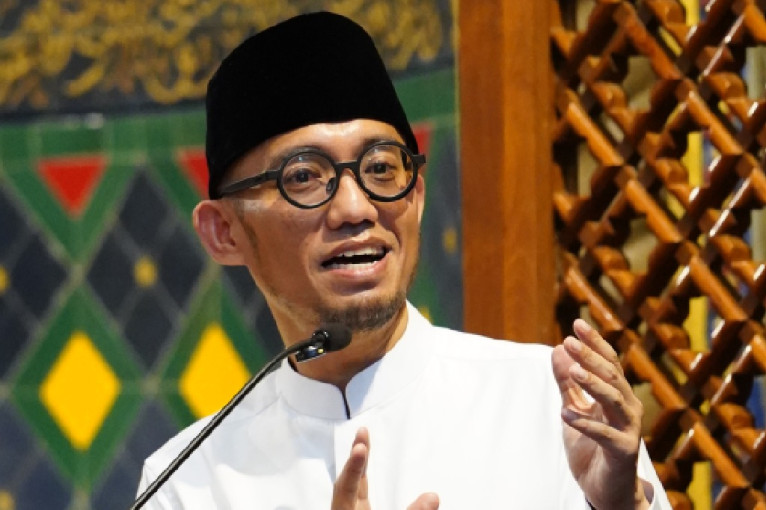
Vice Minister of Hajj and Umrah of the Republic of Indonesia, Dr. Dahnil Anzar Simanjuntak, stated that leaders are the reflection of their people, and vice versa. Therefore, reflection is needed to assess whether the processes of governance that have taken place so far have been carried out properly and correctly. He also emphasized that statecraft requires knowledge, particularly from those who are responsible for making decisions.
The Vice Minister delivered the remarks during the Ramadan Public Lecture held at the UGM Campus Mosque (Maskam UGM) on Sunday (Feb. 22). On this occasion, Dr. Simanjuntak presented a lecture titled “How Does the Qur’an Guide State Governance?”
In his sermon, Dr. Simanjuntak explained that a leader must possess the quality of amanah, or trustworthiness and responsibility. For that reason, society must be able to bring forward capable and trustworthy individuals to assume responsibility in leading the nation.
“In this democratic era, what we demand is the ability to present leaders who fully uphold their mandate, who can be trusted, and who possess integrity,” he said.
Dr. Simanjuntak also highlighted how truth and integrity are being tested in the current digital era, where what is right and what is wrong can be shaped by algorithms. He stressed the importance of literacy skills to filter the vast amount of information presented on social media before consuming it.
“Amid an extraordinary surplus of information, our ability to filter it is crucial,” he said.
He further noted that, according to the Qur’an, there are four essential principles in state governance: justice, deliberation, unity, and responsibility. Dr. Simanjuntak underscored that justice remains the most fundamental principle in public life, as it will always be needed.
“Justice is a discourse that is never finished, never fully resolved until the end of time,” he concluded.
Author: Leony
Editor: Gusti Grehenson
Photograph: RDK Committee
Post-editor: Zabrina Kumara