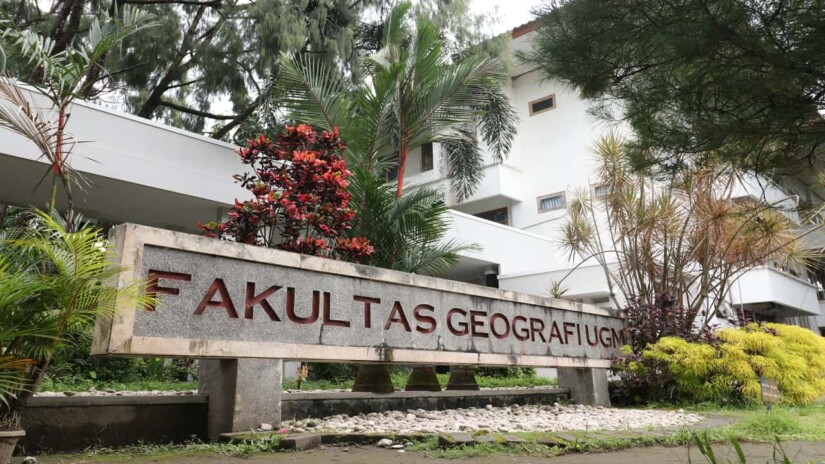
The Undergraduate Program in Environmental Geography at Universitas Gadjah Mada was established under Rector’s Decree No. 1718/UN1.P/SK/HUKOR/2017 and is currently accredited “Unggul” by BAN-PT and internationally accredited by ASIIN. The program focuses on environmental geography within the Earth Sciences consortium, with a Level 6 curriculum in the Indonesian National Qualifications Framework covering regional studies, socio-economic dynamics, resources, land use, and the environment. It integrates physical geography, human geography, and environmental science to understand and address issues related to space, resources, population, hydrology, climate, geomorphology, and disaster mitigation. The curriculum is outcome-based, strengthened through Project-Based Learning and Case-Based Learning, and connected to activities with government, industry, and research partners such as ATR/BPN, KLHK, BIG, Bappeda, DLH, and BKKBN.

Graduates are awarded the Sarjana Sains (S.Si.) degree for the regular program and the Bachelor of Science with Honors (B.Sc.) for the International Undergraduate Program. They develop analytical, spatial, and applied competencies for careers in regional planning, environmental management, disaster studies, population studies, research, and consultancy. The program’s main strength is supported by three academic laboratories: Environmental Hydrology and Climatology, Environmental Geomorphology and Disaster Mitigation, and Population and Economic Resources. Student learning is enriched through strong networks in education, research, community service, and internships. Over the last three years, the program’s academic ecosystem has been supported by numerous collaborations, hundreds of faculty publications, and active student involvement in research and community service. This enables students not only to master concepts, but also to engage directly in solving environmental and regional problems.

Key Strengths

  • National and International Recognition: The Undergraduate Program in Environmental Geography at Universitas Gadjah Mada has received recognition through national accreditation and ASIIN international certification. This ensures that students learn within an academic system aligned with global standards.
  • Field-Based Learning through Real, Current Cases and Projects: Learning is designed around Outcome-Based Education and supported by Project-Based Learning and Case-Based Learning approaches. Students are trained to analyze and solve environmental issues in an applied manner, not only by understanding theories in the classroom, but also through field practicums and fieldwork courses that address current issues such as climate change, land degradation, and natural disasters.
  • Strategic National Partner Network: Students gain learning opportunities through collaborations with government agencies, industry, and research institutions, including ATR/BPN, KLHK, BIG, Bappeda, DLH, and BKKBN. This network provides key access to the world of work, internships, field data, case studies, and professional connections. It also enables students to learn directly from real-world issues and stakeholders in the fields of environment, spatial planning, resources, and population studies.
  • International Mobility and Student Exchange: Student learning experiences are expanded through domestic and international collaboration networks, covering education, research, community service, MBKM, internships, training, and student exchange. These opportunities are supported by active international partners such as Chiba University, TH Köln, Germany; UB, Bangladesh; VAWR, Vietnam; the Department of Geography at NTNU, Norway; the Asian Institute of Technology (AIT); and other overseas institutions.
  • Fast Track Bachelor’s–Master’s Opportunity: The Faculty of Geography at Universitas Gadjah Mada offers a Fast Track Program that enables students to complete two academic degrees, a Bachelor’s degree or Sarjana Sains (S.Si.) and a Master’s degree or M.Sc., within five years. This program is open to all undergraduate programs in the Faculty of Geography and emphasizes continuity between undergraduate and master’s theses, as well as opportunities for international publication.

Career Prospects

Graduates of the Undergraduate Program in Environmental Geography at Universitas Gadjah Mada are prepared to become regional and environmental resource analysts, with competencies in surveying and analyzing regional resources, economic resources, and environmental conditions. The curriculum combines theory, laboratory and field practicums, and fieldwork courses, opening career opportunities in government institutions, consulting firms, research institutions, industry, and development organizations. Most graduates secure employment within less than six months of graduation, earn an initial salary above the local minimum wage, and receive excellent evaluations from employers for disciplinary competence, information technology skills, communication, ethics, and teamwork.

Relevant career pathways for graduates include:

  • Regional and Environmental Resource Analyst: Conducts surveys, mapping, regional potential assessments, and analyses of environmental carrying capacity and environmental support capacity.
  • Spatial and Regional Planner: Works in government agencies, planning consultancies, or development institutions to support spatial planning, land-use evaluation, and regional policy formulation.
  • Geospatial Analyst and GIS Specialist: Processes spatial data, remote sensing imagery, thematic maps, and geospatial databases for planning, environmental management, disaster risk reduction, and resource management. This career pathway is further strengthened by professional certification needs in the geospatial field as an added value for entering the labor market.
  • Environmental Planner / Environmental Analyst: Analyzes environmental impacts, land-use change, land degradation, environmental quality, and sustainable resource management strategies.
  • Disaster and Risk Mitigation Analyst: Works on geomorphological, hydrological, climatic, and regional vulnerability studies, as well as natural disaster mitigation, particularly in government agencies, consulting firms, research institutions, and humanitarian organizations.
  • Population and Economic Resources Analyst: Processes and interprets data on population, mobility, socio-economic dynamics, and resource distribution to support development planning and public policy.
  • Environmental and Regional Researcher / Research Assistant: Works at research centers, universities, research institutions, or collaborative projects related to hydrology, climatology, geomorphology, resources, population, and regional development.
  • Environmental, Spatial Planning, and Regional Development Consultant: Supports government, private-sector, and non-profit governmental projects in preparing environmental studies, field surveys, mapping, risk analysis, and policy recommendations.
  • Technical Officer in Government Agencies and Strategic Institutions: Graduates’ competencies are highly relevant to institutions such as the Ministry of Agrarian Affairs and Spatial Planning / National Land Agency (ATR/BPN), the Ministry of Environment and Forestry (KLHK), the Geospatial Information Agency (BIG), and the Regional Development Planning Agency (Bappeda), the Regional Environmental Agency (DLH), the National Population and Family Planning Board (BKKBN), and other organizations working in the environment, spatial planning, resources, geospatial affairs, and population studies.

Accreditation and Quality Recognition

The Undergraduate Program in Environmental Geography at Universitas Gadjah Mada has obtained the national “Unggul” accreditation from the Independent Accreditation Agency for Natural Sciences and Formal Sciences (LAMSAMA) through Decree No. 038/SK/LAMSAMA/Akred/S/V/2024, valid from 2024 to 2029. In addition, the program has received international recognition from ASIIN — Accreditation Agency for Degree Programs in Engineering, Informatics/Computer Science, the Natural Sciences, and Mathematics. The award of the subject-based ASIIN seal is valid from 1 October 2024 to 30 September 2031. The degree program is offered full-time and is aligned with Level 6 of the European Qualifications Framework for Lifelong Learning (EQF LLL).

Featured Courses

The Undergraduate Program in Environmental Geography at Universitas Gadjah Mada offers several featured course clusters, organized into the following themes:

  • Hydrology, Climatology, and Hydrometeorological Risk Course Cluster: This course cluster equips students with the knowledge to understand water dynamics, climate, extreme weather, floods, droughts, and climate change issues. This field is strengthened by the Environmental Hydrology and Climatology Laboratory, providing students with a strong foundation for analyzing water resource issues and hydrometeorological risks.
  • Environmental Geomorphology and Disaster Mitigation Course Cluster: This course cluster prepares students to understand landforms, geomorphological processes, land degradation, regional vulnerability, and disaster mitigation. This field is supported by the Environmental Geomorphology and Disaster Mitigation Laboratory, one of the program’s distinctive strengths in disaster studies and environmental management.
  • Population, Economic Resources, and Regional Development Course Cluster: This course cluster develops students’ ability to analyze population dynamics, mobility, socio-economic conditions, resource distribution, and regional development. This field is strengthened by the Population and Economic Resources Laboratory, enabling students to examine environmental issues not only from physical perspectives but also from social and economic dimensions.
  • Practicums and Fieldwork Courses: In addition to theoretical learning, the Undergraduate Program in Environmental Geography at Universitas Gadjah Mada provides practicums, field practicums, and Fieldwork Courses as compulsory components of the curriculum. Fieldwork is conducted once a year in semesters 2, 4, and 6, generally for about one week off campus, to train students in observation, surveying, data analysis, and direct problem-solving related to environmental issues in real study areas.
Crisis Center

Please contact us for any problem with SIMASTER

(Direktorat Teknologi Informasi Directorate of Information Technology )

*Hari Senin-Jumat, 07.00 – 16.00

Call this number for any emergencies

(Kantor Keamanan, Keselamatan Kerja, Kedaruratan, dan Lingkungan Office of Workplace and Environmental Security and Safety and Emergencies)

Skip to content