SDG 1: No Poverty
UGM fosters collaboration among inventors and partners as Indonesia ranks sixth globally in active startups, strengthening its digital innovation ecosystem.
UGM calls for transformation in forestry education to produce competent, adaptive professionals for Indonesia’s green and digital industry era.
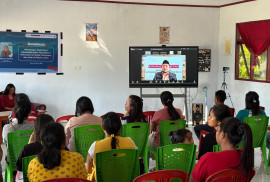
Pusekra UGM collaborates with Murung Raya Regency to develop a creative economy master plan supporting local innovation and tourism
UGM earns second place in the 2025 Mandaya Award for its innovative and sustainable community empowerment program in Gunungkidul.
UGM students study the agricultural economy of South Yogyakarta’s coastal areas, integrating local wisdom through the “Ngarit Jembar Nalar” philosophy.
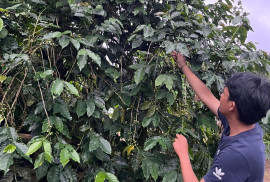
UGM Patriot Expedition Team identifies leading agricultural and plantation commodities in the Muting Transmigration Area, Merauke, South Papua.
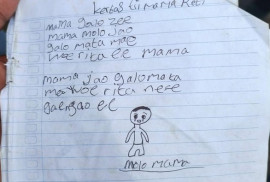
UGM psychologist Dr. Rahmat Hidayat highlights the effects of father absence on children’s emotional, social, and cognitive development.
UGM’s Center for Tourism Studies (Puspar UGM) recommends three strategies to boost sustainable tourism and diversify Berau’s economy beyond mining.
UGM expert emphasizes that social forestry permits should apply to degraded or unproductive forest areas to ensure sustainable management.
UGM research reveals the persistent poverty of Kapuas Hulu transmigrants and calls for improvements in infrastructure, education, and policy.
UGM’s Center for Tourism Studies (Puspar UGM) collaborates with Barito Timur cultural leaders to draft a key framework for regional cultural advancement.
UGM introduces Presokazi rice, a food security innovation derived from the Gamagora rice variety developed through sustainable research.
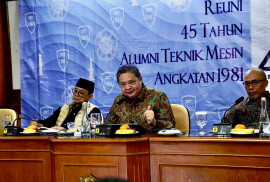
Coordinating Minister AHY highlights equitable regional development and sustainable infrastructure as keys to Indonesia’s resilience.
Animal Science UGM opens its 56th Anniversary series, highlighting functional animal-based foods to support Indonesia Emas 2045.
UGM Professor urges that Indonesia’s Free Nutritious Meal Program be managed through school canteens to ensure food safety and prevent rent-seeking.
UGM’s GO SOUTH 2025 urges stronger Global South cooperation amid geopolitical turbulence, reaffirming the enduring relevance of the Bandung Spirit.
Former President Megawati Soekarnoputri revisits Wanagama Forest and receives a Jatimega tree, 20 years after her first visit.
A UGM study reveals that 87.81% of Indonesian MSMEs have yet to adopt green business practices, primarily due to financing, infrastructure, and regulatory barriers.
KKN-PPM UGM restored the Uvenja Weir in Donggala after a 14-year hiatus, reviving irrigation for 28 hectares of farmland and enhancing local food security.
UGM anthropologist highlights porang’s potential as a healthy, affordable food source to support rural welfare and strengthen national food security.
UGM sociologist Dr. Fina Itriyati and Professor Vedi Hadiz warn that growing inequality is weakening Indonesia’s democracy, fueling an era of public discontent.
UGM economist Wisnu Nugroho says that IDR 200 trillion in fund placement in banks may ease liquidity, but it will not directly drive real sector growth.
UGM presented a book on sustainable partnerships at the KHDTK Blora-Ngawi event during the inauguration of the Watu Macan Reservoir, in collaboration with the Pertamina Foundation.
UGM and Pertamina inaugurated the Watu Macan Reservoir in Blora to support water conservation, community empowerment, and ecosystem sustainability.
UGM student team researches Javanese pranata mangsa knowledge among farmers and fishers in DIY as a strategy for climate change adaptation.
UGM PR Office promotes food research downstreaming through a talk show on sustainable food security, highlighting innovations like Gamagora 7 rice.
UGM held Inovokasia 2025, showcasing vocational innovation, industry collaboration, and sustainability through exhibitions, workshops, and public dialogue.
UGM economists outline seven urgent economic demands to address misallocated budgets, weak institutions, and inequality in Indonesia.
UGM’s Supriyanta dedicates his life to rice breeding, developing Gamagora 7 as an innovation to support farmers’ welfare and national food security.
UGM secures Semesta grant to advance “Strong Research for Food Security,” integrating science, policy, and community for food security.