


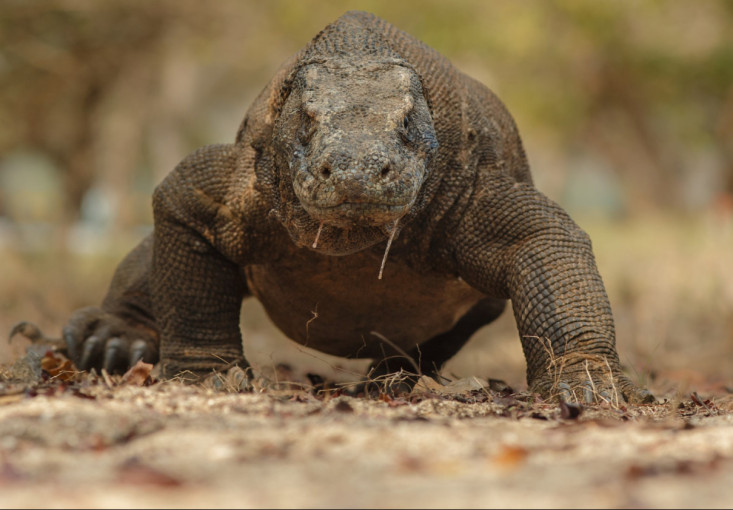
The Komodo dragon, the world’s largest lizard species with a limited (endemic) distribution in Indonesia and protected status, is facing increasing threats to its population. The current population is estimated at 3,319 individuals. This rare species is threatened not only by poaching and natural predators, but also by climate change and the gradual loss of its habitat. Around 58 percent of Komodo dragon habitat is located in Areas for Other Uses (APL), or outside designated forest areas. Expanding habitat protection for the Komodo dragon could also indirectly benefit other key species, including the yellow-crested cockatoo.
A Biology lecturer at Universitas Gadjah Mada and wildlife observer, Donan Satria Yudha, explained that establishing Komodo National Park is a solution to reduce pressure on Komodo dragons caused by habitat degradation. However, the challenge is that Komodo dragons are found not only on Komodo Island but also on Rinca Island and nearby small islands, as well as on the northern mainland of Flores.
“Pressure due to habitat degradation is particularly evident on the northern mainland of Flores,” he said on Tuesday (March 10) at the UGM campus.
According to him, poaching remains a significant threat to the Komodo dragon population. To reduce poaching, Donan suggested several solutions, including increasing the number of forest rangers from the Balai Konservasi Sumber Daya Alam (BKSDA), particularly on the northern mainland of Flores, to safeguard the Komodo population. He also emphasized the importance of strict law enforcement against not only hunters but also buyers of poached wildlife. In addition, a government breeding program, possibly through the Ministry of Forestry or BKSDA, could be implemented. The results of breeding programs could be officially and limitedly traded with certification in accordance with the mechanisms of the Convention on International Trade in Endangered Species of Wild Fauna and Flora (CITES).
“With this system, animal collectors would prefer the official route, because a legitimate channel would be available,” he said.
Another challenge in maintaining the habitat, he added, is the limited number of personnel and insufficient funding to safeguard conservation areas and support conservation activities. In addition, the generally low level of welfare among residents of Rinca Island and Komodo Island contributes to the persistence of poaching.
“If residents of Rinca Island and Komodo Island were more prosperous, they would gladly help the government preserve Komodo dragons,” he added.
He further noted that if the number of conservation personnel matched the size of the protected areas, government conservation funding was available, and local communities were more prosperous, Komodo dragon conservation efforts would be more effective. Local residents would be able to identify outsiders attempting to capture Komodo dragons because they live in the conservation areas year-round. They could also promptly report suspicious activities to authorities.
Regarding the presence of APL within Komodo habitats, Donan explained that the issue is complex because it is closely tied to human welfare and government development commitments. Therefore, he suggested expanding the core zones of conservation areas and increasing the overall extent of conservation regions. In addition, the government and relevant stakeholders must work in synergy to safeguard and preserve the Komodo dragon population. According to him, the government can contribute by issuing new regulations or policies to protect Komodo habitats, especially on the mainland of Flores, by providing cooperation schemes and funding for conservation activities and new protected areas, and by encouraging contributions from related stakeholders and local communities, who are on the front lines of protecting these habitats.
Donan assessed that the government’s role in managing national parks in conservation areas has been very effective in preserving Komodo dragons and maintaining their population. However, he stressed that further involvement from local governments on the mainland of Flores is necessary to protect Komodo habitats.
“The extent of new Komodo habitats on the mainland of Flores, especially on the northern side, needs to be determined so that genetic differences between mainland and island Komodo populations remain preserved,” he said.
Author: Leony
Editor: Gusti Grehenson
Post-editor: Zabrina Kumara
Photo: Freepik