


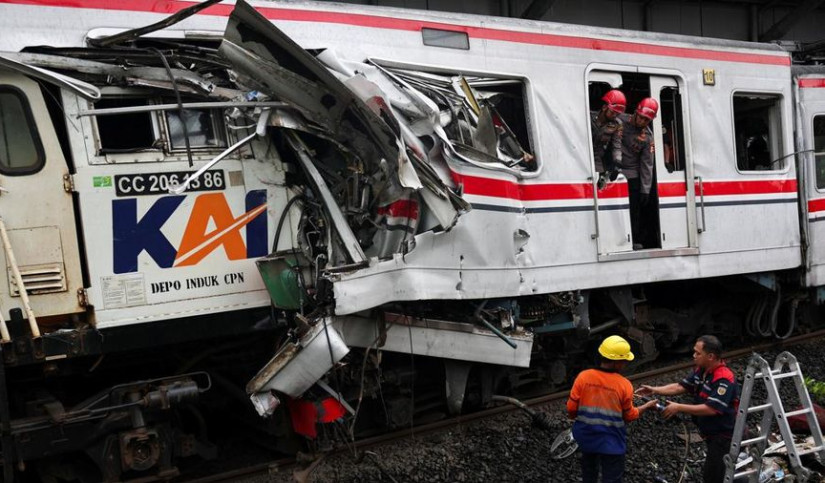
A train accident involving the Argo Bromo Anggrek and a KRL Commuter Line occurred at Bekasi Timur Station, Bekasi, West Java, on Monday (April 27) evening. The incident involved an electric commuter train colliding with an online taxi and the Argo Bromo Anggrek train. The collision resulted in 106 casualties, with 90 people injured and 16 fatalities.
Iwan Puja Riyadi, a researcher and expert staff member at the Center for Transportation and Logistics Studies (PUSTRAL) at Universitas Gadjah Mada (UGM), stated that the train accident was not caused by a single factor but rather by a chain of events that led to the tragedy. The accident, he explained, was the result of a domino effect, with the root of the problem originating at a level crossing.
“There may have been several contributing factors, triggered by a primary cause, possibly a taxi that stalled or stopped at the crossing,” Iwan explained on Thursday (April 30).
Despite the use of modern systems (block systems), the risk of accidents remains. Trains cannot come to an abrupt stop. Iwan noted that there may have been a delay in information received by the Argo Bromo Anggrek train, making it difficult to stop instantly, even though braking had been applied.
“It is possible that due to the incident, the train behind received the information only when it was already close to the location,” he said.
In addition, congestion in rail traffic at the station further contributed to the chain of events. Beyond technical issues, Iwan emphasized that the main cause of the accident lies in public behavior that has not kept pace with technological systems.
“Public awareness remains low, as reflected in the behavior of forcing through crossing gates,” he explained.
According to him, public behavior in Indonesia has not fully adapted to modern technological advancements. Although technological systems have been implemented through railway crossing gates, accidents will continue to occur if people fail to comply with them.
“Our behavior toward modern systems must also change,” he said.
Iwan urged road users to obey traffic signs rather than expecting systems to accommodate non-compliance.
As a preventive measure to avoid similar accidents in the future, Iwan proposed eliminating level crossings. He explained that, from a regulatory standpoint, level crossings between roads and railway lines are generally not permitted, except under certain conditions, such as low traffic volume or challenging topography. Therefore, improvements should be made by constructing flyovers or underpasses to eliminate intersections between road vehicles and trains.
“Conceptually, level crossings should not exist, except under specific conditions,” he concluded.
Author: Fatihah Salwa Rasyid
Editor: Gusti Grehenson
Post-editor: Zabrina Kumara
Photo: Reuters