


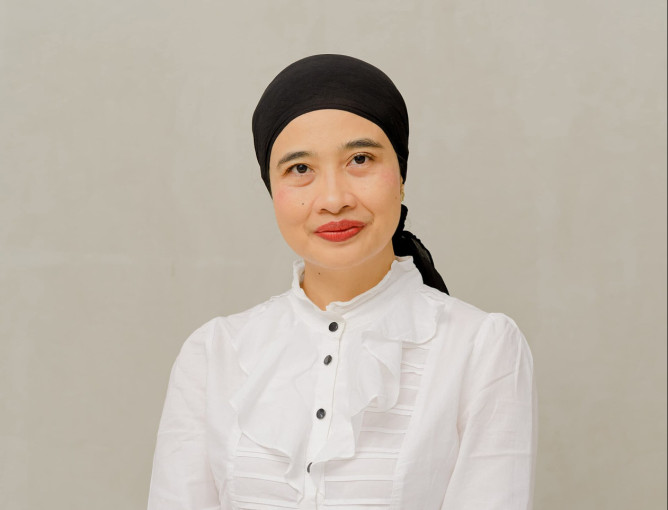
The discourse surrounding the closure of study programs deemed irrelevant to industry has also drawn the attention of novelist and sociologist Okky Madasari. The language and literature expert believes that this discourse has the potential to undermine critical thinking skills and the socio-cultural foundations of future generations. On the contrary, culture, language, and literature should be given greater space for expression so that every social change can be properly documented as part of the dynamics that support the supremacy of Indonesian culture. This was conveyed by Okky during the Cultural Talk at Cultural Festival 15, organized by UGM Residence at Grha Sabha Pramana, coinciding with Labor Day on Friday (May. 1).
The discussion, titled “Bahasa dan Sastra Sebagai Diplomasi Bangsa” (Language and Literature as Cultural Diplomacy), opened with Okky’s views on the news regarding the closure of study programs such as Literature, History, and Anthropology. The International Relations undergraduate alumna of UGM argued that these programs are, in fact, highly relevant to industry needs.
According to her, language and culture have great potential to drive the national economy. She cited concrete examples such as K-pop culture, the popularity of Javanese songs, and Eastern Indonesian songs that are currently on the rise.
“Korea has a strong bargaining position, which is why many studies and academic programs focus on it, including at UGM. K-pop is one example of how cultural distribution and promotion have successfully become a key pillar of a country’s economy,” she added.
From this perspective, literature and language play an important role in diplomacy, shaping Indonesia’s position in the global arena. Indonesian cultural products should have significant potential, considering the country’s strategic position along global trade routes. As the largest country in Southeast Asia, Indonesia could contribute substantially to the national economy through its cultural products, Okky emphasized. However, the question remains: how can these cultural products be introduced more widely?
During the question-and-answer session, students from diverse backgrounds asked a range of questions. One of the prominent concerns was the decline in the use of standard language on social media. Okky believes that language should not be rigidly standardized, as different forms of language use can reflect social dynamics. In her view, language should not be controlled; rather, its users naturally follow trends shaped by technological developments.
“Language on social media reflects how today’s generation communicates. KBBI must continue to document new vocabulary and expand its coverage, including terms emerging from social media. This ongoing renewal reflects the richness of language,” she said.
Furthermore, Okky emphasized that language should be dynamic and used according to context. Formal Indonesian may seem out of place if used in inappropriate contexts. The presence of so-called “language policing” would distance information from reality. Instead, users should adapt, choosing appropriate language for writing essays, short stories, and poetry, or for using regional languages in daily conversations.
“On social media, language does not have to be strictly correct. Any form of language can be used in different situations and conditions, depending on the context,” Okky concluded.
Author: Ika Agustine
Editor: Gusti Grehenson
Post-editor: Jasmine Ferdian
Photo: Wikipedia and UGM Residence Documentation