


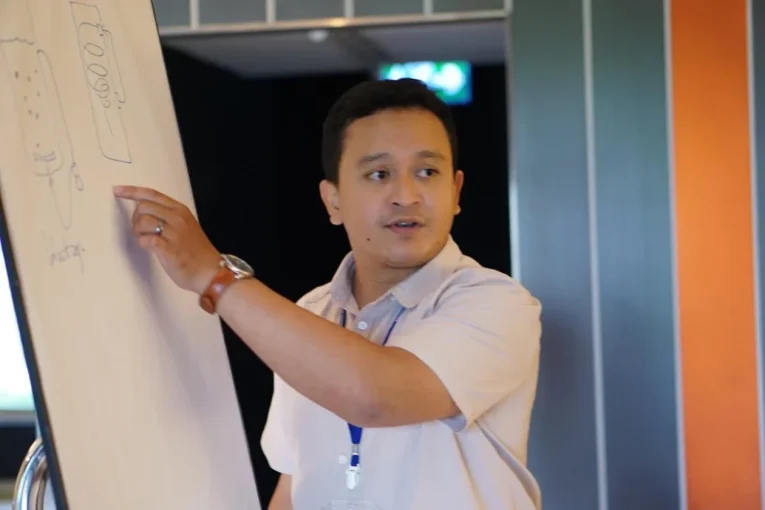
Dr. Hanifrahmawan Sudibyo, a lecturer in the Department of Chemical Engineering, Faculty of Engineering, Universitas Gadjah Mada (FT UGM), has once again been entrusted to represent Indonesia as a Lead Author in the preparation of an international report on guidelines for the use of carbon dioxide removal technologies, carbon capture, utilization, and storage for greenhouse gas inventories. This involvement is part of a global effort coordinated by the Intergovernmental Panel on Climate Change (IPCC) to update national greenhouse gas inventory guidelines.
The initial phase of the report preparation began with the first Lead Author Meeting 1 (LAM1), held on April 14-16, 2026, at the Food and Agriculture Organization (FAO) Headquarters in Rome, Italy.
“This meeting served as an important forum to agree on the methodological framework, task distribution, and the direction of scientific development that will be used in the report,” said Dr. Hanif on Tuesday (5/5).
Hanifrahmawan’s participation in preparing this report reflects Indonesia’s active contribution to the development of global methodologies for climate change mitigation, particularly for biochar-based carbon dioxide removal technologies relevant to tropical conditions and land systems in Southeast Asia.

For Hanif, his involvement in this international report can help advocate for the utilization of Indonesia’s natural resources, both domestically and internationally. He also hopes that more delegates or representatives from Indonesia will be involved in preparing the IPCC methodology report.
“We hope to provide broader perspectives, especially considering that developing countries like Indonesia have a strong and well-established agricultural background,” he said.
At this early stage, Hanif explained, the team is focusing on updating methodologies for estimating biochar carbon stocks and dynamics based on the 2019 Refinement framework. The 2019 Refinement has not explicitly determined whether applying biochar to organic soils leads to positive priming, which accelerates soil organic matter decomposition, or negative priming, which slows it.
The approach being developed uses pyrolysis temperature and the H/Corg ratio as key indicators to determine the persistent carbon fraction (Fperm) and to evaluate non-persistent carbon fractions in the carbon balance. In addition, the team is developing quantitative approaches to estimate biochar carbon stocks over timeframes ranging from 1 to 100 years, while accounting for environmental factors such as soil temperature and the vertical distribution of biochar within the soil profile.

Beyond that, the study evaluates the impact of biochar on non-CO₂ emissions, particularly N₂O and CH₄, in agricultural systems such as rice paddies, and analyzes priming effects on soil carbon dynamics.
“For organic soils and peatlands, including restoration and rewetting ecosystems, an in-depth literature review is conducted to ensure sufficient scientific evidence supports the development of the methodology,” he explained.
Looking ahead, Hanif stated that the report preparation process will continue through several key stages, including Lead Author Meeting 2 (LAM2) in Mexico on August 11-14, 2026, for the First-Order Draft, followed by LAM3 in Nepal on January 19-22, 2027, for the Second-Order Draft, and LAM4 for finalizing the report scheduled in 2027.
“In the 2027 Methodology Report, content related to the application of biochar to organic soils will be updated in line with recent research over the past five years, which shows that negative priming is more dominant,” he explained.
Hanif added that the primary focus of his and the team’s contribution to this report is the development of methodologies for applying biochar in mineral and organic soils, including peatlands.
“My participation specifically focuses on the methodology report within the agriculture, forestry, and other land use sector,” he concluded.
Author: Salwa
Editor: Gusti Grehenson
Post-editor: Zabrina Kumara
Photo: Courtesy of Hanif