


Universitas Gadjah Mada (UGM) and the Papua Provincial Government have agreed to establish cooperation through a Memorandum of Understanding (MoU), focusing primarily on human resource development, improving healthcare quality, regional development through collaboration, and community service through the implementation of the Three Pillars of Higher Education.
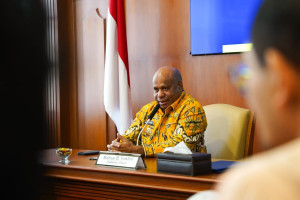
Papua Governor Mathius Derek Fakhiri stated that the Papua Provincial Government is currently working to improve the quality of healthcare services, which is a fundamental basis for developing human resources. He expressed hope that this collaboration would support improvements in healthcare services across the six provinces in Papua through the establishment of a Hospital-Based University dedicated to producing specialist doctors from Indigenous Papuan communities.
“We certainly hope that in the future our children will be able to study at UGM so they can return with valuable knowledge and devote themselves to serving the land of Papua,” he said on Friday (May 8) at the UGM Central Office Building.
In addition to the healthcare sector, Governor Fakhiri expressed the Papua Government’s hope to collaborate in supporting the Papua Cerah vision (Smart, Prosperous, and Harmonious Papua) together with UGM experts in agriculture, including rice field development programs, healthcare, and the mining sector, to improve the welfare of Papuan communities.
He also expects UGM to contribute as a leading institution in addressing independence-related issues in the Pacific region, one of which could be realized by opening language classes for residents from Pacific countries so they can study in Papua and directly witness Papua’s development.
“We hope this collaboration can help us establish language classes so our brothers and sisters from the Pacific can study in Papua. This is expected to position Papua as the nation’s frontline,” he explained.
UGM Vice Rector for Student Affairs, Community Service, and Alumni, Dr. Arie Sujito, welcomed the cooperation plan in the healthcare sector, which has become the primary priority. According to Dr. Sujito, the Faculty of Medicine, Public Health, and Nursing UGM will serve as the main driving force in the collaboration, particularly in Papua’s healthcare sector, by involving higher education institutions in Papua.
“And of course, this cooperation will also be followed by practical collaborations that can support the successful implementation of healthcare quality improvement programs,” he said.
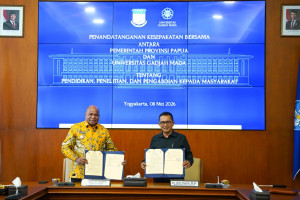
Furthermore, Dr. Sujito explained that UGM remains committed to providing the ADik scholarship program for Papuan youth. UGM also continues to organize the Community Service Program (KKN) in various regions across Indonesia, particularly in Papua. The program is expected to enable students to directly adapt to Papuan communities and understand the realities of Papua firsthand.
“Therefore, we are very grateful to Papua for continuously welcoming our presence through various community service and cooperation programs. We have gained many valuable experiences through interacting and adapting with friends in Papua. This serves as the foundation for ensuring that this cooperation continues and grows stronger in the future,” he explained.
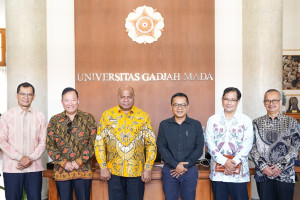
He emphasized the importance of collaboration involving various parties, particularly universities in Papua, to create meaningful change and comprehensively address issues such as welfare, social inequality, and poverty.
“The most important strength is collaboration rather than competition. Hopefully, this will strengthen the relationship between UGM and Papua,” Dr. Sujito concluded.
Author: Cyntia Noviana
Editor: Gusti Grehenson
Post-editor: Zabrina Kumara
Photo: Aldi Firmansyah