


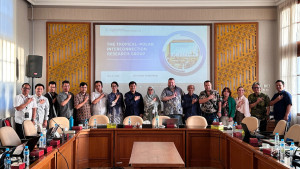
In response to climate anomalies and the increasing frequency of disasters, a team of researchers from Universitas Gadjah Mada (UGM) has established a polar-region research group to address the impacts of climate change in Southeast Asia. Through the Tropical-Polar Interconnection Research Group, the team is collaborating with the National Research and Innovation Agency (BRIN) and researchers from Denmark, Norway, and Argentina to study the relationship between changes in polar regions and their impacts on tropical regions.
A lecturer in Geological Engineering at Universitas Gadjah Mada and one of the initiators of the research group, Nugroho Imam Setiawan, fondly known as Imam, emphasized the urgency of Indonesia’s role as one of the largest tropical regions in Southeast Asia. Indonesia’s geographical position directly on the equator, combined with its status as an archipelagic country, makes it highly vulnerable to climate change.
“Several hydrometeorological disasters currently being experienced are closely linked, both directly and indirectly, to changes occurring in polar regions,” he said on Wednesday (May 13).
Imam explained that BRIN had agreed to directly involve UGM researchers in collaborations with scientists from Ukraine, Denmark, Norway, Argentina, and organizations focusing on Antarctic research.
“UGM has several researchers with experience in polar studies, which is still very rare. As a tropical country, we need a platform or consortium that focuses on the relationship between tropical and polar regions,” he said.
Imam stated that the National Antarctic Scientific Center (NASC) of Ukraine has officially joined the research group. The institution has even offered support for researcher participation and operational assistance for research expeditions and voyages to Chile, which are scheduled to begin in December 2026.
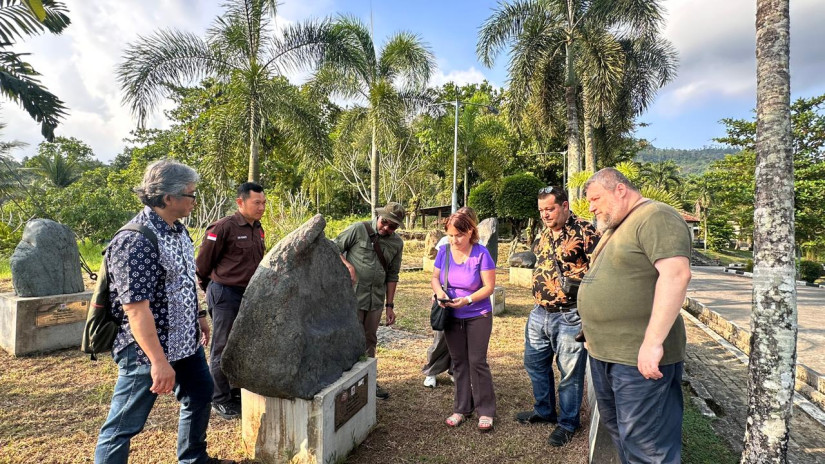
Recently, delegations from UGM, BRIN, and the National Antarctic Scientific Center also visited the Karangsambung Geodiversity Scientific Conservation Area, which BRIN manages. The visit aimed to observe the facility’s rock-sample storage, sediment-storage units, laboratory equipment, and the Watu Kelir Geosite.
“This visit became a momentum for knowledge transfer, introducing the characteristics of Indonesian regions, while also opening opportunities for further research collaboration among institutions,” he said.
For Imam, the establishment of this research group is expected to serve as a dedicated body for Indonesia to study Antarctic dynamics through collaborative research grants, shared laboratory facilities, and complementary collaborations among researchers.
“Under current conditions, strengthening collaboration is extremely important. Without collaboration, activities in distant and less familiar regions would be difficult to pursue,” said the Head of UGM’s Geological Engineering Study Program.
According to Imam, the impacts of the climate crisis have affected nearly every aspect of life, requiring extensive collaborative research across agriculture, fisheries, geography, biology, and the social sciences and humanities.
“UGM is expected to become a hub for tropical and polar research in Southeast Asia. Moreover, Indonesia holds an interesting and important position for international scientists, one that has long been highly prominent,” he concluded.
Author: Ika Agustine
Editor: Gusti Grehenson
Post-editor: Zabrina Kumara
Photo: Strategic Management Bureau of Universitas Gadjah Mada