


Universitas Gadjah Mada (UGM) continues to strengthen its commitment to downstreaming research through community empowerment by implementing hybrid agrivoltaic technology to support the realization of a green, self-sufficient village in Pandowoharjo Village, Special Region of Yogyakarta. In collaboration with the Solar Research Institute (SRI) at Universiti Teknologi MARA (UiTM), the partnership focuses on developing community empowerment-based technology supported by sustainable energy.
The program also promotes gender equality through the active involvement of the Women Farmers Group (KWT), the village administration, BUMKal Amarta, the Indonesian National Armed Forces Village Supervisory Non-Commissioned Officer (Babinsa), the Community Police Officer (Babinkamtibmas), and the Kalurahan Consultative Body. The village administration has even expressed its commitment by providing personnel for the assembly, operation, and post-installation maintenance of the equipment.
In its implementation, the installed hybrid solar power plant (PLTS Hybrid) will have a capacity of 2.6 kWp to meet the needs of smart irrigation systems and village downstream-processing machinery. The prototype assembly process is being carried out at the Renewable Energy Laboratory of UGM’s Department of Nuclear Engineering and Engineering Physics, involving village representatives to ensure knowledge transfer.
“To ensure sustainability, the system is planned to be equipped with internet-based surveillance cameras installed by the Kalurahan administration, integration of RiTx sensors for real-time soil and weather monitoring, and artificial intelligence (AI)-based anomaly detection training to minimize maintenance costs,” said team leader Ahmad Agus Setiawan, Ph.D., on Tuesday (May. 12).
In addition to Agus, the team includes Professor Bayu Dwi Apri Nugroho, from UGM’s Faculty of Agricultural Technology (FTP UGM), as well as international collaborator Professor Nofri Yenita Dahlan, Director of the Solar Research Institute (SRI) UiTM. On the same occasion, Professor Nugroho, a member of the team, an agricultural technology expert from FTP UGM, and an expert staff member at the National Development Planning Agency (BAPPENAS), emphasized the importance of integrating climate data into the development of agrivoltaic systems in the project.
“Microclimate optimization is key so that solar panels not only generate electricity but also create an ecosystem that supports the growth of horticultural crops beneath them,” he explained.
Agus said the team had recently completed a series of strategic visits to Malaysia from May 5 to 9 to strengthen international collaboration in developing agrivoltaic technology in Pandowoharjo. The visits aimed to facilitate knowledge transfer regarding solar energy management at various scales and its applications in the agricultural sector.
“We want to ensure that the system we are building in Pandowoharjo meets global standards,” said Agus.
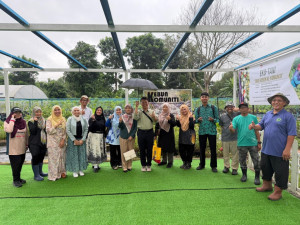
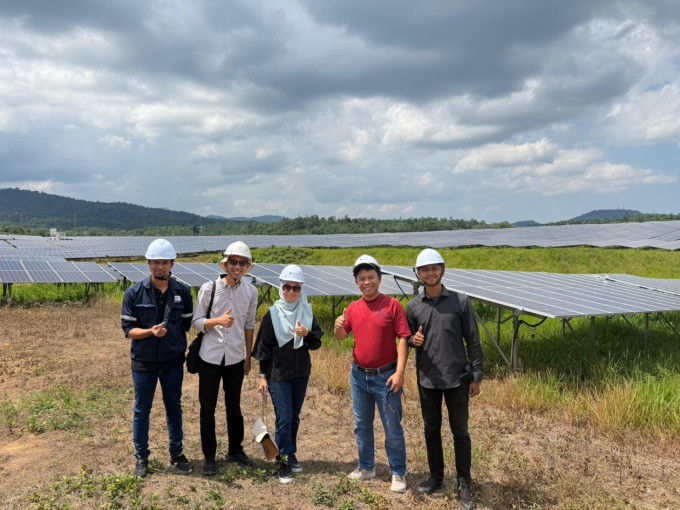
While in Malaysia, the team visited the UiTM Large-Scale Solar (LSS) Park 2 in Gambang, Pahang, to study the management of large-capacity solar systems. Accompanied by SRI UiTM, the UGM team also visited Universiti Putra Malaysia (UPM). The visit provided new insights into the potential integration of solar panels with livestock farming and food crops.
During a meeting with the UGM team, Professor Mohammad Effendy bin Yaacob, an academic from UPM, emphasized that the technology should directly benefit farmers’ welfare. Meanwhile, Professor Dahlan, Director of SRI UiTM, stressed the importance of thorough agrivoltaic planning.
“Agrivoltaic planning must be carefully conducted through energy yield simulations and shading analysis to ensure crop productivity is maintained,” she explained.
Author: Diyana Khoirunnisa
Editor: Gusti Grehenson
Post-editor: Jasmine Ferdian
Photo: Courtesy of Ahmad Agus Setiawan