


For many farmers, weeds or unwanted plants that grow among cultivated crops are often seen as a major problem in agriculture and plantations. Weed infestations can reduce crop yields by competing for nutrients and limiting plant growth. One pest that commonly attacks vegetable crops such as chili peppers, tomatoes, and celery, as well as food crops like potatoes, is the root-knot nematode (Meloidogyne incognita).
This parasitic organism poses a serious threat to plants, as it can attack multiple host species and inhibit growth by forming root galls. Interestingly, several weeds, particularly invasive plants, contain secondary metabolites that can disrupt pest activity by acting as feeding deterrents, growth inhibitors, reproductive disruptors, or toxic compounds.
Mukhlis Ibrahim, a doctoral student in Agricultural Science specializing in Plant Pests at the Faculty of Agriculture Universitas Gadjah Mada, is exploring the potential of invasive weeds as alternative materials for plant pest control.
“These weeds can serve as sources of natural active compounds for controlling plant pests,” said Ibrahim on Thursday (May 7). “Previous studies have shown that several invasive plants contain secondary metabolites capable of disrupting pest activity.”
In his preliminary research, Ibrahim examined compounds found in weeds that could be developed into biopesticides.
“Depending on the formulation process, the final product can take liquid form for spray applications or powder form,” he explained.
The current research focuses on the root-knot nematode (Meloidogyne incognita). Ibrahim stated that several candidate compounds tested in the study were identified as bioactive against the pest, including alkaloids, flavonoids, phenolics, tannins, saponins, and dilapiol.
These compounds are then processed into liquid biopesticides for spray applications or powdered formulations to control pest infestations.
“Overall, this research highlights the untapped potential of invasive plants that have long been underestimated,” he said.
However, the research process did not always run smoothly. For approximately three months, Ibrahim spent long hours in the laboratory designing experiments, repeating tests, and evaluating results that often fell short of expectations.
“There were times when I came home late at night feeling exhausted and discouraged,” he recalled. “At one point, the exhaustion made me want to give up. But whenever those doubts appeared, I remembered my parents and realized that this struggle was not only for myself.”

Amid the lengthy research process, Ibrahim had the opportunity to present his screening research at the 3rd International Conference on Sustainable Industrial Agriculture (IC-SIA), organized by Universitas Jember in July 2025.
His presentation earned him the Best Presenter Award at the conference, second place in the National Young Researcher Award organized by the Indonesian Phytopathological Society, and the Young Researcher Appreciation Award in the Under 30 category.
The experience became an important stepping stone in bringing his research to broader scientific forums. With nearly one month of preparation, Ibrahim refined his data, improved presentation visuals, and practiced extensively to ensure the material could be understood by audiences from various backgrounds.
“Every practice session is an investment,” he said. “I believe sincere effort is never wasted.”
His participation in IC-SIA later opened opportunities to present his research internationally. In April 2026, Ibrahim presented his findings at the 13th International Conference on Chemical and Biological Sciences (ICCBS 2026) in Osaka. The conference also earned him international recognition for his contribution and active participation in the global scientific forum.
At the conference, he not only presented his findings but also took part in panel discussions, academic networking sessions, and exchanges of ideas with researchers from different countries.
“If I once doubted the value of my research, now I carry those findings with confidence as part of a scientific contribution at the global level,” he remarked.
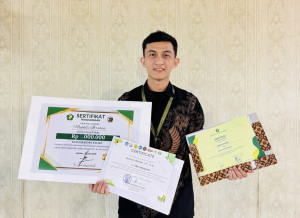
According to Ibrahim, the experience proves that a long process, beginning with small steps, can eventually open up greater opportunities. He believes Indonesian youth have enormous potential to compete and contribute in global academic forums.
Nevertheless, Ibrahim admitted that his greatest happiness did not come from the awards or certificates he received, but from sharing those achievements with the people closest to him.
“That happiness came when I called my parents and heard their voices trembling with emotion,” he said.
He also expressed appreciation for the support of fellow students who became companions in sharing stories, laughter, and experiences throughout his doctoral journey. In addition, he conveyed gratitude to his supervisory team for guiding him throughout the research process.
“I am grateful to my doctoral supervisory team for their patience and guidance throughout this journey, namely Professor Siwi Indarti, Dr. Nugroho Susetya Putra, and Valentina Dwi Suci Handayani,” he said.
Through this journey, Ibrahim learned that something often considered small can create a significant impact when pursued wholeheartedly. A simple screening study opened the way to international scientific forums, while plants long regarded merely as weeds may hold valuable potential for scientific innovation.
“No small step is ever wasted when done wholeheartedly,” he concluded.
Author: Hanifah
Editor: Gusti Grehenson
Post-editor: Jasmine Ferdian
Photo: Courtesy of Mukhlis Ibrahim