


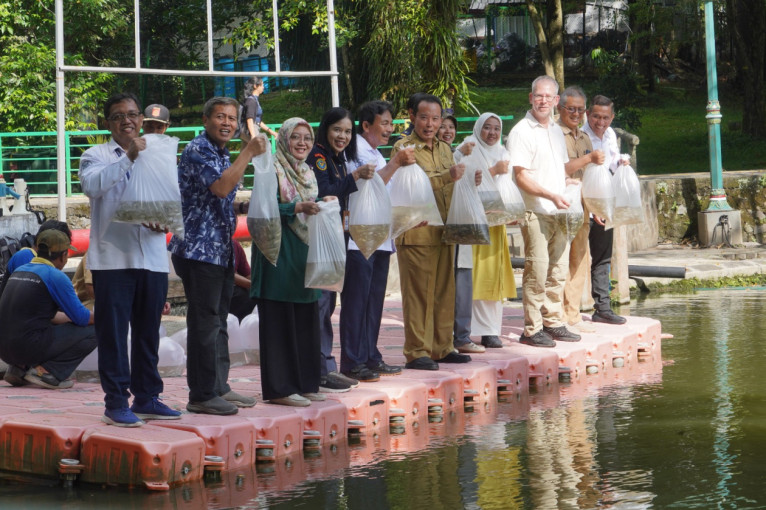
To support the conservation of inland public fishery resources, the Department of Fisheries, Faculty of Agriculture, Universitas Gadjah Mada (Agriculture UGM), in collaboration with the Yogyakarta Special Region Marine and Fisheries Agency (DKP DIY), carried out the release of native fish fry into the Wisdom Park Lake at UGM on Monday (May. 18).
The fish stocking used native species considered adaptive to natural habitats and safe for maintaining aquatic ecosystem balance. The native fish fry released consisted of 2,200 Wader fish, 1,500 Nilem fish, and 3,750 Tawes fish. The program also represented multi-stakeholder collaboration in safeguarding the sustainability of aquatic ecosystems in the Yogyakarta Special Region. In addition to the fish release, the activity included a river clean-up action in the Wisdom Park area.
In addition to participants from both institutions, the activity was also attended by academics from the University of Tasmania, Professor Caleb Gardner. The presence of various parties demonstrated the importance of cross-sector synergy in supporting water resource conservation.
Collaboration between local government and higher education institutions is considered a strategic step toward strengthening science-based, conservation-oriented environmental management. Through this activity, UGM also supports efforts to preserve native fish and sustain public aquatic ecosystems.
Director of Human Resources and Professor of the Department of Fisheries, Agriculture UGM, Professor Suadi, expressed appreciation for the collaboration established between the university and the local government. He hopes the released fish fry will grow and reproduce well, providing ecological and educational benefits for both the community and the campus environment.
According to Professor Suadi, the success of aquatic resource conservation requires sustained involvement from various stakeholders. Professor Suadi added that activities like this also serve as direct learning opportunities for students to understand aquatic ecosystem management.
“We hope the fish released can grow well and benefit both the environment and the community,” he said.
Representing the UGM Department of Fisheries, Professor Djumanto emphasized that using native species is an important step to ensure that restocking activities do not disrupt the balance of aquatic ecosystems. He explained that native fish species have a greater adaptive capacity to local water-habitat conditions than introduced species.
According to Professor Djumanto, this approach is essential for maintaining the sustainability of fish populations while preserving the ecological functions of public waters in the Yogyakarta Special Region.
Meanwhile, Head of DKP DIY, R. Hery Sulistio Hermawan, explained that the fish stocking activity is a follow-up to the cooperation between UGM and DKP DIY in supporting native fish conservation. According to him, the program aims not only to increase fish populations in their natural habitats but also to maintain the sustainability of public aquatic ecosystems in the region.
He revealed that similar native fish stocking programs had previously been implemented at 13 public water bodies across the Yogyakarta Special Region as part of an ecosystem-based fisheries conservation and rehabilitation strategy.
“This activity is part of our joint effort to sustainably preserve native fish resources and public aquatic ecosystems,” said Hery.
The fish fry release was conducted to strengthen native fish populations in public waters while maintaining ecosystem balance. The use of native species is considered more adaptive to habitat conditions, thereby minimizing the risk of ecological disturbance. Through this activity, the UGM Department of Fisheries and DKP DIY hope to raise public awareness of the importance of preserving native fish and managing public aquatic resources.
Collaboration between the government, academics, and the community is expected to further strengthen sustainable fisheries conservation efforts in the Yogyakarta Special Region.
Author: Triya Andriyani
Post-editor: Rajendra Arya
Photo: UGM Department of Fisheries